Did you know the rate of back surgery in the United States is now at least 40 percent higher than in any other country? This statistic can feel overwhelming when you’re already dealing with chronic pain and the fear of failed back surgery syndrome. It’s completely natural to feel anxious about long recovery times or confused by the technical differences between traditional open procedures and modern, minimally invasive neurosurgery. Knowing the right questions to ask a spine surgeon before surgery is the most effective way to transform that uncertainty into clinical confidence.
We understand that your goal isn’t just a successful procedure; it’s a return to your normal daily activities. This comprehensive, expert-vetted checklist provides the exact tools you need to audit a surgeon’s technology and philosophy. You will gain a clear understanding of the latest 2026 advancements, including AI-powered robotics and continuously navigated endoscopic TLIF. We’ll preview everything from specific surgical methodologies to realistic timelines for returning to work and family life, ensuring you feel empowered to take the next step toward lasting relief and progress.
Key Takeaways
- Learn how to distinguish incidental MRI findings from the true source of your pain to ensure your surgical goals align with clinical reality.
- Discover how to audit a surgeon’s proficiency with advanced technologies like robotic-assisted navigation and Artificial Disc Replacement.
- Master the specific questions to ask a spine surgeon before surgery to determine if you are a candidate for ultra-precise Endoscopic Spine Surgery rather than traditional open methods.
- Establish a realistic, week-by-week recovery timeline that prioritizes a safe and efficient return to your normal daily activities.
- Gain the professional clarity needed to finalize your decision, including how to discuss second opinions and coordinate care at specialized centers in Plano or Lewisville.
Understanding the Necessity and Goals of Your Spine Surgery
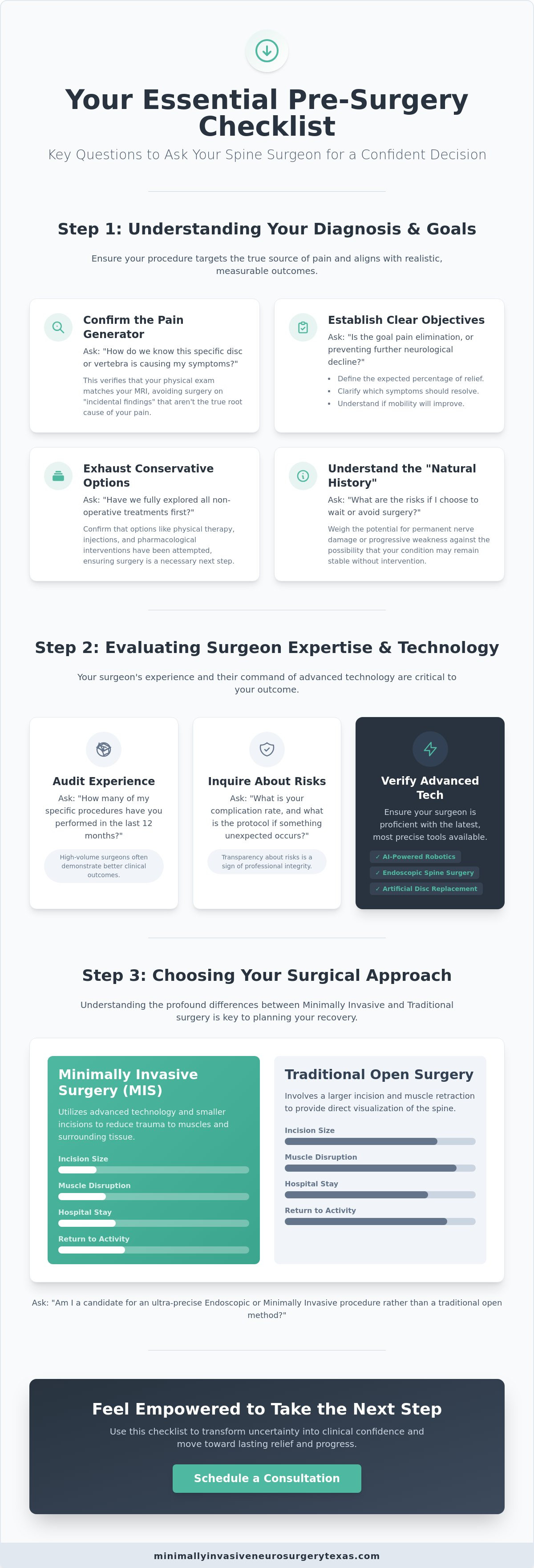
Deciding on back surgery is a pivotal moment in your healthcare journey. It requires a shift from passive observation to active inquiry. One of the most critical questions to ask a spine surgeon before surgery is whether your clinical symptoms truly align with your imaging findings. Many patients have “incidental findings” on an MRI. These are structural abnormalities that look concerning on a screen but aren’t actually causing your specific pain. Surgery on the wrong level won’t provide relief; therefore, you must verify that your physical exam matches your diagnostic scans with absolute certainty.
Before moving forward, you should understand the “natural history” of your spinal condition. This term describes what happens if you choose to wait or avoid surgery altogether. In some cases, waiting might lead to permanent nerve damage or progressive weakness. In others, your condition might remain stable, allowing for continued non-operative management. You must confirm that you’ve exhausted all conservative options, including physical therapy and pharmacological interventions, before transitioning to a surgical plan. This ensures that surgery is a necessary step rather than a premature one.
Diagnosing the Source of Your Pain
Confirming the exact origin of your discomfort is the most vital step in preoperative planning. Ask your surgeon: “How did you confirm this specific disc or vertebrae is the pain generator?” A pain generator is the foundational anatomical structure, such as a compressed nerve root or a degenerated joint, that is directly responsible for your clinical symptoms. To isolate this, your surgeon may utilize diagnostic injections or advanced imaging to ensure the treatment area is correct. This level of precision is essential for the success of Minimally invasive spine surgery and ensures that the intervention addresses the root cause of your suffering.
Establishing Clear Surgical Objectives
Success should be defined by clear, measurable outcomes rather than vague promises. You need to know if the procedure focuses on decompression, which involves removing tissue that’s pressing on nerves, or stabilization, which involves reinforcing the spinal structure. Ask: “Is the goal to eliminate pain, or to prevent further neurological decline?” In some instances, the priority is to stop a condition from worsening rather than achieving a complete absence of pain. Clarifying the expected percentage of relief helps you form a realistic vision for your return to normal activity. Use these specific goals to audit the surgeon’s plan:
- Will this procedure improve my mobility or just reduce leg pain?
- What specific neurological symptoms are expected to resolve immediately?
- Is there a risk that the pain could return if the underlying condition progresses elsewhere?
By establishing these benchmarks early, you can move from a state of concern to a state of informed confidence. Knowing exactly what the surgeon intends to achieve allows you to better evaluate your progress during the recovery phase. This clarity is the foundation of a successful surgical outcome and your long-term spinal health.
Evaluating Surgeon Expertise and Advanced Technology
Selecting the right surgeon involves more than just checking a list of credentials. You need to understand their specific mastery of the procedure you require. One of the most vital questions to ask a spine surgeon before surgery is how many times they have performed your specific operation, such as an Artificial Disc Replacement, in the last twelve months. High-volume surgeons typically demonstrate better clinical outcomes and lower infection rates. You should also ask about their specific complication rates and their protocol for managing unexpected findings during a procedure. A surgeon who is transparent about risks and their mitigation strategies demonstrates the professional integrity necessary for a trust-based relationship.
Beyond individual skill, the surgical team plays a massive role in your recovery. Inquire about who will be in the operating room and which specific tasks the lead surgeon performs versus a fellow or resident. It is also helpful to review standardized Questions to ask your surgeon to ensure no detail is overlooked. This level of scrutiny isn’t about doubt; it’s about verifying that you are receiving care from a specialized, boutique center that prioritizes personal attention over hospital volume. If you are ready to move forward, you can consult with a specialized neurosurgeon to discuss your specific case.
The Role of Robotic Navigation and AR
Modern spinal care in 2026 relies heavily on sub-millimeter precision. Ask your surgeon if they utilize advanced platforms like Globus Excelsius or Augmedics AR. These systems provide a digital roadmap of your anatomy, allowing for the incredibly accurate placement of hardware. This technology doesn’t just improve safety; it often reduces your radiation exposure during the operation by minimizing the need for repetitive X-rays. Precision is paramount. When hardware placement is accurate, the risk of adjacent segment disease decreases, supporting your long-term return to normal activity.
Board Certification and Specialization
Authority is built on certified excellence. You must verify if your surgeon is board-certified in neurosurgery or orthopedic surgery, as these disciplines offer different perspectives on spinal health. Ask what percentage of their practice is dedicated exclusively to the spine. A “high-tech healer” who focuses 100 percent of their time on spinal conditions will be more familiar with the latest 2026 innovations and clinical updates. This specialization ensures that your surgeon isn’t just a generalist, but a master of cutting-edge robotic technology and specialized surgical methodologies.
Minimally Invasive vs. Traditional Surgery: Making the Choice
The choice between traditional open surgery and modern, minimally invasive neurosurgery is a decision that dictates your entire recovery trajectory. In traditional surgery, large incisions require the surgeon to peel muscle away from the bone; this often leads to significant postoperative pain and longer healing times. Conversely, minimally invasive techniques use specialized instruments to tunnel through the muscle fibers without tearing them. This approach drastically reduces blood loss and hospital stays. Research indicates that minimally invasive methods can reduce infection risks by nearly six times the normal rates seen in open procedures.
When reviewing your options, one of the most critical questions to ask a spine surgeon before surgery is whether your specific pathology can be addressed via endoscopic spine surgery. This ultra-modern approach uses a tiny camera and specialized tools, allowing for maximum precision with minimal disruption. While most conditions in 2026 are treatable with these advanced methods, a surgeon might still recommend a traditional “open” approach for severe spinal deformities or complex revisions where a wider field of view is clinically necessary. Understanding why a specific technique is chosen helps you align your expectations with the surgical reality.
The Benefits of Smaller Incisions
Preserving the multifidus muscle is the key to a fast recovery. This muscle provides essential stability to your spine; damaging it during surgery can lead to long-term weakness. Smaller incisions mean less internal scarring and a significantly reduced inflammatory response. You should ask: “What is the typical length of stay for this procedure?” In 2026, many of these procedures are performed in ambulatory surgery centers, allowing you to return home the same day. Beyond the functional advantages, these questions to ask your spine surgeon help you understand the aesthetic and functional benefits of specialized spine surgery techniques.
Artificial Disc Replacement vs. Spinal Fusion
If your surgeon recommends a fusion, it’s important to explore motion-preserving alternatives. Ask: “Am I a candidate for neck disk replacement instead?” While a fusion locks two vertebrae together, potentially putting stress on the levels above and below, an artificial disc mimics natural movement. This reduces the risk of adjacent segment disease, where the surrounding discs wear out prematurely due to increased load. Maintaining motion is the primary goal of ADR over fusion. Choosing the right technology now helps prevent the need for additional surgeries in the future and supports your long-term return to normal activity.
Planning for Recovery and Your Return to Activity
Recovery is not a passive waiting period; it’s an active phase of your clinical journey. Establishing a concrete, week-by-week timeline is essential for managing expectations and ensuring a safe return to your normal daily activities. During the first week, your primary focus is gentle mobility and effective pain management. By the second week, most patients see a significant reduction in acute discomfort. One of the most practical questions to ask a spine surgeon before surgery is exactly when you can transition from simple walking to more structured physical therapy. While some surgeons prefer an immediate start, others wait until the initial inflammatory phase has subsided to protect the surgical site.
Safety remains our top priority throughout your healing process. You must be able to identify clinical red flags that require an immediate call to our Lewisville or Plano office. These include a fever over 101 degrees, unexpected drainage from the incision, or a sudden onset of leg weakness. Understanding your restrictions is equally vital. Most patients are restricted from lifting anything heavier than a gallon of milk for the first few weeks. Driving is typically permitted once you’re no longer taking narcotic pain medications and have regained the reaction speed necessary for North Texas roads. If you have questions about your specific recovery path, you can schedule a post-operative consultation to review your progress.
The First 48 Hours and Beyond
The initial two days after surgery are focused on stabilization. Ask your surgeon about the specific pain management strategies they use to minimize opioid reliance. Many modern practices utilize “Enhanced Recovery After Surgery” protocols that combine various non-narcotic medications to keep you comfortable. You also need clear wound care instructions for your minimally invasive ports. These tiny incisions require very little maintenance, but you must know when it’s safe to shower. Usually, showering is permitted after 48 to 72 hours, though submerging the incision in a bath or pool is strictly prohibited until the skin has completely healed.
Returning to Your North Texas Lifestyle
We know you’re eager to get back to the activities that define your life in DFW. Ask: “When can I return to specific activities like golf, gardening, or my daily commute in heavy traffic?” Commuting on the Sam Rayburn Tollway or the Dallas North Tollway requires significant core stability and sitting tolerance. Your surgeon will provide a long-term prognosis for returning to these high-demand activities based on your specific procedure. Whether you’re looking forward to a round of golf in Plano or tending to your garden in Lewisville, having a professional roadmap ensures you don’t overexert yourself too early. This structured approach is what allows our patients to achieve a successful return to normal activity.
Finalizing Your Decision: Logistics and Personal Comfort
Finalizing your surgical plan requires a shift from clinical data to practical logistics. You must confirm which hospital or surgery center in Plano or Lewisville will be the site of your procedure. Boutique surgical centers often provide a more streamlined, patient-centered experience than large, crowded hospital systems. One of the most important final questions to ask a spine surgeon before surgery is: “Will you be offended if I seek a second opinion?” A confident, professional surgeon will never be offended. They understand that peace of mind is a prerequisite for healing. If a surgeon discourages a second opinion, it’s a significant red flag regarding their professional transparency.
The final step in this process is a personal “gut check.” Do you feel heard and respected by the surgeon? Does the clinical staff answer your calls promptly and treat your concerns with compassion? Your comfort level with the surgical team is a vital component of a successful clinical outcome. Trust your instincts. When you find a team that combines certified authority with genuine empathy, you’ve found the right partner for your spinal health journey. This emotional alignment is what allows you to move forward with absolute certainty.
Insurance and Financial Transparency
Navigating the financial aspects of care is just as important as the clinical ones. Verify if the practice handles the prior authorization process, especially with 2026 regulatory updates that affect many spine procedures. You should also ask about the “Global Period” for follow-up appointments. This is the timeframe where post-operative visits are typically included in the initial surgical fee. Be sure to identify any potential third-party fees from anesthesiology or facility charges to avoid unexpected billing. Professional practices prioritize financial clarity to reduce your stress during the recovery phase.
The MINT Advantage with Dr. Scott Kutz
Choosing MINT means choosing a practice dedicated to the absolute forefront of modern innovation. We specialize in minimally invasive spinal fusion Texas residents trust for faster recovery and reduced physical impact. Dr. Scott Kutz and his team operate as high-tech healers, balancing robotic precision with personal attention. Unlike impersonal hospital systems, our boutique approach ensures you aren’t just a number on a chart. We prioritize your specific health goals and your return to normal activity above all else.
Ready to get your questions answered? Schedule a consultation with Dr. Scott Kutz today.
Securing Your Path to Lasting Relief
You’ve learned how to audit surgical technology and why choosing a boutique center over a massive hospital system can significantly impact your clinical outcome. By preparing specific questions to ask a spine surgeon before surgery, you move from a state of concern to a state of informed confidence. You now understand that the ultimate goal isn’t just a successful procedure; it’s a safe and efficient return to your normal daily activities.
At MINT, board-certified neurosurgeon Dr. Scott Kutz combines certified authority with the latest 2026 innovations. Our practice utilizes the Globus Excelsius robotic navigation system for sub-millimeter precision and offers motion-preserving artificial disc replacement as a specialized alternative to traditional fusion. We’re dedicated to providing the relief of suffering you deserve through personalized care and cutting-edge technology.
Empower your recovery—book your consultation with MINT in Plano or Lewisville. Your health is our top priority, and we’re ready to help you take the next step toward a pain-free life.
Frequently Asked Questions
How do I know if my spine surgeon is well-qualified?
A well-qualified surgeon holds board certification in neurosurgery or orthopedic surgery and has completed a dedicated spine fellowship. You should verify their experience with specific 2026 technologies like robotic-assisted navigation. Mastery of these tools indicates a commitment to precision and modern clinical standards. Ask how many procedures they perform annually to ensure they maintain the high volume necessary for optimal outcomes. This specialized focus distinguishes a boutique center from a general hospital system.
Is it normal to feel nervous before back surgery?
Feeling nervous is a completely normal response to the prospect of spinal intervention. We acknowledge this anxiety and address it through a combination of clinical authority and compassionate reassurance. Modern advancements in minimally invasive neurosurgery have significantly reduced the unknowns of surgery. By understanding the sub-millimeter precision of our robotic systems, many patients find their fear replaced by informed confidence. Our team is here to support your emotional well-being as much as your physical recovery.
Can I have minimally invasive surgery if I’ve had previous back surgery?
Previous back surgery doesn’t automatically disqualify you from minimally invasive options. While scar tissue from traditional open procedures can add complexity, modern endoscopic techniques often allow surgeons to navigate around old surgical sites. A specialized neurosurgeon will use advanced imaging to map a safe path to the pain generator. This approach minimizes further trauma to already sensitive tissues. It’s an excellent way to address recurrent issues while prioritizing a faster return to normal activity.
What is the most important question to ask about surgical risks?
The most critical question involves asking about the surgeon’s personal complication rates for your specific procedure. This is one of the essential questions to ask a spine surgeon before surgery to ensure you have a realistic understanding of the risks. A transparent surgeon will discuss their data openly and explain the protocols they use to mitigate those risks. Knowing how they handle unexpected findings or intraoperative challenges is the foundation of a trust-based clinical relationship.
How long should I wait to get a second opinion?
You should seek a second opinion as soon as you feel any uncertainty about a recommended surgical path. There is no required waiting period, and professional surgeons welcome the additional clarity. A second opinion can confirm the necessity of the procedure or offer motion-preserving alternatives like Artificial Disc Replacement. This step is about your personal comfort and ensuring you’ve explored every high-tech option available in 2026 for your spinal health.
What happens if the surgeon finds something unexpected during the operation?
Surgeons rely on detailed preoperative planning and real-time robotic navigation to minimize surprises. If an unexpected anatomical variation is found, the surgeon follows a pre-established contingency plan to ensure patient safety. This might involve adjusting the placement of hardware or modifying the decompression technique. The priority is always to stabilize the spine and protect neurological function. Our specialized center is equipped with the advanced technology needed to handle these complex clinical decisions with absolute certainty.
Will I need to stay overnight in a hospital in Plano or Lewisville?
Many patients in our Plano and Lewisville centers return home the same day as their procedure. The shift toward outpatient spine surgery is a major trend in 2026, driven by the reduced physical impact of minimally invasive methods. While a complex multi-level fusion might require a one-night stay for observation, simple decompressions and disc replacements are frequently performed in ambulatory surgery centers. This allows you to begin your recovery in the comfort of your own home.
How soon can I start physical therapy after a minimally invasive procedure?
Structured physical therapy typically begins between two and six weeks after your procedure. While we encourage gentle walking immediately after surgery to promote circulation, we wait for the initial healing phase to conclude before starting rigorous exercises. Your surgeon will provide a customized timeline based on the stability of your spine and the specific surgical methodology used. This gradual approach ensures your muscles are properly supported as you work toward a full return to normal activity.