What if the most critical factor in your recovery isn’t just a doctor’s years of experience, but their mastery of the specific technology used in the operating room? Choosing a specialist for back surgery is a heavy decision, and it’s common to feel anxious about long recovery times or the possibility of an unnecessary procedure. You deserve to feel certain that your diagnosis is precise and that your surgical team is at the absolute forefront of modern innovation.
This guide provides a clear, clinical framework on how to choose a spine surgeon in DFW so you can vet local specialists with absolute confidence. We’ll examine the 2026 Texas Medical Board requirements and the vital distinctions between orthopedic and neurosurgical expertise. You’ll learn how to identify providers using ultra-minimally invasive techniques, which currently maintain complication rates under 6%, and how new FDA cleared platforms like the Medtronic Stealth AXiS™ are redefining surgical accuracy. We’ll give you the exact criteria needed to find a high-tech healer who prioritizes your safety and your rapid return to normal activity.
Key Takeaways
- Understand the critical distinction between neurosurgeons and orthopedic surgeons, particularly why neurosurgical expertise is vital for conditions involving the spinal cord and delicate nerve structures.
- Learn exactly how to choose a spine surgeon in DFW by verifying non-negotiable credentials, including board certification and specialized fellowship training in modern, minimally invasive methodologies.
- Discover how a surgeon’s philosophy regarding tissue-sparing techniques versus traditional open surgery directly impacts your post-operative pain and recovery timeline.
- Gain a practical consultation checklist featuring five essential questions to help you evaluate a prospective surgeon’s clinical outcomes and communication style before proceeding with care.
- Explore the advantages of a boutique, patient-centered neurosurgical practice that utilizes advanced robotic and endoscopic technology to ensure a faster return to normal activity.
Navigating the DFW Spine Care Landscape: Neurosurgeon vs. Orthopedic Surgeon
Many patients assume all back specialists are the same. This is a common misconception that complicates the process of how to choose a spine surgeon in DFW. While both paths lead to the operating room, the foundational training and surgical philosophy differ significantly. Understanding these backgrounds helps you select a provider who aligns perfectly with your specific pathology and long term health goals. You shouldn’t have to guess which specialist is right for your condition when your mobility is on the line.
The Neurosurgical Advantage for Spinal Nerves
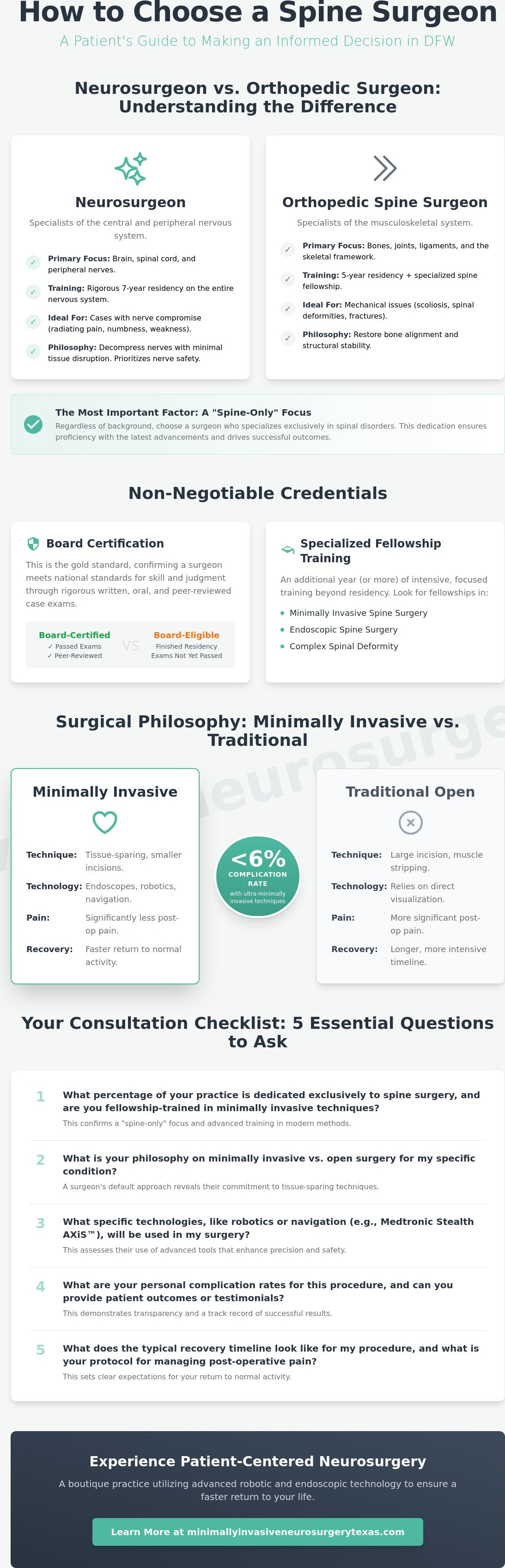
Neurosurgeons complete a rigorous seven year residency focused exclusively on the brain, spinal cord, and peripheral nerves. This extensive training makes them the preferred choice for complex cases where the nervous system is compromised. If you suffer from radiating pain, numbness, or loss of motor function, a neurosurgeon’s perspective is invaluable. They view the spine as a protective housing for the neural pathways rather than just a series of bones. This specialized expertise translates to extreme precision during delicate procedures like endoscopic spine surgery. A neurosurgeon’s primary role is to decompress neural structures with minimal disruption to the surrounding tissue. Their mastery of the central nervous system ensures that every movement in the operating room prioritizes the safety of your nerves.
When Orthopedic Spine Surgeons are the Right Fit
Orthopedic surgery focuses on the musculoskeletal system, including the bones, joints, and ligaments that provide structural support. These specialists are often the right fit for managing mechanical issues like severe scoliosis, complex spinal deformities, or high grade fractures where bone alignment is the primary concern. They typically undergo a five year residency followed by a dedicated spine fellowship. While they are experts in the skeletal framework, their foundational training does not emphasize the internal neural structures to the same degree as neurosurgery. Both specialties overlap in many areas, including spinal fusions and discectomies, but their starting points are different.
The best choice for your care is often a surgeon who maintains a spine-only focus. This means they have moved beyond general practice to specialize exclusively in spinal disorders. When you research how to choose a spine surgeon in DFW, look for a practitioner who treats the spine every single day. This level of dedication ensures they are proficient in the latest technological advancements and clinical protocols. Whether they began in neurosurgery or orthopedics, their commitment to spinal excellence is what drives successful outcomes and a faster return to normal activity. Specialized, boutique centers often provide this level of focused attention, avoiding the impersonal nature of large hospital systems.
Core Credentials: Why Board Certification and Fellowship Training are Non-Negotiable
Credentials serve as the primary filter for patient safety and surgical excellence. When you evaluate how to choose a spine surgeon in DFW, you’ll encounter two specific terms: board-eligible and board-certified. A board-eligible surgeon has completed their residency but hasn’t yet passed the final certification exams. In contrast, a board-certified surgeon has successfully navigated rigorous written and oral testing. This process includes a comprehensive peer-review of their actual surgical cases to ensure they meet national standards for clinical judgment and technical skill.
Decoding Board Certification
The certification process is a multi-year commitment to clinical transparency. It requires surgeons to submit their surgical outcomes for scrutiny by a panel of established experts. This ensures the physician isn’t just technically capable but also makes sound, ethical decisions regarding when to operate. You can verify a surgeon’s standing through the American Board of Neurological Surgery (ABNS) or the American Board of Orthopedic Surgery. This step is a vital part of how to choose a spine surgeon who prioritizes your long term health. Starting September 1, 2026, the Texas Medical Board will also require all practitioners to use the CE Broker system for license renewal. This mandate ensures your surgeon remains compliant with the latest medical advancements and safety protocols.
The Role of Sub-Specialization
General neurosurgery covers a vast range of conditions, from brain tumors to peripheral nerve issues. While this breadth of knowledge is impressive, it often lacks the hyper-focus required for complex spinal pathologies. A dedicated Spine Fellowship provides an additional year of intensive training focused exclusively on the vertebral column. This is where a surgeon masters advanced, tissue-sparing techniques like artificial disc replacement and endoscopic approaches. This specialized mastery is a hallmark of specialized neurosurgical care at boutique practices.
Dr. Scott Kutz at MINT exemplifies this sub-specialized path through his dedicated focus on minimally invasive methodologies. His fellowship training allows for a level of precision that general surgeons may not reach. Choosing a specialist who maintains active membership in professional societies like the North American Spine Society (NASS) ensures they stay at the absolute forefront of innovation. This level of dedication is what ultimately facilitates a faster return to normal activity and the relief of chronic suffering. You deserve a surgeon whose credentials reflect a lifelong commitment to mastering the spine.
Evaluating Surgical Philosophy: Traditional Open Surgery vs. Minimally Invasive Techniques
A surgeon’s philosophy determines your entire recovery experience. Traditional open surgery often requires significant muscle retraction and large incisions, which can lead to extended hospital stays and increased post-operative pain. In contrast, a modern surgical philosophy focuses on tissue preservation. When you look at how to choose a spine surgeon in DFW, ask whether they prioritize these advanced, less invasive methods as their standard of care. The most reputable specialists also embrace a “conservative first” approach. They don’t rush you into the operating room if physical therapy or targeted injections can resolve the issue. Surgery should be the final step, not the first, ensuring that every patient receives the most appropriate level of care for their specific condition.
The Minimally Invasive Standard
Minimally invasive surgery (MIS) utilizes specialized instruments and small incisions, often less than one centimeter in length. This approach drastically reduces blood loss and lowers the risk of site infections compared to traditional methods. Because the surgeon works between the muscle fibers rather than cutting through them, the body heals much faster. Patients in Plano and Lewisville benefit from these techniques through significantly reduced recovery times for minimally invasive spine surgery, often returning to work and daily activities weeks sooner than open surgery patients. This focus on efficiency and patient comfort is a core pillar of high-quality neurosurgical care that prioritizes your return to normal activity.
High-Tech Precision: Robotics and Augmented Reality
Precision is the ultimate goal in spine care. Modern systems like the Globus Excelsius robotic platform provide a level of accuracy in screw placement that was previously unattainable. This technology allows for meticulous pre-operative planning, ensuring that every implant is positioned with sub-millimeter precision. Alongside these robotic tools, Augmented Reality (AR) systems like Augmedics allow surgeons to “see” the patient’s anatomy through the skin in real-time. This 3D visualization eliminates the guesswork often associated with complex decompressions. As noted in the National Spine Health Foundation guide to choosing a surgeon, understanding a doctor’s technological proficiency is vital for modern patients. Significant investment in these proprietary systems is a definitive hallmark of a practice operating at the absolute forefront of modern innovation. By choosing a surgeon who masters these tools, you ensure your procedure is as safe and effective as possible.
The DFW Consultation Checklist: 5 Questions to Ask Your Prospective Surgeon
Entering a consultation can feel overwhelming, but it is your most powerful opportunity to evaluate how to choose a spine surgeon in DFW. You aren’t just a patient; you’re a partner in your own recovery journey. A surgeon’s bedside manner and their willingness to answer technical questions are just as telling as their clinical resume. If a doctor seems rushed or dismissive of your concerns, it’s a clear signal to look elsewhere. You deserve a specialist who treats your health as their top priority and explains complex medical information with absolute certainty.
Vetting the Diagnosis and Procedure
The first part of your meeting should focus on the necessity and precision of the proposed intervention. Use these questions to gauge the surgeon’s expertise and commitment to conservative care:
- Question 1: “What are the non-surgical alternatives we haven’t explored yet?” A high-tech healer exhausts every conservative option, from targeted injections to specialized physical therapy, before recommending the operating room.
- Question 2: “How many of these specific procedures do you perform annually?” Surgical volume is a direct indicator of proficiency. For example, if you are considering a minimally invasive spinal fusion, you want a surgeon who performs this technique weekly. Mastery of specialized clinical acronyms and instruments comes from repetition.
- Question 3: “What is your personal complication rate for this surgery?” Verified data for ultra-minimally invasive procedures shows complication rates under 6%. Your surgeon should be transparent about their outcomes and how they use technology to mitigate risks.
Understanding the Logistics and Support
The technical success of the surgery is only half the battle; the logistical support during your recovery is equally vital. This is where the distinction between a boutique practice and a large hospital system becomes evident. In the Dallas-Fort Worth area, many specialized procedures are now performed at outpatient surgical centers. These facilities often provide a more controlled environment with lower infection risks and a more personal emotional style than massive hospital complexes.
- Question 4: “Will my surgery be performed at an outpatient center or a hospital, and why?” Outpatient centers are often ideal for minimally invasive work, allowing you to return home the same day.
- Question 5: “Who will be my primary point of contact during my recovery?” Knowing you have a direct line to your care team provides immense relief. Specialized practices like MINT emphasize accessible post-operative care so you are never left searching for answers.
Be sure to ask about success rates for motion-preserving options like neck disk replacement. A major red flag is any surgeon who pushes for a procedure without a thorough review of your imaging or one who dismisses your concerns about recovery timelines. If you’re ready to experience a patient-centered approach, schedule a consultation with our neurosurgical team to discuss your specific path to a return to normal activity.
Personalized Spinal Care in Plano and Lewisville: The MINT Advantage
Selecting a specialist who combines high-tech precision with a local, boutique feel is the final piece of the puzzle when deciding how to choose a spine surgeon in DFW. At Minimally Invasive Neurosurgery of Texas, Dr. Scott Kutz has built a practice centered on a patient-first philosophy that prioritizes clinical excellence and emotional reassurance. Your care isn’t dictated by the administrative quotas of a massive hospital system. Instead, it’s guided by your specific clinical needs and your personal lifestyle goals. We recognize that chronic back pain is more than just a medical diagnosis; it’s a significant barrier to enjoying the vibrant life available in North Texas. Our mission is to remove that barrier through the most advanced surgical methodologies available today.
Why MINT Stands Out in North Texas
Minimally Invasive Neurosurgery of Texas stands out in the region because we maintain an exclusive focus on spinal health. We don’t perform cranial neurosurgery or offer chiropractic services. This singular dedication allows our team to master the nuances of the vertebral column with absolute certainty. By specializing in advanced neurosurgical techniques, we provide our patients with sophisticated alternatives to traditional, high-impact procedures. Our integration of cutting-edge tech, like robotic navigation and endoscopic tools, isn’t just about staying modern. It’s about reducing your time in the operating room, minimizing tissue disruption, and accelerating your return to normal activity. This specialized approach is the hallmark of a high-tech healer who remains deeply committed to the local community.
Our clinics in Plano and Lewisville offer a specialized, calm environment that avoids the impersonal nature of large medical complexes. We’ve positioned these locations to ensure that world-class spinal care is accessible to neighbors across the entire DFW metroplex. When you walk through our doors, you aren’t just another chart. You’re a person who deserves a persistent, thorough diagnostic process to find the actual root cause of your suffering. We don’t settle for surface-level assessments or “one-size-fits-all” treatments. We use every diagnostic tool available to ensure your path forward is based on an accurate, data-driven understanding of your condition.
Take the First Step Toward Relief
The journey toward a pain-free life begins with an informed choice. If you’ve been researching how to choose a spine surgeon in DFW, the MINT advantage is found in our blend of board-certified authority and compassionate, personalized attention. You don’t have to navigate this path alone or settle for invasive methods that require months of recovery. We prioritize your comfort from the moment you schedule your first consultation to the day you complete your final follow-up visit. Our results-oriented rhythm is designed to move you from a state of concern to a state of informed confidence.
Don’t let another season pass while sidelined by discomfort. Take the first step toward lasting relief today. Contact our team to schedule a comprehensive evaluation at either our Plano or Lewisville office. We’re ready to help you reclaim your mobility and start your journey back to a life without limits.
Your Path to a Pain-Free Future
Choosing the right specialist is the most significant step you’ll take toward physical recovery. By prioritizing board certification, specialized fellowship training, and a surgical philosophy rooted in minimally invasive innovation, you can proceed with absolute certainty. You now have the clinical framework needed for how to choose a spine surgeon in DFW that values your safety and long term mobility. Don’t settle for traditional, highly invasive methods when modern technology offers a faster return to normal activity.
Board-certified neurosurgeon Dr. Scott Kutz provides the specialized expertise of a master healer with the personal attention of a boutique practice. Our team utilizes cutting-edge endoscopic and robotic spine surgery systems at our convenient Plano and Lewisville locations to ensure sub-millimeter precision during every procedure. Schedule Your Consultation with Dr. Scott Kutz at MINT Today to find the root cause of your pain and begin a tailored treatment plan. Your journey back to a vibrant, active life is within reach, and we’re here to guide you every step of the way.
Frequently Asked Questions
Is it better to see a neurosurgeon or an orthopedic surgeon for back pain?
Neurosurgeons are often the preferred choice for back pain involving the spinal cord or delicate nerve roots because their residency training focuses exclusively on the central nervous system. While orthopedic surgeons excel at structural bone issues like scoliosis, a neurosurgeon’s expertise is vital for procedures requiring neural decompression. Both specialties perform spine surgery, but you should choose a specialist whose foundational training aligns with your specific nerve or disc pathology.
How do I check if a spine surgeon in Dallas is board-certified?
You can verify a specialist’s credentials by visiting the official websites of the American Board of Neurological Surgery (ABNS) or the American Board of Orthopedic Surgery (ABOS). These portals allow you to search by the doctor’s name to confirm they have passed the required peer-review and testing. This verification is a critical part of how to choose a spine surgeon in DFW who meets the highest national safety and ethical standards.
What are the red flags to look for when choosing a spine surgeon?
Major red flags include a surgeon who recommends an operation before exploring conservative therapies or one who cannot explain their personal complication rates. You should also be wary of practices that lack investment in modern robotic or navigation technology. A high-tech healer will always prioritize transparency and provide a clear, data-driven rationale for any proposed surgical intervention rather than rushing you into the operating room.
Does a minimally invasive approach really lead to a faster recovery?
Minimally invasive neurosurgery significantly reduces recovery timelines by avoiding the extensive muscle cutting required in traditional open procedures. By working through small incisions, surgeons minimize blood loss and post-operative pain. This approach allows most patients to return to their normal activity levels weeks sooner than they would after a conventional back surgery, often with a much lower risk of site infection and reduced reliance on pain medication.
Should I get a second opinion before having spine surgery in DFW?
Seeking a second opinion is a standard and encouraged practice for any elective spine procedure in the Dallas-Fort Worth area. A second perspective ensures that your diagnosis is accurate and that the proposed treatment plan is the most appropriate option for your long term health. Most reputable surgeons welcome this step as it builds patient confidence and reinforces the clinical necessity of the surgery before you proceed.
What is the success rate of minimally invasive spine surgery?
Clinical studies of ultra-minimally invasive and endoscopic procedures consistently show high success rates with complication rates under 6%. These outcomes are largely due to the precision of robotic navigation and the reduced physical impact on the body’s surrounding tissues. When you research how to choose a spine surgeon in DFW, look for a specialist who can provide specific success metrics and clinical outcomes for your particular spinal condition.
How long does it take to get an appointment with a top spine surgeon in Plano?
Wait times for an initial consultation in Plano vary significantly between large hospital networks and specialized boutique centers. While some large systems have backlogs of several weeks, boutique practices often prioritize patient accessibility and can see new patients within a few days. Our team understands the urgency of chronic pain and works to provide comprehensive evaluations as efficiently as possible to start your recovery journey sooner.
Do DFW spine surgeons accept most major insurance plans?
Most spine surgeons in North Texas accept a wide range of major private insurance plans, though coverage for specific advanced technologies can vary. It’s essential to contact the practice’s billing department directly to verify your benefits before your first visit. A transparent practice will provide a clear explanation of your out-of-pocket responsibilities and help you navigate the insurance authorization process to ensure there are no surprises during your care.