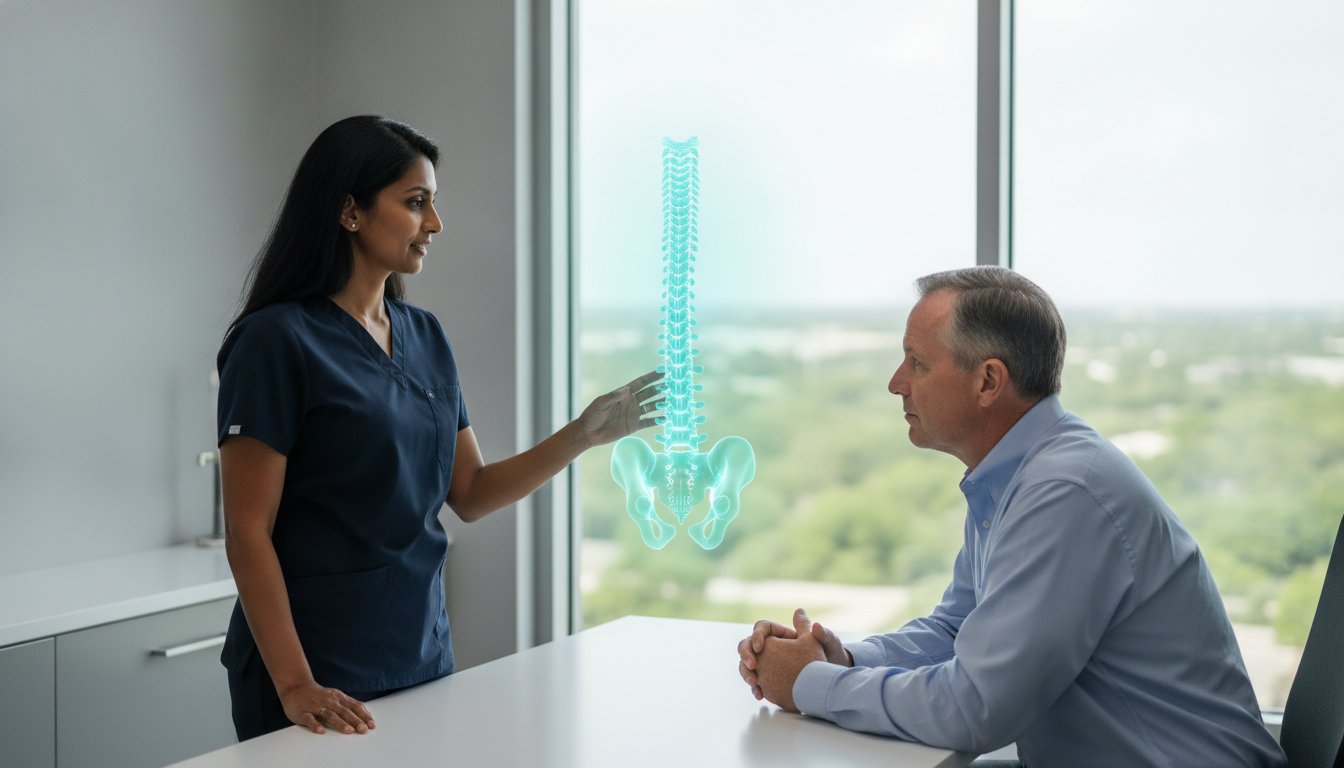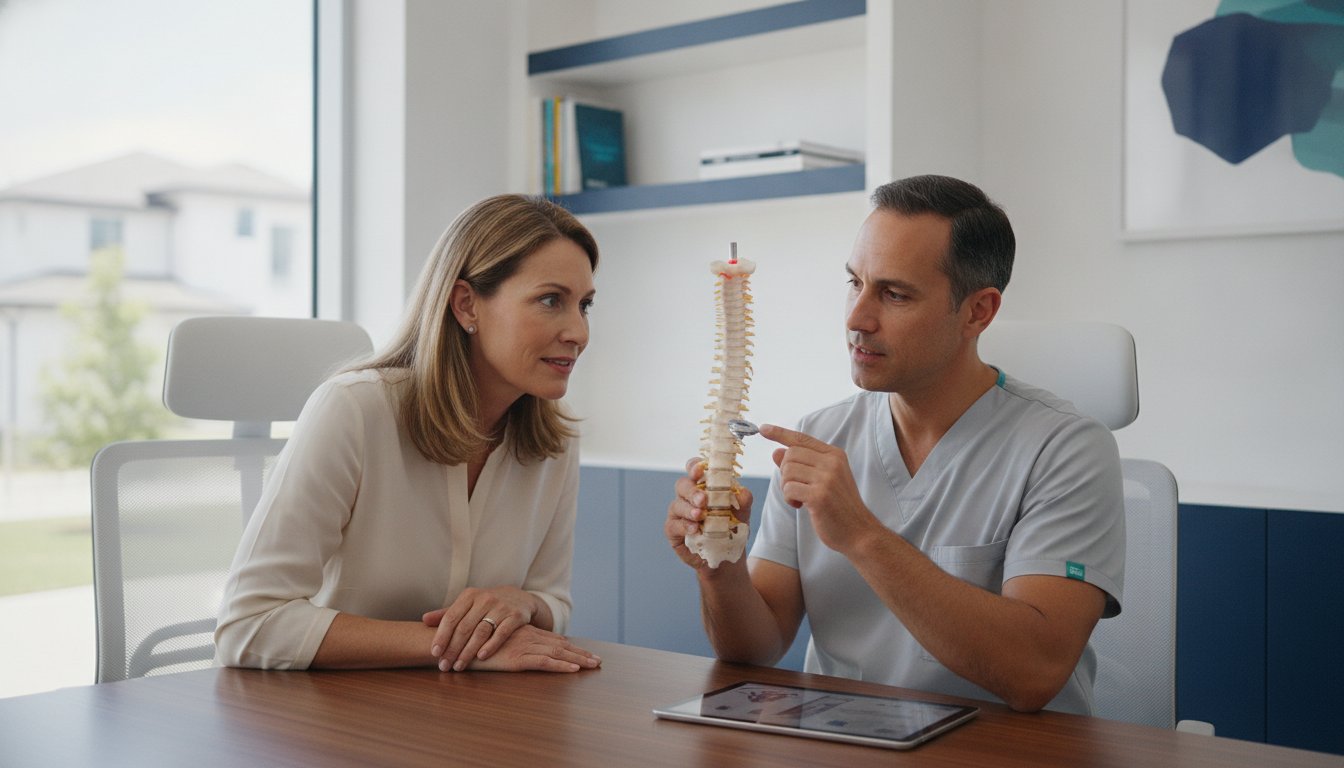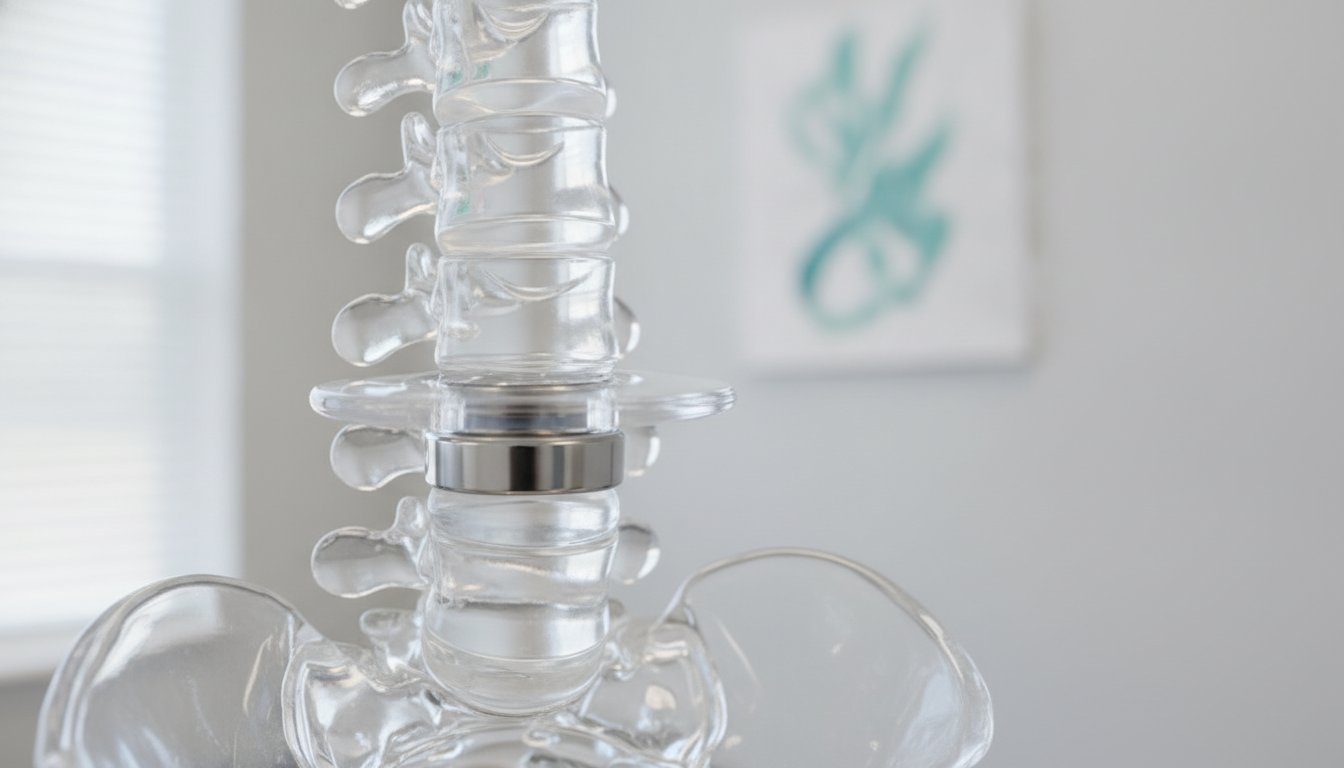
Did you know that the FDA rates the lumbar artificial disc replacement success rate at over 90 percent, a figure that notably outperforms the 70 to 90 percent success range associated with traditional spinal fusion? For those enduring the daily grind of chronic lower back pain, this data offers a powerful sense of optimism. You’ve likely spent years searching for relief while worrying that a fusion might lead to adjacent segment disease or a permanent loss of flexibility. It’s completely natural to prioritize your long-term mobility and want to avoid the cycle of repeat surgeries.
We understand that your primary goal is a full return to normal activity without the heavy burden of a long recovery. This 2026 guide provides a clear look at how motion-preserving technology and ultra-minimally invasive techniques are redefining patient outcomes. You’ll learn about the clinical evidence supporting modern implants like the Activ-L and ProDisc-L, and why these high-tech solutions are superior for maintaining spinal health. We will preview the latest satisfaction statistics and the specific medical criteria that ensure your journey toward pain-free living is both safe and successful.
Key Takeaways
- Understand why the lumbar artificial disc replacement success rate is clinically rated at over 90 percent, offering a more reliable alternative to traditional spinal fusion.
- Discover how maintaining natural spinal mobility protects neighboring discs and significantly reduces the long-term risk of adjacent segment disease.
- Identify the specific patient selection criteria and bone health requirements that serve as the critical foundation for a successful surgical outcome.
- Learn how advanced robotic navigation and minimally invasive neurosurgery techniques allow for sub-millimeter precision and a faster recovery.
- Explore the MINT approach to spine care, which is specifically designed to restore your quality of life and facilitate a swift return to normal activity.
Understanding the Success Rate of Lumbar Artificial Disc Replacement
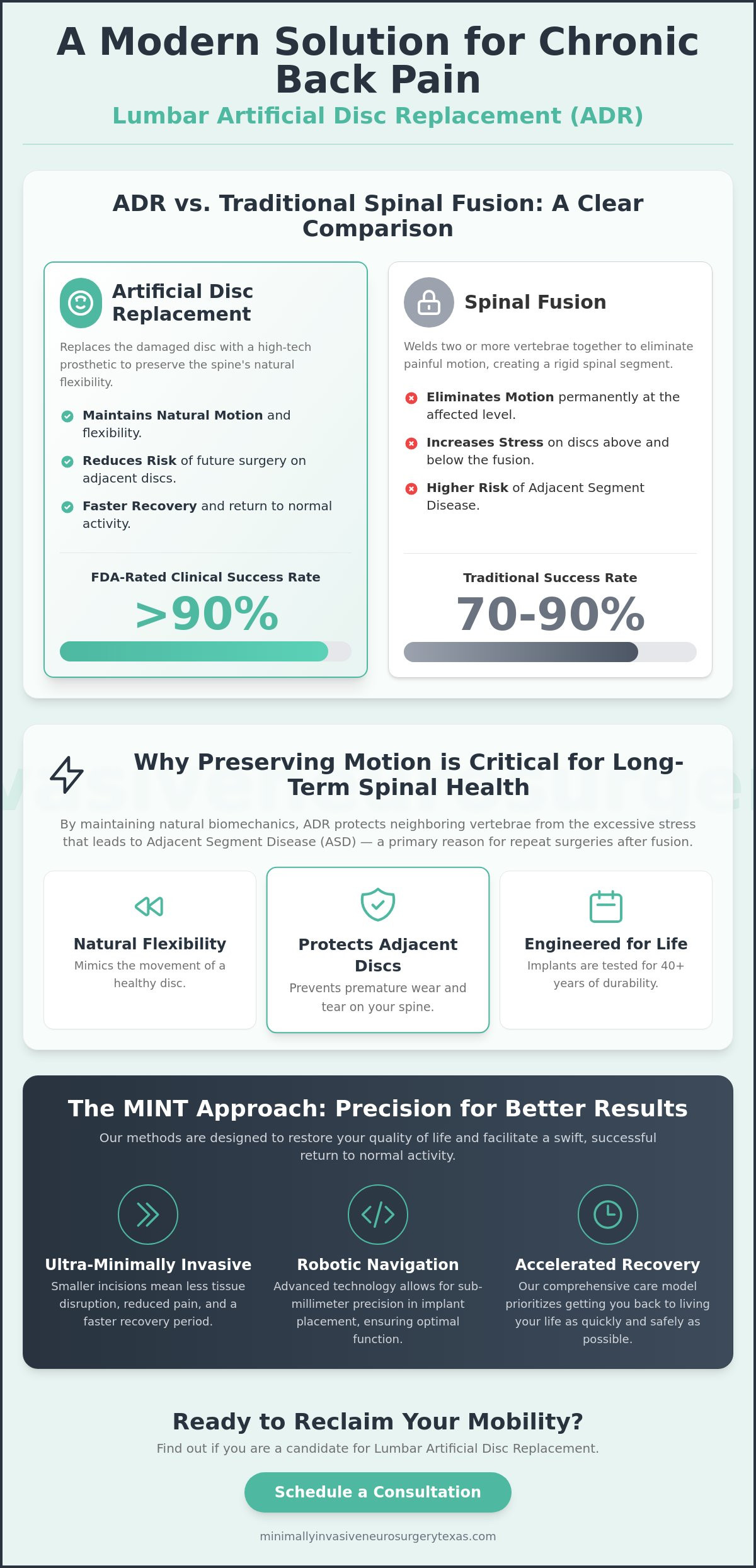
Measuring the success of a surgical intervention requires looking beyond simple pain relief. In the context of modern spine care, the lumbar artificial disc replacement success rate is defined by a triad of clinical outcomes: a significant reduction in pain, a measurable improvement in physical function, and the long-term avoidance of revision surgery. Clinical data from the FDA and leading orthopedic studies consistently place the success rate for this procedure between 90 and 95 percent. This high level of efficacy is a testament to the precision of motion-preserving technology and its ability to outperform traditional fusion in specific patient populations.
Unlike traditional fusion, which eliminates movement at the affected segment, Total disc replacement (TDR) prioritizes the natural mechanics of the human spine. Success isn’t just about what is removed; it’s about what is preserved. By maintaining your natural range of motion, we protect the structural integrity of the surrounding discs. Modern prosthetic implants are engineered for extreme durability. Many current designs are tested to withstand the mechanical stresses of a typical human lifestyle for 40 years or more, providing a permanent solution for degenerative disc disease. This durability is a cornerstone of why the lumbar artificial disc replacement success rate remains high even decades after the initial procedure.
Pain Relief vs. Functional Recovery
Clinicians often use the Visual Analog Scale (VAS) to quantify a patient’s journey from chronic suffering to relief. While a lower VAS score indicates less pain, true success involves functional recovery. There’s a distinct difference between merely being comfortable and returning to high-impact activities like sports or heavy lifting. We define clinical success as the exact intersection where objective medical data meets a transformative improvement in your daily quality of life. This means you aren’t just surviving; you’re thriving in your physical environment again.
10-Year Success Data and Longevity
Long-term follow-up studies provide the most reassuring evidence for patients concerned about the future. Data spanning over a decade shows that outcomes remain remarkably stable, with very low rates of prosthetic wear-out. Modern lumbar implants utilize advanced materials like highly cross-linked polyethylene and porous titanium to encourage bone integration. A common misconception is that these devices require frequent replacement. Current engineering ensures these discs are built to last a lifetime for the vast majority of patients. This long-term reliability is why ADR is the preferred choice for younger, active individuals seeking to maintain their mobility.
ADR vs. Spinal Fusion: Comparing Success and Long-Term Outcomes
Choosing between spinal fusion and artificial disc replacement requires a deep understanding of how each procedure impacts your long-term mobility. Traditional spinal fusion relies on immobilization; it essentially welds two or more vertebrae together to eliminate painful motion. While effective at stopping movement, this creates a rigid segment that no longer functions like a natural joint. Conversely, ADR offers mobile stability. It replaces the damaged disc with a prosthetic that maintains the spine’s natural flexibility. This fundamental difference is why the lumbar artificial disc replacement success rate is often viewed through the lens of long-term spinal health rather than just immediate pain relief.
Why Motion Matters for Your Spine
When a segment of the spine is fused, the mechanical stress that would normally be absorbed by that disc is transferred to the levels above and below. This phenomenon, known as Adjacent Segment Disease, is a primary reason why some fusion patients eventually require additional surgeries. ADR mimics natural disc biomechanics to protect these neighboring vertebrae from premature wear. By distributing force evenly, we reduce the likelihood of “failed back surgery syndrome.” For patients with significant instability or severe facet joint arthritis who might not be ideal candidates for motion preservation, our Minimally Invasive Spinal Fusion in Texas: The Comprehensive 2026 Guide offers a detailed look at how we achieve stability with minimal tissue disruption.
Recovery Comparison: Back to Life Faster
The recovery timeline for ADR is significantly shorter than that for traditional fusion. Fusion patients typically face a 6 to 12 month healing process as they wait for the bone graft to solidify and bridge the vertebrae. In contrast, ADR patients often return to light activity and work within 6 to 12 weeks. Because ADR doesn’t require bone graft healing, there’s a lower risk of non-union complications. Early mobilization is a critical component of ADR success; it encourages the surrounding muscles to stay active and supports the integration of the implant. This efficiency allows you to bypass the sedentary lifestyle often forced by more invasive methods. If you’re ready to explore these advanced options, you can consult with a spine specialist to determine the best path for your unique anatomy.
Comparative data consistently shows that ADR patients require fewer follow-up surgeries over a ten-year period. The preservation of motion acts as a safeguard for the rest of your back. While fusion remains a gold standard for specific deformities, the lumbar artificial disc replacement success rate reflects a shift toward restorative, high-tech solutions that prioritize your future activity levels. We focus on providing the clinical precision necessary to ensure your surgical outcome matches your personal goals for a return to normal activity.
Key Factors that Determine Your ADR Surgical Outcome
A successful surgical outcome is never the result of chance. It’s the product of rigorous clinical standards and precise execution. While the lumbar artificial disc replacement success rate is statistically high, individual results depend heavily on several foundational variables. We categorize these into patient-specific biology, lifestyle choices, and the technical proficiency of the surgical team. When these elements align, the potential for a full return to normal activity becomes a tangible reality rather than a distant hope.
Patient selection is perhaps the most critical component, accounting for roughly 50 percent of the success equation. We don’t simply treat a scan; we treat a person. Identifying the specific source of pain through advanced imaging ensures that the prosthetic disc addresses the actual pathology. Additionally, the structural integrity of your vertebrae is paramount. Because the artificial disc must anchor into the bone, vertebral strength and density are non-negotiable requirements. If the bone is too weak to support the implant, the risk of subsidence or failure increases, which is why we conduct thorough bone health assessments during the diagnostic phase.
Lifestyle factors also play a decisive role in how well you heal. Smoking, for instance, significantly impairs blood flow and slows the body’s ability to integrate the new implant with the surrounding bone. Your commitment to maintaining a healthy weight and staying active also influences the long-term durability of the device. Finally, the experience of the neurosurgeon correlates directly with the outcome. Utilizing robotic navigation and specialized clinical acronyms for minimally invasive approaches requires a high level of specialization. Precision in implant placement is measured in millimeters, and this level of accuracy is what separates a standard result from an exceptional one.
Are You a Candidate for Lumbar ADR?
Success is most predictable in patients with single-level degenerative disc disease who haven’t found relief through conservative care. While some multi-level cases are eligible, the criteria are stricter to ensure spinal stability. Contraindications include severe facet joint arthritis, osteoporosis, or significant spinal deformities like scoliosis. In these instances, alternative methods like minimally invasive neurosurgery may be a safer path. We rely on a clear MRI and CT scan for surgical planning to map your unique anatomy before the first incision is made.
Post-Operative Commitment
Recovery is a phased journey that requires your active participation. Specialized physical therapy is essential for maintaining disc mobility and retraining the muscles supporting your spine. During the initial six weeks, following weight-lifting restrictions is vital to allow the bone to grow into the porous surface of the implant. We view the recovery phase as a collaborative effort where the patient acts as a vital partner in securing the final surgical outcome. Your dedication to the post-operative protocol ensures that the high lumbar artificial disc replacement success rate applies to your specific case.
Minimally Invasive ADR in Plano and Lewisville: Precision for Better Results
The MINT approach isn’t just about smaller scars. It’s about protecting the delicate tissues and structural supports that surround your spine. By utilizing specialized instruments and smaller incisions, we avoid the extensive muscle stripping required in traditional open surgeries. This preservation of muscle attachments and fascia directly influences the lumbar artificial disc replacement success rate by ensuring the body retains its natural stabilizing forces. Patients in Plano and Lewisville benefit from this refined methodology, which results in significantly reduced blood loss and a lower risk of post-operative infection. We focus on these minute details because they represent the difference between a standard recovery and an exceptional one.
Precision remains the hallmark of modern neurosurgery. We utilize the Globus Excelsius robotic navigation system to achieve sub-millimeter accuracy during implant placement. This technology provides a real-time, 3D map of your spine, allowing the surgeon to guide the prosthetic disc into its ideal position with absolute certainty. When combined with Augmedics AR (Augmented Reality), we can visualize the internal anatomy through the skin, further enhancing the safety profile of the procedure. There is a direct correlation between perfect implant placement and the long-term lumbar artificial disc replacement success rate. To learn more about how we utilize these innovations, see our Minimally Invasive Neurosurgery in Plano: A Modern Guide.
Advanced Technology in the Operating Room
Our commitment to innovation means utilizing tools that provide a level of visual clarity once thought impossible. Augmedics AR allows us to keep our eyes on the patient while seeing a digital overlay of the spinal structure. This ensures the artificial disc is perfectly centered, which is vital for maintaining the natural biomechanics of your back. When an implant is placed with robotic guidance, the mechanical stress is distributed exactly as nature intended, reducing wear and tear over decades of use.
The “High-Tech Healer” Advantage
The success of your surgery depends as much on the hands of the surgeon as it does on the technology. Dr. Scott Kutz brings years of specialized expertise in motion-preserving technology to every patient interaction. As a board-certified neurosurgeon, he understands the complex interplay between the spinal cord, nerve roots, and the mechanical requirements of an artificial disc. Choosing a specialized, boutique practice over a large hospital system ensures you receive personalized attention. You aren’t just another number in a crowded ward; you’re a patient whose recovery is our singular priority. This boutique approach allows for a level of clinical precision and compassionate care that larger institutions often struggle to provide. If you’re ready to experience the high-tech healer difference, you can book an appointment at our Lewisville or Plano location today.
Why Choose MINT for Your Lumbar Disc Replacement in Texas
Selecting the right surgical partner is the most influential decision you’ll make on your journey to recovery. At Minimally Invasive Neurosurgery of Texas, we combine the clinical authority of a specialized surgical center with the compassionate, personalized attention of a boutique practice. Our focus remains steadfast on the preservation of motion and the relief of suffering. We don’t just aim for a successful surgery; we aim for a transformative improvement in your daily quality of life. By choosing a practice that operates at the absolute forefront of modern surgical innovation, you’re securing a future defined by mobility rather than restriction. This specialized approach ensures that your unique anatomy and lifestyle goals are integrated into every step of the surgical plan.
The high lumbar artificial disc replacement success rate we achieve is a direct result of our commitment to absolute precision. We understand that chronic back pain can feel like an endless cycle of failed treatments and diminishing hope. Our high-tech healer philosophy ensures that every patient benefits from the expertise of a board-certified neurosurgeon who specializes in motion preservation. You’ll find that our team prioritizes your health as the top priority, moving you from a state of concern to a state of informed confidence. You don’t have to live in fear of traditional fusion or the long recovery times associated with outdated methods.
Consultation and Diagnostic Accuracy
Every successful outcome begins with an accurate diagnosis. We utilize advanced imaging to confirm that your pathology is a perfect match for motion-preserving technology. This rigorous screening process is why the lumbar artificial disc replacement success rate remains so high for our patients. If you’ve been told you aren’t a candidate elsewhere, or if you’re dealing with failed back surgery syndrome, a second opinion at MINT can provide the clarity you need. We take the time to explain the technical aspects of your care, ensuring you understand how the implant will function within your spine. For patients who may also be experiencing discomfort in the upper spine, our Neck Disk Replacement in Plano & Lewisville: A Comprehensive Buying Guide for 2026 offers similar insights into cervical health.
Taking the Next Step Toward Recovery
Reclaiming your life starts with a single conversation. Our scheduling process is designed to be straightforward and efficient for residents across North Texas. We’re dedicated to helping you return to the activities you love, whether that’s professional sports, weekend hiking, or simply playing with your children without pain. The narrative arc of your recovery begins with a thorough evaluation and ends with a return to normal activity. Don’t let another year pass under the burden of chronic pain. Our team is ready to guide you through the diagnostic journey toward a successful clinical outcome. Schedule your consultation with Dr. Scott Kutz at MINT today and take the first step toward a mobile, pain-free future.
Reclaim Your Active Lifestyle with Confidence
Modern spine surgery has moved beyond the limitations of immobilization. By choosing motion preservation, you’re investing in the long-term health of your entire spine and protecting yourself from the risks of adjacent segment disease. The clinical data is clear; the lumbar artificial disc replacement success rate is remarkably high when backed by expert patient selection and surgical precision. You don’t have to settle for the permanent restrictions of traditional fusion when high-tech solutions are available right here in North Texas.
At MINT, board-certified neurosurgeon Dr. Scott Kutz utilizes over a decade of minimally invasive excellence to provide life-changing results. By integrating advanced systems like the Globus Excelsius robotic navigation, we ensure your implant is placed with the sub-millimeter accuracy required for a lifetime of movement. This combination of clinical authority and compassionate care is the hallmark of our practice. It’s time to stop managing your pain and start planning your return to normal activity. Take the first step toward a restorative outcome and Consult a Dallas-Fort Worth ADR Specialist today. Your future of pain-free mobility is closer than you think.
Frequently Asked Questions
What is the success rate of lumbar artificial disc replacement?
The lumbar artificial disc replacement success rate is clinically rated at over 90 percent according to FDA data. This outcome is notably higher than the 70 to 90 percent success range associated with traditional spinal fusion. Success is defined by a combination of significant pain reduction, improved physical function, and the long-term avoidance of follow-up surgeries.
How long does an artificial lumbar disc last?
Modern prosthetic discs are engineered to last 40 years or more under typical mechanical loads. High-tech materials like porous titanium and highly cross-linked polyethylene allow the device to mimic the durability of a healthy human disc. This longevity ensures that young, active patients can maintain their mobility for decades without needing a replacement.
Can an artificial disc replacement fail?
While the lumbar artificial disc replacement success rate is high, failures can occur due to factors like implant migration or inadequate bone density. These risks are minimized through precise surgical techniques and rigorous patient screening. If an implant doesn’t integrate properly, it may require a revision or a transition to a stabilization procedure.
Is lumbar ADR safer than spinal fusion?
ADR is frequently safer for long-term spinal health because it eliminates the risk of adjacent segment disease. Fusion often causes the discs above and below the surgical site to wear out prematurely due to increased stress. By preserving natural motion, ADR protects the rest of your spine and reduces the need for future interventions.
What is the recovery time for a lumbar disc replacement?
The typical recovery timeline for a lumbar disc replacement is between 6 and 12 weeks. Unlike fusion, which requires months for bone grafts to solidify, ADR allows for early mobilization and a faster return to work. Most patients find they can resume light exercises and daily routines much sooner than with traditional methods.
Who is not a candidate for lumbar ADR?
Patients with severe osteoporosis, advanced facet joint arthritis, or spinal instability are typically not candidates for this procedure. The artificial disc requires strong vertebral bone to anchor itself effectively. We perform a comprehensive evaluation of your bone health and spinal alignment to ensure ADR is the safest path for your recovery.
Does insurance cover lumbar artificial disc replacement in 2026?
Most major insurance providers, such as UnitedHealthcare and Premera Blue Cross, now cover single-level ADR as of early 2026. These policies consider the procedure medically necessary when specific criteria, like the failure of conservative therapy, are met. Our team helps you navigate these requirements to ensure your path to recovery is as smooth as possible.
How do I know if my lumbar disc replacement was successful?
You’ll know the procedure was successful when you experience a dramatic reduction in nerve pain and a restoration of your natural flexibility. Clinical success is measured by your ability to move comfortably and perform daily tasks that were previously impossible. The ultimate goal is your full return to normal activity and the long-term relief of suffering.