What if the key to resolving your chronic back pain isn’t a massive incision and a long hospital stay, but a procedure so precise it uses robotic navigation to preserve your healthy tissue? You’ve likely spent months worrying about permanent nerve damage or feeling overwhelmed by the conflicting marketing terms surrounding different surgical options. It’s exhausting to search for a disc pain spine surgeon who prioritizes your long-term mobility over simply fixing an image on a scan.
We understand that your top priority is a safe, effective return to normal activity. In Lewisville and Plano, modern neurosurgical advancements now allow for artificial disc replacement and endoscopic techniques that focus on precision preservation rather than the outdated open and fuse mentality. Recent data suggests that minimally invasive spine surgery can result in cost savings of up to 33 percent compared to open surgery, primarily through shorter hospital stays and fewer complications. This article explores how robotic precision and the specialized expertise of a neurosurgeon differ from general orthopedic approaches, ensuring you achieve the smallest possible incision and a faster recovery.
Key Takeaways
- Learn to recognize the critical “red flag” symptoms that signal a need for an immediate neurosurgical evaluation rather than standard rest.
- Understand the distinct advantages of consulting a specialized disc pain spine surgeon to ensure your treatment focuses on long-term tissue preservation.
- Explore how advanced robotic navigation and augmented reality systems provide the surgical accuracy necessary for the smallest possible incisions.
- Discover the benefits of choosing a specialized neurosurgeon over a general orthopedic surgeon for complex disc-related conditions.
- See how a dedicated local practice in Lewisville and Plano streamlines your recovery and supports a faster return to normal activity.
Understanding Disc Pain: When to See a Spine Surgeon
Many patients mistake a persistent ache for simple muscle fatigue. However, true discogenic pain originates deep within the spinal structure, and it’s a condition that requires a specialized clinical approach. Your intervertebral discs act as sophisticated shock absorbers, providing the flexibility and cushioning your spine needs to move freely. When these discs degrade or sustain an injury, they often release inflammatory proteins that irritate surrounding nerves. This chemical irritation can be just as painful as physical compression, making it difficult to find relief through rest alone. This is usually the stage where patients begin searching for a disc pain spine surgeon to gain a definitive diagnosis and a path forward.
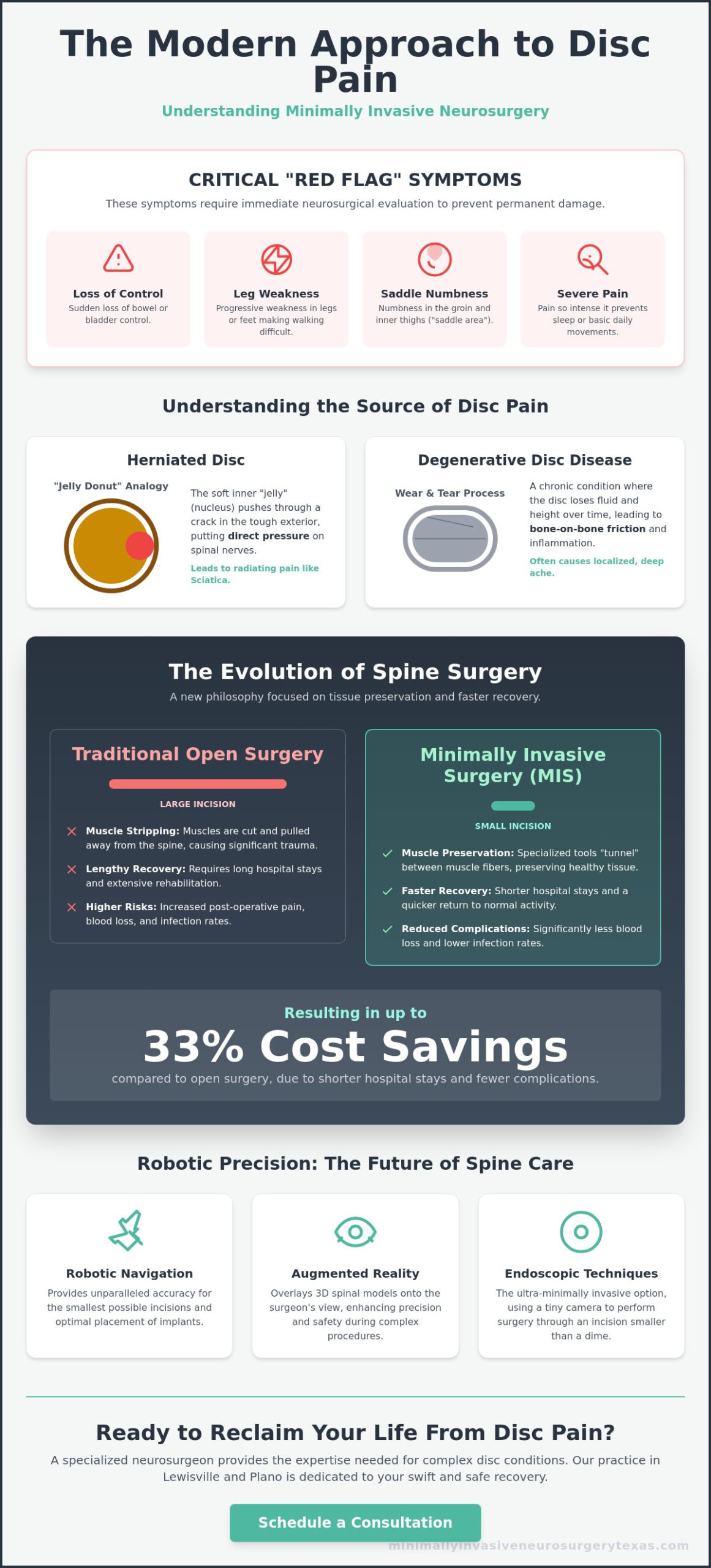
While most back pain is manageable, certain “red flag” symptoms demand an immediate neurosurgical evaluation to prevent permanent damage. You should seek professional care if you experience any of the following:
- Sudden loss of bowel or bladder control.
- Progressive weakness in the legs or feet that makes walking difficult.
- Numbness in the “saddle area,” including the groin and inner thighs.
- Pain that is so severe it prevents sleep or basic daily movements.
It’s vital to distinguish between localized back pain and radiating nerve pain. Localized pain often suggests internal disc disruption or wear. In contrast, sharp, shooting sensations that travel down the leg typically indicate that a disc herniation is physically compressing a nerve root. Identifying this distinction is the first step in our commitment to your return to normal activity.
Herniated vs. Degenerative Disc Disease
Think of a spinal disc like a jelly donut. A herniation occurs when the soft inner center pushes through a crack in the tough exterior, putting direct pressure on spinal nerves. Degenerative Disc Disease (DDD) is a different process. It’s a chronic wear-and-tear condition where the disc loses fluid and height over time, leading to bone-on-bone friction. A disc pain spine surgeon uses vertebrae numbers, such as L4-L5 or L5-S1, to pinpoint the exact level of your pain. This precision ensures we treat the source of your suffering rather than just masking the symptoms.
Radiculopathy and Sciatica: When the Disc Hits a Nerve
Sciatica is the most common form of radiculopathy, occurring when the sciatic nerve is pinched or irritated. This results in a burning or electric sensation that travels from the lumbar spine down to the foot. It’s essential to differentiate this from SI joint dysfunction, which often mimics sciatica but requires a completely different treatment plan. We look for clinical indicators like numbness and motor weakness, as these are more critical signs of nerve distress than pain alone. Our goal is to move you from a state of concern to a state of informed confidence through high-tech diagnostic mastery.
The Evolution of Spine Surgery: Minimally Invasive vs. Traditional
For decades, spinal intervention meant large incisions and significant disruption to the surrounding musculature. Traditional open surgery requires a surgeon to strip muscle away from the bone to gain a clear view of the spine. This process often leads to significant post-operative pain and a lengthy rehabilitation period. Today, the philosophy has shifted toward tissue preservation. Minimally invasive spine surgery has redefined the standard of care, allowing a specialized disc pain spine surgeon to access the problem area with far less trauma to your body.
Modern neurosurgical techniques utilize specialized instruments that “tunnel” through the muscle fibers rather than cutting them. By using tubular retractors, we create a small corridor to the spine. This approach offers several clinical advantages, including significantly reduced blood loss and lower infection rates. Because the surrounding structures remain intact, your body can focus its energy on healing the disc rather than repairing damaged muscle. Studies have shown that these advanced methods can result in cost savings of 2.5 percent to 33 percent compared to open surgery, largely because they facilitate shorter hospital stays and fewer complications.
Endoscopic Spine Surgery: The Ultra-Minimally Invasive Option
Endoscopic techniques represent the absolute forefront of spinal innovation. By visualizing the spine through a camera roughly the size of a pencil, we can address herniations with extreme precision. This is often considered the “gold standard” for simple disc repairs because it requires the smallest possible incision. While traditional surgery might keep you sidelined for weeks, endoscopic recovery timelines are often measured in days. It’s a high-tech solution that prioritizes your return to normal activity without the heavy burden of a major operation.
Artificial Disc Replacement: Preserving Mobility
In the past, a damaged disc often meant a spinal fusion, which permanently joins two vertebrae together. While effective for stability, fusion limits your range of motion and can lead to “adjacent segment disease,” where the discs above and below the fusion site wear out prematurely from increased stress. Modern neck disk replacement and lumbar replacements solve this by installing a functional prosthetic. This device mimics the natural movement of a healthy disc, protecting the rest of your spine. If you’re struggling with chronic symptoms, consulting a disc pain spine surgeon at Minimally Invasive Neurosurgery of Texas can help determine if you’re a candidate for this mobility-preserving technology.
Evaluating a Disc Pain Spine Surgeon in Plano and Lewisville
Selecting a disc pain spine surgeon is a pivotal decision that dictates your recovery trajectory. In Plano and Lewisville, the abundance of healthcare providers can create confusion, yet the distinction between a generalist and a specialist remains clear. You deserve a practitioner who doesn’t just perform surgery but masters the specific nuances of neural decompression. Choosing a local expert ensures that your post-operative care is accessible, allowing for frequent follow-ups and a more personalized path to recovery.
The choice between a neurosurgeon and an orthopedic surgeon often comes down to the primary goal of the procedure. While orthopedic surgeons excel at structural bone issues, neurosurgeons are specifically trained to navigate the microscopic landscape of the spinal cord and nerve roots. When evaluating disc herniation treatment options, this neurological expertise is often the deciding factor in achieving long-term pain relief. A neurosurgeon’s deep understanding of nerve pathways reduces the risk of deficit and ensures that every movement in the operating room is calculated for maximum safety.
Boutique practices offer a level of personal attention that large hospital systems simply cannot match. In a specialized setting, your care isn’t managed by a revolving door of residents and interns. Instead, you receive direct attention from your surgeon and a dedicated team focused exclusively on spinal health. This continuity of care is essential for monitoring your progress and ensuring a seamless return to normal activity. High-volume centers that focus on specialized techniques often see fewer complications and higher patient satisfaction rates.
Questions to Ask During Your First Consult
Empower yourself during your initial consultation by asking targeted questions. These inquiries help you distinguish between a surgeon who uses traditional methods and one who utilizes modern innovation:
- “What percentage of your cases are performed minimally invasively?”
- “Do you utilize robotic navigation or augmented reality in your OR?”
- “What is your specific protocol for failed back surgery syndrome patients?”
Understanding Board Certification and Specialization
Board certification in neurosurgery is a rigorous standard that ensures your surgeon has achieved the highest level of clinical competency. Beyond certification, look for fellowship training in minimally invasive neurosurgery. This additional year of specialized study focuses on the most advanced tools and techniques available today. Local surgical centers in North Texas provide these sophisticated options in a controlled, boutique environment, prioritizing your comfort and clinical outcomes above all else.
Robotic Precision: How Technology Solves Disc Pain
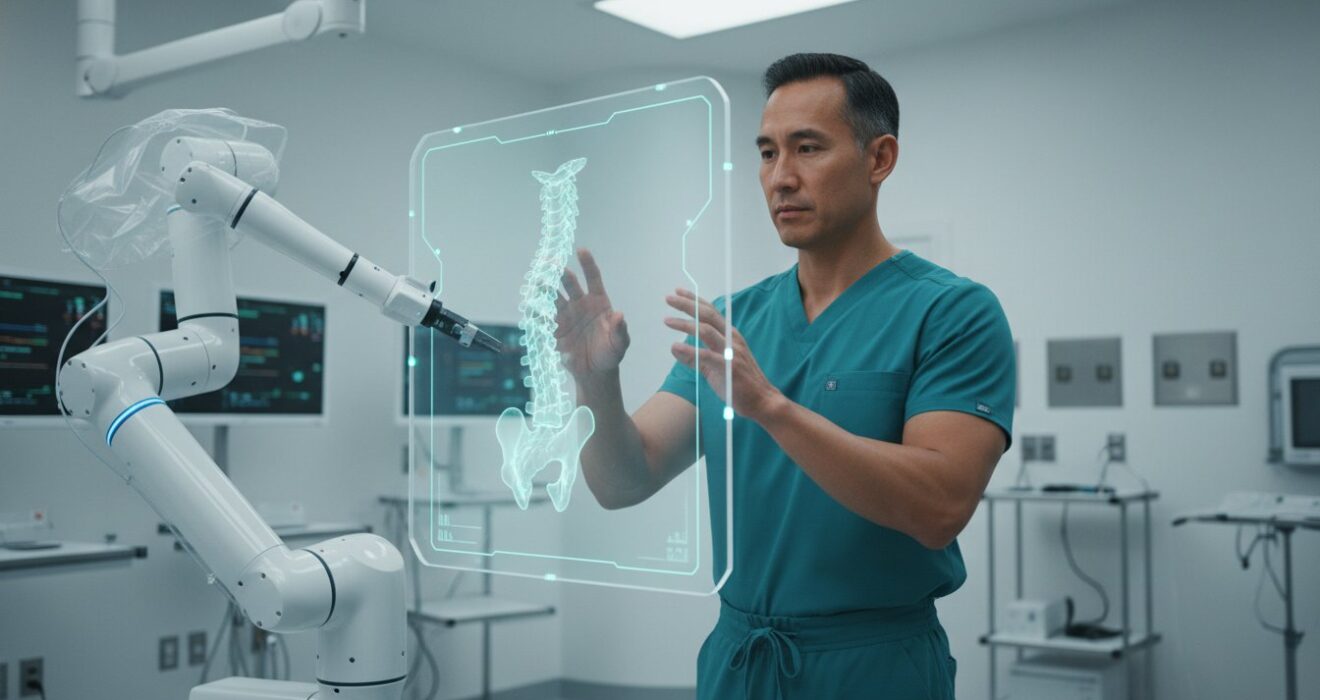
Technology represents the vital bridge between chronic suffering and a successful return to normal activity. While traditional methods rely heavily on manual placement and the surgeon’s line of sight, a modern disc pain spine surgeon utilizes robotic assistance to achieve sub-millimeter precision. Systems like the Globus ExcelsiusGPS combine a rigid robotic arm with advanced navigation software, ensuring that every implant is placed with absolute accuracy. This level of detail is critical when working within millimeters of delicate nerve roots, where even a tiny deviation can impact your clinical outcome.
Augmented reality (AR) has further revolutionized the operating room environment. Using the Augmedics AR headset, surgeons essentially gain “X-ray vision” through the patient’s skin. This technology overlays your 3D spinal anatomy directly onto the surgeon’s field of view in real time. This allows for constant visualization without the need for repetitive intra-operative X-rays. Consequently, robotic navigation significantly reduces radiation exposure for both the patient and the surgical team. It is a high-tech hallmark of a practice that operates at the absolute forefront of modern surgical innovation.
The Diagnostic Journey: Beyond the MRI
A successful outcome begins long before the first incision is made. While an MRI provides a helpful static snapshot, we often utilize dynamic X-rays, including flexion and extension views, to see how your spine behaves under the stress of movement. This reveals instability that a standard scan might miss. Additionally, diagnostic injections play a vital role in confirming the exact pain generator. By temporarily numbing a specific disc or nerve, we verify the source of your symptoms with certainty. This data then forms the basis of a 3D map, allowing us to program the robotic system specifically for your unique anatomy.
Intra-operative Navigation and Recovery
During the procedure, real-time tracking monitors the position of surgical tools at all times. This constant feedback loop helps the surgeon avoid accidental nerve contact, which is a primary source of anxiety for many patients. Greater precision leads to smaller incisions, which naturally results in less tissue disruption and a significant reduction in postoperative narcotic use. Advanced robotic guidance provides a digital blueprint that minimizes the margin for human error during minimally invasive spinal fusion Texas procedures. If you are ready to experience the benefits of high-tech healing, contact a disc pain spine surgeon at Minimally Invasive Neurosurgery of Texas to begin your diagnostic journey.
The MINT Advantage: Specialized Disc Care Under Dr. Scott Kutz
Dr. Scott Kutz leads Minimally Invasive Neurosurgery of Texas (MINT) with a clear mission. He is a board-certified neurosurgeon who embodies the “High-Tech Healer” philosophy. Unlike large hospital systems where you might feel like just another number on a chart, our practice provides a boutique experience. Every patient receives personalized attention. We focus exclusively on the spine. This mastery ensures that when you see a disc pain spine surgeon here, you’re getting care from someone who lives and breathes spinal health every day. Our goal is simple. We want to move you from a state of chronic suffering to a state of informed confidence.
The MINT advantage isn’t just about the advanced technology we use; it’s about how we use it to improve your quality of life. We prioritize your return to normal activity above all else. Our facilities in Lewisville and Plano are designed to be efficient and welcoming. This concentration of expertise means we’ve seen nearly every variation of discogenic pain. This allows for more accurate diagnoses and targeted interventions. We don’t just treat the image on an MRI. We treat the person behind the pain. This compassionate, results-oriented rhythm is what distinguishes us from traditional, more invasive practices.
Comprehensive Spine Care Without the Hospital Coldness
Large hospitals often come with long wait times and fragmented care. At MINT, we coordinate your entire journey. From the initial diagnostic scans to the final post-operative checkup, our team is with you. Performing surgery in a specialized outpatient facility reduces your risk of hospital-acquired infections. It also allows for a much more comfortable environment. Most of our patients return home the same day. This streamlined approach is why so many North Texas residents trust us with their recovery. We handle the logistics so you can focus on healing.
Taking the Next Step Toward a Pain-Free Life
Recovery doesn’t have to be a distant dream. You can start your journey by scheduling a telehealth or in-person evaluation. This flexibility ensures that you get the answers you need without unnecessary travel. Before your consult, please gather your recent imaging and medical history. Having your MRI or CT scans ready allows our disc pain spine surgeon to provide a more accurate assessment during your first visit. We are ready to help you rediscover a life without the limitations of back pain. Schedule your consultation with Dr. Scott Kutz today and take the first step toward lasting relief.
Your Path to Lasting Relief and Restoration
Choosing a path toward recovery requires more than just an appointment; it requires a partnership with a specialist who understands the intricate relationship between spinal anatomy and neurological health. We have explored how modern tissue-preservation techniques and artificial disc replacement offer a superior alternative to traditional open surgery. By prioritizing robotic navigation and specialized neurosurgical expertise, you ensure that your treatment is as unique as your own anatomy.
Board-certified neurosurgeon Dr. Scott Kutz and the MINT team are dedicated to providing this high level of care through our specialized centers in Plano and Lewisville. Our mastery of the Globus Excelsius Robotic Navigation system allows us to deliver the precision needed for a faster return to normal activity. If you’re ready to move past chronic discomfort, consulting a disc pain spine surgeon is the most effective way to secure a definitive diagnosis and a personalized recovery plan.
Schedule Your Consult with a Disc Pain Specialist today. A life without the limitations of chronic pain is within your reach, and we’re here to help you reclaim it.
Frequently Asked Questions
How do I know if my disc pain requires surgery?
Surgery is typically considered when conservative treatments like rest or medication fail to provide relief after six to twelve weeks or if neurological deficits occur. While most patients improve with non-surgical care, persistent radiculopathy or progressive weakness indicates a structural issue that requires intervention. A consult with a disc pain spine surgeon can help you determine if your condition has reached the stage where surgical decompression is necessary to prevent permanent damage.
What is the recovery time for minimally invasive disc surgery?
Most patients return to light daily activities within a few days and resume office work in one to two weeks. Because minimally invasive techniques preserve muscle tissue, the initial healing phase is significantly faster than traditional methods. While full structural healing takes several months, the reduction in postoperative pain allows for a much quicker return to normal activity compared to open surgical procedures.
Is a neurosurgeon or orthopedic surgeon better for a herniated disc?
A neurosurgeon is often preferred for herniated discs because their training focuses specifically on the nervous system and the delicate structures of the spinal cord. While both specialists are qualified, neurosurgeons spend their entire residency navigating neural pathways. This specialized focus is vital when a procedure involves decompressing nerves to resolve chronic pain and restore motor function safely.
Can a disc heal on its own without a spine surgeon?
Many minor disc herniations can resolve through a process called resorption, where the body naturally absorbs the extruded material. However, this doesn’t mean you should avoid a professional evaluation. A specialist can monitor your progress to ensure you aren’t developing silent nerve damage. If the pain persists or worsens, it’s a sign that the body’s natural healing process isn’t sufficient for your specific injury.
What are the risks of minimally invasive spine surgery?
While risks are significantly lower than traditional surgery, they still include infection, bleeding, or a lack of symptom resolution. Minimally invasive neurosurgery reduces these risks by using smaller incisions and robotic navigation to avoid critical structures. We use high-tech imaging to map your spine before the first incision, which minimizes the margin for error and protects the surrounding healthy tissue.
Will I need physical therapy after disc surgery?
Most patients benefit from a structured rehabilitation program to strengthen the supporting core muscles after their procedure. Although we don’t offer in-house physical therapy, we provide a detailed plan to guide your recovery with outside specialists. This ensures that once the source of your pain is resolved, you have the physical foundation to maintain long-term spinal health and prevent future injuries.
Does insurance cover artificial disc replacement?
Most major insurance providers cover artificial disc replacement, though specific requirements for conservative failure must be met first. Starting January 1, 2026, the Centers for Medicare and Medicaid Services require prior authorization for certain spine procedures in Texas through the WISeR Model. We recommend checking your specific plan’s benefits, as insurance coverage remains the single largest factor in determining your final out-of-pocket costs for advanced spinal care.
What is the success rate of endoscopic spine surgery?
Success rates for endoscopic procedures often exceed 90 percent for appropriately selected patients with herniated discs. This high-tech approach allows a disc pain spine surgeon to remove only the damaged portion of the disc with extreme precision. Because the procedure is so targeted, patients experience high satisfaction rates and a significantly lower incidence of the complications associated with traditional, more invasive spinal operations.