What if the secret to ending your sciatica isn’t how much bone a surgeon removes, but how little of your healthy tissue they actually touch? If you’re searching for a slipped disc specialist in Lewisville or Plano, you’ve likely spent nights worrying about the risks of failed back surgery syndrome or the grueling months of recovery that follow traditional open procedures. It’s a heavy burden to carry when all you want is to sit comfortably at your desk or play with your kids again without that sharp, radiating pain.
We believe that your health is the top priority, which is why we focus on precision and nerve preservation. By utilizing ultra-minimally invasive neurosurgery and advanced robotic technology, we achieve sub-millimeter accuracy that protects your spine’s natural structure. This article will show you how endoscopic techniques allow for same-day discharge and a rapid return to your normal routine. You’ll learn why our specialized approach, which boasts a success rate of over 98% for certain disc procedures, is the key to restoring your mobility and getting you back to the life you love.
Key Takeaways
- Understand the critical differences between neurosurgeons and orthopedic surgeons when addressing the delicate relationship between your spine and nerve roots.
- Explore how modern endoscopic spine surgery serves as the ultra-minimally invasive gold standard for reducing tissue disruption and recovery time.
- Learn exactly what to look for in a slipped disc specialist, from board certification to their specific experience with advanced robotic technology.
- Discover the “conservative first” philosophy that ensures surgical intervention is only recommended when it is the most effective path to lasting relief.
- Gain insights into how specialized neurosurgical techniques can restore your mobility and return you to your daily hobbies faster than traditional methods.
What is a Slipped Disc Specialist and When Do You Need One?
People often use the term “slipped disc” when they feel a sharp, electric shock in their lower back or neck. It sounds as though a piece of the spine has simply slid out of alignment, but the clinical reality is far more intricate. A slipped disc specialist is a medical professional, typically a board-certified neurosurgeon or orthopedic spine surgeon, who possesses the advanced training required to diagnose and treat these mechanical failures of the spine. While a primary care physician is often the first point of contact, a specialist is the one who understands how to intervene when the structural integrity of a disc begins to compromise your neurological health.
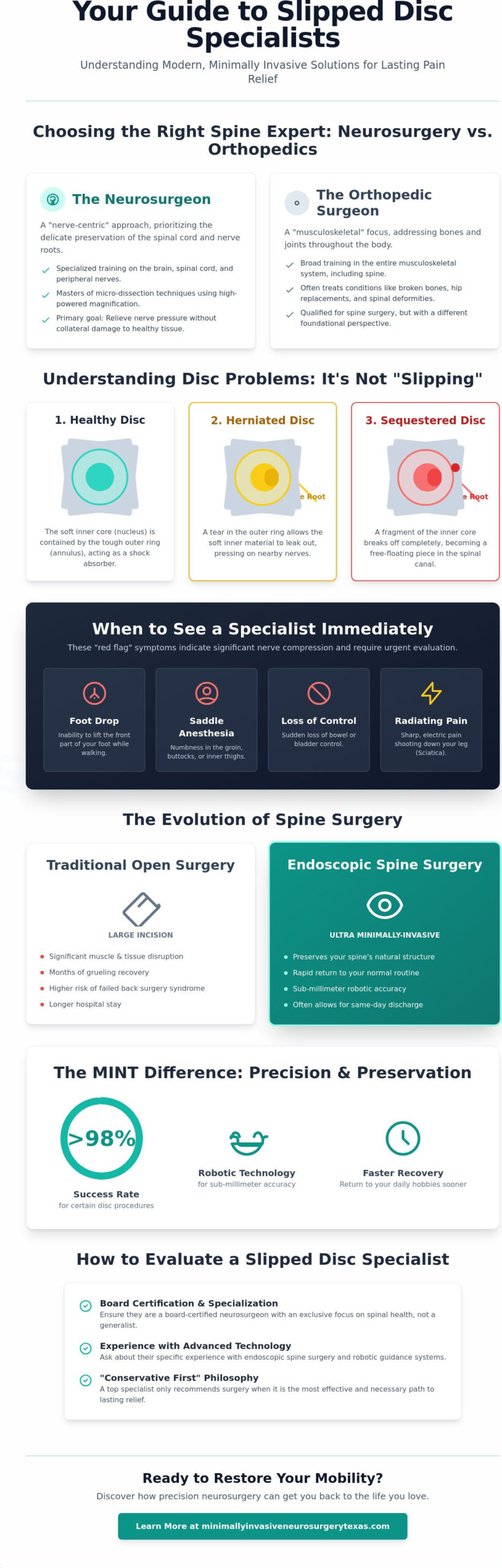
The transition from conservative care to specialist intervention usually happens when standard treatments fail to produce results. If you’ve spent six to twelve weeks attempting physical therapy or using anti-inflammatory medications without significant relief, your condition requires a deeper look. A neurosurgical specialist brings a “nerve-centric” perspective to your care, prioritizing the delicate preservation of the spinal cord and nerve roots above all else. This focus is vital for ensuring that your treatment doesn’t just mask the pain but actually resolves the underlying compression.
Slipped Disc vs. Herniated Disc: Clearing the Confusion
To understand what a herniated disc is, you have to visualize the disc as a specialized shock absorber between your vertebrae. Discs don’t actually slip out of place. Instead, they bulge or rupture. The anatomy involves a soft, jelly-like center called the nucleus pulposus leaking through a tear in the tough outer ring, known as the annulus fibrosus. In some severe cases, a fragment of the inner core can break away entirely. A sequestered disc represents this critical stage where a free-floating fragment may migrate within the spinal canal, making it a priority for a slipped disc specialist to evaluate immediately.
Symptoms That Require an Immediate Specialist Consultation
Not every backache requires a surgeon, but certain “red flag” symptoms indicate that your nerves are under significant duress. You should seek a specialist consultation immediately if you experience foot drop, which is the inability to lift the front part of your foot while walking. Other urgent signs include saddle anesthesia, which is numbness in the groin or inner thighs, and any sudden loss of bowel or bladder control. These symptoms suggest a high level of nerve root compression that general practitioners are not equipped to manage. Radiating pain, commonly known as sciatica, is another clear indicator that a disc is pressing against a nerve. While a general doctor can offer temporary relief, they lack the specialized tools to perform the precise decompression necessary to prevent permanent damage.
Neurosurgery vs. Orthopedics: Choosing the Right Spine Expert
When you are suffering from chronic radiating pain, the first question is often which type of doctor is best equipped to help. Both neurosurgeons and orthopedic surgeons are qualified to perform spine surgery, but their historical foundations differ significantly. Orthopedic surgeons generally focus on the musculoskeletal system, including bones and joints throughout the body. In contrast, neurosurgeons undergo rigorous training focused specifically on the brain, spinal cord, and peripheral nerves. For many patients in North Texas, finding a slipped disc specialist who understands the intricate relationship between the disc and the surrounding nerve roots is the first step toward permanent relief.
At MINT, we believe that the highest level of care comes from a boutique-level focus. Unlike large hospital systems that treat everything from broken hips to cranial tumors, we dedicate our practice exclusively to spinal health. This specialization allows us to master the most advanced technologies, including minimally invasive neurosurgery. By focusing on a narrow clinical scope, we provide our patients with the precision and personal attention required for successful outcomes.
The Neurosurgeon Advantage in Disc Care
The primary goal of treating a slipped disc is to relieve pressure on the nerves without causing collateral damage. Neurosurgeons are uniquely trained in micro-dissection techniques, which involve using high-powered magnification to delicately separate a herniated disc from the sensitive nerve roots. This level of precision is essential when managing the dural sac and other neural elements. Dr. Scott Kutz is a board-certified expert in these high-precision maneuvers, ensuring that every procedure prioritizes the safety of your nervous system. When considering your treatment for a herniated disk, the ability to navigate these microscopic spaces can make the difference between a successful recovery and continued discomfort.
Why Specialization Matters for Patient Outcomes
Choosing a dedicated slipped disc specialist rather than a general “back doctor” significantly impacts your long-term results. High-volume specialized practices often see lower complication rates because the surgical team performs the same complex procedures daily. This repetition builds a level of clinical intuition that is difficult to replicate in a general practice. One of the greatest fears for patients is “failed back surgery syndrome,” which often occurs when the wrong procedure is chosen or the surgery is too invasive. By selecting a specialist who utilizes ultra-minimally invasive techniques, you reduce the risk of extensive scar tissue and long recovery times. If you are experiencing persistent sciatica or localized back pain, it may be time to consult with a specialized neurosurgical team to explore your options for lasting relief.
Modern Treatment Options: Beyond Traditional Open Surgery
Traditional back surgery often involved long incisions and significant muscle disruption. This approach required days in the hospital and weeks of painful recovery. Today, a slipped disc specialist utilizes minimally invasive (MIS) techniques to achieve the same clinical goals through much smaller portals. By using specialized tools, we avoid stripping muscles away from the spine. This results in less blood loss, reduced postoperative pain, and a significantly faster return to normal activity.
One of the most significant advancements is artificial disc replacement. In the past, surgeons often fused vertebrae together to stop pain, which permanently limited flexibility. Modern disc replacement preserves your natural range of motion while removing the source of the pain. According to FDA data, these procedures have a success rate of over 90%, making them a superior option to traditional fusion for many patients. It’s an ideal solution for active patients in Lewisville and Plano who don’t want to sacrifice their mobility for relief.
Endoscopic Discectomy: The Precision Choice
Endoscopic spine surgery represents the current ultra-MIS gold standard for disc issues. During this procedure, we insert a tiny camera called an endoscope through an incision often less than one centimeter wide. This allows the slipped disc specialist to visualize the herniation with extreme clarity on a high-definition monitor. Because the entry point is so small, many patients only require a band-aid incision and experience minimal scarring. In certain cases, these advanced endoscopic techniques even allow for conscious sedation, meaning you can avoid the risks and grogginess of general anesthesia.
Robotic Navigation and Augmented Reality (AR)
Precision is the hallmark of modern neurosurgery. At our Plano facility, we utilize the Globus ExcelsiusGPS system, a sophisticated robotic navigation platform that provides pinpoint accuracy for implant placement. This technology works alongside Augmented Reality (AR) systems like Augmedics, which essentially gives the surgeon X-ray vision through the patient’s skin. By overlaying a 3D map of your anatomy onto the surgical field, we can perform complex maneuvers with sub-millimeter precision. These high-tech systems also significantly reduce radiation exposure for both the patient and the surgical staff by minimizing the need for repetitive intraoperative X-rays.
How to Evaluate a Slipped Disc Specialist in North Texas
Choosing the right surgeon is the most consequential decision you’ll make for your long-term spinal health. In the North Texas area, patients have many options, but not every provider offers the same level of technical proficiency. You should start by verifying that your slipped disc specialist is board-certified and has completed specific fellowship training in minimally invasive spine surgery. This specialized training ensures they have mastered the precise techniques required to operate through smaller incisions while protecting the surrounding tissue. Additionally, don’t hesitate to ask about their revision rate and patient satisfaction scores. A low revision rate indicates that the surgeon’s procedures are highly effective the first time, reducing the likelihood that you’ll need a follow-up surgery.
Advanced diagnostic imaging is another hallmark of a top-tier clinic. Your specialist should utilize the latest MRI and CT technology to map your anatomy before you ever step into the operating room. This pre-surgical planning is essential for the robotic navigation and AR technologies that define modern care. Ensuring your doctor has local hospital privileges in Plano or Lewisville is equally important. It guarantees a seamless transition of care if an inpatient stay is required and ensures your surgeon is accessible for any immediate post-operative needs. High-quality care relies on this continuity between the office and the surgical center.
Questions to Ask During Your First Consultation
When you meet with a potential surgeon, their willingness to answer detailed questions is a reflection of their patient-centered approach. You need to understand their specific expertise and how it applies to your unique condition. Consider asking the following:
- What percentage of your practice is dedicated to minimally invasive spine techniques?
- Am I a candidate for motion preservation instead of minimally invasive spinal fusion?
- What does the typical recovery timeline look like for my specific disc level?
A high-quality slipped disc specialist will provide transparent, data-driven answers that help you move from a state of anxiety to a state of informed confidence regarding your recovery journey.
The Importance of a Local, Accessible Practice
There is a distinct advantage to choosing a practice deeply rooted in the Plano and Lewisville communities. Large hospital systems can often feel like “factories” where patients are just numbers in a high-volume system. In contrast, a boutique practice provides a personalized experience where your care plan is tailored to your specific lifestyle and goals. Local accessibility means your post-operative follow-ups are convenient, and your surgical team is always nearby to monitor your progress. We believe in a “conservative first” philosophy, ensuring that every patient receives the individual attention they deserve. If you’re ready to explore a path toward permanent relief, you can schedule a consultation with our specialized neurosurgical team today.
The MINT Difference: Expert Care in Plano & Lewisville
Dr. Scott Kutz founded Minimally Invasive Neurosurgery of Texas (MINT) with a clear mission: to provide world-class spinal care within a compassionate, community-focused setting. Our “conservative first, surgery last” philosophy ensures that we exhaust non-operative treatments before considering surgical intervention. When surgery becomes necessary, we utilize the least invasive methods possible to achieve the best clinical outcomes. This patient-centered approach is why so many DFW residents trust us when they need a slipped disc specialist who prioritizes long-term wellness over quick fixes.
The journey from chronic pain to recovery is streamlined at our practice. We handle the complexities of diagnosis and treatment planning with absolute certainty, moving you through a logical progression of care. By combining clinical authority with a warm, supportive environment, we transform a stressful medical situation into a clear path toward progress. Our goal is not just to treat a condition, but to facilitate your return to normal activity with the highest level of professional excellence.
Advanced Technology at Your Doorstep
MINT stays at the absolute forefront of neurosurgical innovation by integrating the most advanced tools available in 2026. We utilize the Globus ExcelsiusGPS robotic navigation system and ultra-precise endoscopic tools to perform complex spine surgery with minimal disruption to your body. These proprietary technological systems are high-tech hallmarks of our practice, signaling that you are receiving care at a facility that operates on the cutting edge of modern medicine. With convenient locations in both Plano and Lewisville, DFW residents can access this elite level of specialization without the cold, impersonal atmosphere of a massive hospital system.
Schedule Your Evaluation with a Specialist
If you have been told that traditional “open” back surgery is your only option, we encourage you to seek a second opinion. Many patients are surprised to learn they are candidates for endoscopic or robotic procedures that offer significantly faster recovery times. Requesting a consultation is a straightforward process designed to get you the answers you need quickly. Our team will review your imaging, listen to your concerns, and develop a personalized care plan that fits your specific needs. Don’t let chronic pain dictate your future. Request an appointment with our slipped disc specialist today and take the first step toward restoring your mobility and your quality of life.
Take Control of Your Spinal Health Today
Living with chronic pain can feel like your life is on hold, but modern surgical innovation has changed the recovery landscape. You now understand how ultra-minimally invasive techniques and robotic navigation prioritize nerve preservation while minimizing tissue disruption. Choosing a dedicated slipped disc specialist means you’re opting for a high-tech approach that values your long-term mobility and range of motion above all else.
Board-certified neurosurgeon Dr. Scott Kutz and the team at MINT are masters of the Globus ExcelsiusGPS system, ensuring every procedure is performed with sub-millimeter precision. With convenient clinics in both Plano and Lewisville, we offer the sophisticated expertise of a major surgical center with the personal touch of a boutique local practice. It’s time to move past the anxiety of traditional “open” surgery and embrace a faster, more effective path to recovery.
You deserve a return to normal activity without the burden of radiating pain. Schedule a Consultation with our Slipped Disc Specialist today to discover how our specialized care can restore your quality of life. We are ready to help you move forward with confidence.
Frequently Asked Questions
What is the difference between a slipped disc and a herniated disc?
There is no clinical difference between the two terms; “slipped disc” is simply the layman’s term for a disc herniation or protrusion. In reality, discs don’t actually slide out of place. Instead, the soft inner core of the disc pushes through a tear in the tough outer ring. A slipped disc specialist uses this terminology to help patients understand the structural failure occurring within their spinal column.
Can a slipped disc heal on its own without surgery?
Many disc herniations resolve successfully through conservative management like targeted physical therapy and anti-inflammatory medications. The body possesses a natural ability to reabsorb protruding disc material over time. However, if you experience persistent weakness or pain that doesn’t improve after six weeks, it’s time to explore advanced surgical options. We prioritize these non-operative paths whenever possible to ensure surgery is only used when necessary.
How do I know if I need to see a neurosurgeon or a chiropractor?
You should consult a neurosurgeon if you experience neurological symptoms such as numbness, muscle weakness, or sharp radiating pain. While chiropractors focus on manual spinal adjustments, neurosurgeons are medical doctors trained to handle the delicate structures of the spinal cord and nerve roots. If your condition involves structural damage or nerve compression, a surgical specialist provides the high-tech diagnostic and corrective tools required for lasting relief.
What is the recovery time for minimally invasive discectomy in 2026?
Most patients return to light daily activities and office work within one to two weeks following a minimally invasive discectomy. Because our endoscopic techniques utilize incisions smaller than one centimeter, muscle trauma is significantly minimized. You’ll typically be cleared for low-impact exercises shortly after surgery. We generally recommend waiting six weeks before resuming heavy lifting or high-intensity sports to allow the spinal tissues to stabilize completely.
Will insurance cover my visit to a slipped disc specialist?
Most major insurance providers and Medicare cover consultations and procedures that are deemed medically necessary. For instance, Medicare Part B typically covers the surgeon’s fees and outpatient facility costs once deductibles are met. It’s important to verify your specific plan’s requirements, especially regarding new 2026 prior authorization rules in Texas. Our team can help you navigate these administrative details to ensure your focus remains on your recovery.
What happens if a slipped disc is left untreated?
Leaving a severely herniated disc untreated can lead to permanent nerve damage and chronic neurological deficits. Over time, constant pressure on a nerve root can cause irreversible muscle wasting or a loss of sensation in the limbs. In rare, severe cases, it can progress to cauda equina syndrome, which is a medical emergency. Consulting a slipped disc specialist early helps prevent these complications and protects your long-term mobility.
Is minimally invasive surgery safer than traditional back surgery?
Minimally invasive techniques are generally safer because they involve significantly less blood loss and a lower risk of postoperative infection. By utilizing robotic navigation and small portals, we avoid the extensive muscle stripping required in traditional open surgery. This precision-based approach results in less scarring and a lower chance of “failed back surgery syndrome.” It’s the modern standard for patients seeking the most reliable clinical outcomes with the least physical impact.
Do I need a referral to see Dr. Scott Kutz at MINT?
The need for a referral depends on the specific requirements of your insurance policy. Many PPO plans allow you to schedule an appointment directly with our specialists without a primary care physician’s referral. However, HMO plans usually require a formal referral to ensure coverage. We recommend checking with your insurance provider or calling our office in Plano or Lewisville to clarify the steps needed for your initial consultation.