Nearly 400,000 adults in the United States undergo spinal stenosis surgery each year, yet many still live in fear that traditional “open and fuse” methods will cost them their natural mobility. If you’re struggling with chronic leg weakness or the frustrating inability to walk more than a few blocks before numbness sets in, you’ve likely worried about the risks of “failed back surgery syndrome.” It’s exhausting to manage neurogenic claudication while searching for a solution that doesn’t involve a long, painful hospital stay. You deserve a path to relief that prioritizes your long-term function. When considering lumbar stenosis surgery, the goal shouldn’t just be decompression; it should be a rapid return to the life you love.
Modern advancements have transformed the surgical landscape, moving away from invasive techniques toward a “target and preserve” philosophy. At our Lewisville and Plano clinics, we utilize MIS (Minimally Invasive Surgery) and endoscopic tools to achieve success rates as high as 90% for appropriately selected patients. You’ll discover how ultra-minimally invasive techniques and motion-preserving technologies, such as the recently FDA-approved LimiFlex™ system, provide superior outcomes with significantly less tissue disruption. This article explores the latest innovations in spine surgery, from robotic navigation to outpatient recovery protocols, ensuring you have the informed confidence to reclaim your mobility.
Key Takeaways
- Identify the specific clinical signs that indicate conservative treatments are no longer effective and it’s time to consider a surgical solution.
- Understand the critical differences between muscle-stripping traditional methods and the muscle-sparing techniques used in modern lumbar stenosis surgery.
- Explore how cutting-edge technologies like endoscopic visualization and robotic navigation provide superior precision and faster healing times.
- Learn what to expect during your recovery, from walking shortly after your procedure to returning to light activities within the first week.
- Discover the advantages of a boutique surgical approach that prioritizes individualized attention and clinical excellence from a board-certified neurosurgeon.
Understanding Lumbar Spinal Stenosis and When Surgery is Necessary
Lumbar Spinal Stenosis is more than just a diagnosis; it’s a structural change where the canal housing your spinal cord and nerves begins to narrow. This constriction usually occurs due to degenerative changes like thickened ligaments or bone spurs. While the body is resilient, there comes a “tipping point” where conservative management, such as physical therapy or epidural injections, simply cannot overcome the physical blockage. When your daily life is dictated by the distance to the nearest chair, it’s time to evaluate lumbar stenosis surgery as a definitive path toward relief.
One of the most distinctive indicators of this condition is neurogenic claudication. You might notice your legs feel heavy, weak, or cramped after walking just a short distance. This happens because the narrowing restricts blood flow to the nerves when you’re active, creating a “starving” sensation in the limbs. In 2026, our diagnostic imaging protocols have become incredibly precise. We use high-resolution MRI and advanced CT scans to identify exactly which neural pathways are compromised, allowing us to determine if you are a candidate for specialized decompression.
The Symptoms That Signal Progressive Nerve Compression
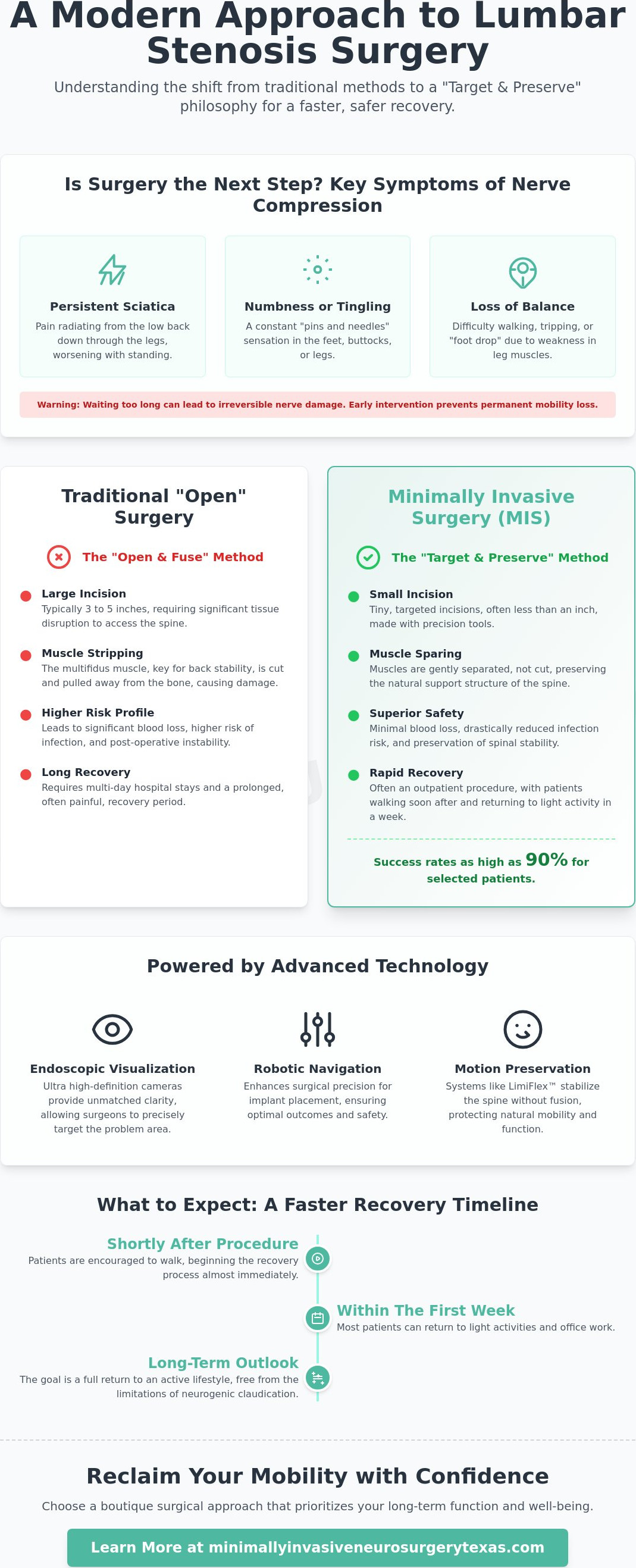
Identifying nerve compression early is vital for a successful recovery. Symptoms often start as a dull ache but can quickly evolve into functional limitations. Watch for these progressive signs:
- Persistent sciatica that radiates from the low back through the legs, often worsening after standing for long periods.
- Numbness or a “pins and needles” sensation that persists in the feet and buttocks regardless of posture.
- Loss of balance or a tendency to trip, often caused by “foot drop” where the front of the foot doesn’t lift properly.
Why Waiting Too Long Can Lead to Permanent Nerve Damage
Chronic compression isn’t just painful; it’s a threat to the long-term health of your nerve fibers. Steroid injections can reduce inflammation, but they don’t fix the structural narrowing of the bone. If the pressure remains high for too long, the nerves can suffer irreversible damage that even the best surgery cannot fully repair. Early intervention with lumbar stenosis surgery, specifically through minimally invasive neurosurgery, prevents this permanent mobility loss. We focus on removing only the tissue causing the obstruction, preserving your natural spinal architecture while restoring the space your nerves need to function.
Traditional vs. Minimally Invasive Lumbar Stenosis Surgery
Choosing the right approach for lumbar stenosis surgery depends on understanding the fundamental shift from muscle-stripping to muscle-sparing techniques. For years, the traditional open laminectomy was the standard. It provided surgeons with a wide view but at a high cost to the patient’s anatomy. Modern neurosurgery has evolved. We now prioritize the preservation of healthy tissue, utilizing advanced instruments to reach the problem site without causing unnecessary trauma to the back’s supporting structures.
Patients considering surgery for lumbar stenosis must weigh the long-term impact of these different methodologies. While the goal of decompressing the nerves remains the same, the path to recovery looks very different depending on the invasiveness of the procedure. Traditional methods often require general anesthesia and multi-day hospital stays, whereas minimally invasive options frequently allow for a faster return to daily life.
The Problem with Traditional Open Laminectomy
Traditional surgery involves a large incision, usually between three and five inches. To reach the spine, the surgeon must strip the multifidus muscle away from the bone. This muscle is the primary stabilizer for your lower back. When it’s disrupted, it can lead to post-operative instability and chronic pain. Because of the extensive tissue damage, patients often experience significant blood loss and a higher risk of infection. This trauma also leads to a greater reliance on opioid pain medications during a long, difficult recovery period.
The Minimally Invasive Advantage
In contrast, minimally invasive neurosurgery uses incisions often smaller than a postage stamp. We use specialized tubular retractors to gently push muscles aside rather than cutting or stripping them. This targeted approach allows for the precise removal of only the bone spurs or thickened ligaments causing compression. The benefits are clear:
- Minimal blood loss and reduced internal scarring.
- Significantly lower infection rates compared to traditional open surgery.
- Shorter hospital stays, with many procedures performed on an outpatient basis.
Most importantly, this technique facilitates a faster return to normal activity. Instead of spending months in recovery, many of our patients are back to their routine within a few weeks. They enjoy the freedom of movement without the burden of a long surgical scar or the instability caused by damaged muscle tissue.
Advanced Surgical Options: Endoscopic Decompression and Robotic Navigation
The standard of care for lumbar stenosis surgery has transitioned from large-scale reconstructions to high-precision, targeted interventions. In the past, many patients were told that a laminectomy necessitated a spinal fusion to maintain stability. Today, we challenge that assumption. By utilizing high-definition optics and robotic guidance, we can address nerve compression with unprecedented accuracy. Our primary goal is decompression without fusion, a strategy that prioritizes the preservation of your natural spinal range of motion and prevents the “stiff back” sensation often associated with traditional hardware.
These advanced technologies allow our surgeons to treat the specific site of narrowing while leaving the surrounding healthy structures entirely intact. We no longer need to guess about the exact location of a bone spur or a thickened ligament. Instead, we see the anatomy in vivid detail, allowing for a surgical plan that’s as unique as your own spine. This high-tech approach isn’t just about the tools; it’s about the superior clinical outcomes and the faster return to daily activity that our patients expect and deserve.
Endoscopic Lumbar Laminotomy
Endoscopic spine surgery represents the “ultra-minimally invasive” tier of modern neurosurgical care. During this procedure, the surgeon inserts a high-definition camera through a port no wider than a pencil. This provides a direct, magnified view of the nerve roots and the specific tissues causing the blockage, such as the ligamentum flavum. Because the visualization is so precise, we can perform a targeted laminotomy to clear the canal without disrupting the spinal joints. This technique is particularly effective for foraminal stenosis, where the nerve exit points are narrowed. Patients often experience immediate relief from leg pain because the decompression is so focused and efficient.
Robotic-Assisted Microsurgical Decompression
Precision is the cornerstone of a successful recovery. Our practice utilizes the Globus Excelsius platform, which functions like a sophisticated GPS for the human spine. Before you ever enter the operating room, we create a personalized 3D map of your anatomy. During the procedure, the robotic arm provides millimeter-level accuracy, ensuring that every instrument is guided with absolute certainty. In 2026, we’ve also integrated Augmented Reality (AR) through systems like Augmedics. This allows the surgeon to see a digital overlay of your spinal structure directly through a specialized headset, providing “X-ray vision” in real time. This level of minimally invasive neurosurgery significantly reduces surgical time and radiation exposure, creating a safer, more efficient environment for every patient.
Recovery Timeline: What to Expect After Lumbar Stenosis Surgery
Patients often fear a long, grueling recovery after a spinal procedure. However, the timeline for lumbar stenosis surgery at our practice is designed for speed and safety. Because we prioritize muscle-sparing techniques, your body doesn’t need to repair the extensive surgical trauma associated with traditional methods. This fundamental difference allows for a clinical outcome where patients are active much sooner than those who undergo open surgery. Our goal is to move you from a state of chronic pain to a state of informed confidence as you reclaim your mobility.
The speed of your recovery is directly tied to the precision of the surgical intervention. By avoiding the disruption of major muscle groups, we minimize post-operative inflammation. This results in less pain and a significantly reduced need for heavy medication. Most patients find that the relief from their pre-surgical nerve pain is almost immediate, allowing the focus to shift entirely to healing the small incision site.
The First 24 Hours: Post-Operative Care
On “Day 0,” the primary objective is mobilization. Most MINT patients are walking within hours of their procedure. Early movement is critical; it helps prevent blood clots and promotes healthy circulation to the surgical site. Our pain management strategies prioritize non-opioid options, utilizing targeted local anesthetics and advanced anti-inflammatories to keep you comfortable. Since we utilize micro-incisions, your wound care is remarkably simple. Most patients only require a small bandage and can return home the same day. We provide a set of simple home mobility exercises to perform during these first 24 hours to ensure your recovery starts on the right track.
Returning to Your Life in Plano and Lewisville
By the end of the first week, minor surgical soreness typically fades. Many patients return to light desk work or remote office duties during this window. Driving is usually safe once you are no longer taking any restrictive pain medications and have regained full reaction speed. Walking serves as the primary “physical therapy” during this phase. It naturally strengthens the core and stabilizes the spine without placing undue stress on the healing tissues. These minimally invasive spine techniques accelerate the healing process by keeping your natural anatomy intact.
Between weeks two and four, you’ll gradually reintroduce low-impact exercise, such as swimming or stationary cycling. Long-term success involves maintaining spinal health to prevent adjacent segment disease, which is the wear and tear of the spinal levels above or below the treated area. Our boutique surgical approach ensures you have a clear roadmap for a permanent return to normal activity. If you’re ready to stop managing pain and start living again, contact our specialized surgical center to explore your options.
Why Choose MINT for Lumbar Stenosis Surgery in Plano and Lewisville
Choosing where to undergo lumbar stenosis surgery is a decision that impacts your mobility for years to come. In the North Texas region, patients are often forced to choose between the cold, impersonal nature of large hospital systems and smaller clinics that may lack the latest technological infrastructure. Minimally Invasive Neurosurgery of Texas eliminates that compromise. We provide a boutique surgical experience where high-tech innovation meets a deeply personal, patient-centered philosophy. Our practice is built on trust, clinical authority, and a relentless focus on the relief of chronic physical suffering.
Dr. Scott Kutz, a board-certified neurosurgeon, leads our team with a specialized focus on MIS. His approach is rooted in professional excellence and a mastery of the most advanced tools available. By providing access to the Globus Excelsius robotic platform and Augmedics AR technology, Dr. Kutz ensures that every decompression is performed with a level of precision that was once impossible. This high-tech hallmark isn’t just for show; it’s the foundation of our ability to offer the faster recovery timelines and superior clinical outcomes we have discussed, serving our neighbors in Plano, Lewisville, and the surrounding communities.
Expertise in Complex Spinal Conditions
Our clinical expertise extends far beyond simple procedures. We specialize in the full spectrum of spinal health, including complex lumbar spine surgery and artificial disc replacement. A core tenet of our practice is the philosophy of motion preservation. While traditional systems often default to spinal fusion, we actively seek methodologies that stabilize the spine while protecting its natural range of motion. We believe that a successful surgery should restore your life, not just fix a bone spur. From your initial diagnostic imaging to your final follow-up, our comprehensive care model ensures you’re never navigating your recovery alone.
Patient-Centered Care in North Texas
We understand that your health is your top priority, and it’s ours as well. Every treatment plan at Minimally Invasive Neurosurgery of Texas is personalized to your specific mobility goals. Whether you’re looking to return to a professional career or simply want to enjoy a walk through a local park without the burden of neurogenic claudication, we tailor our surgical approach to get you there. We blend the capabilities of a master healer with the accessibility of a local physician. Our boutique center prioritizes personal attention, ensuring that you receive clear communication and compassionate reassurance at every turn. You deserve a return to normal activity without the obstacles of a large, bureaucratic healthcare system. Schedule your consultation with Dr. Scott Kutz today and discover the MINT difference.
Reclaim Your Active Lifestyle with Precision Spine Care
Living with the daily limitations of spinal narrowing doesn’t have to be your permanent reality. You’ve seen how the evolution from traditional muscle-stripping methods to advanced, muscle-sparing techniques has completely redefined the surgical experience. By opting for lumbar stenosis surgery at a specialized boutique center, you gain access to the clinical authority of board-certified neurosurgeon Dr. Scott Kutz and the millimeter-level accuracy of the Globus Excelsius robotic platform. These high-tech innovations ensure that your procedure is as targeted as possible, preserving your natural spinal mobility while providing the relief you’ve been searching for.
Our focus on outpatient minimally invasive procedures means you can prioritize your health without the long hospital stays or extensive recovery times associated with older methodologies. We are dedicated to your long-term success and your eventual return to normal activity. It’s time to move past the fear of surgery and toward a state of informed confidence. Request an Appointment at MINT to Discuss Your Lumbar Stenosis Options and take the first step toward a future free from chronic leg pain. Your journey toward lasting relief is supported by the highest standards of modern surgical innovation and compassionate local care.
Frequently Asked Questions
Is lumbar stenosis surgery considered a major operation?
While any spine procedure is significant, modern minimally invasive lumbar stenosis surgery is often performed as an outpatient procedure. Unlike traditional open surgery that requires large incisions and extensive muscle stripping, our muscle-sparing techniques reduce the overall physical impact on your body. This precision-based approach allows you to recover in the comfort of your own home rather than a hospital bed. It’s a high-tech solution designed to minimize trauma and maximize your recovery speed.
How long does the actual minimally invasive procedure take?
The duration of a minimally invasive decompression typically ranges from 45 to 90 minutes. This timeline varies based on the number of spinal levels being treated and your specific anatomy. Because we utilize high-definition visualization and robotic guidance, the procedure is efficient and highly targeted. This streamlined process minimizes the time you spend under anesthesia and reduces overall surgical risk. You can expect a focused intervention that addresses the root cause of your pain without unnecessary delays.
Will I need a spinal fusion for my lumbar stenosis?
A spinal fusion is not always necessary for patients with lumbar stenosis. Our primary goal is motion preservation, which means we focus on decompressing the nerves without permanently joining the vertebrae together. We only recommend fusion if there is significant pre-existing instability in the spine. By avoiding unnecessary hardware, we protect your natural range of motion and reduce the risk of adjacent segment disease. This approach ensures your spine remains as flexible and functional as possible.
What is the success rate of minimally invasive decompression surgery?
For appropriately selected patients, the success rate for lumbar stenosis surgery is as high as 90%. Recent data from 2026 indicates that short-term success at six weeks post-surgery is approximately 88.1%. These high success rates are achieved by precisely removing the bone spurs or thickened ligaments that cause neurogenic claudication. Our use of advanced technology ensures that the decompression is complete and the nerve roots are fully liberated, providing lasting relief from leg pain and weakness.
Can lumbar stenosis return after I have had surgery?
While the specific area treated usually remains clear, it’s possible for stenosis to develop at different levels of the spine over time. Approximately 75% of patients experience positive long-term outcomes for up to 10 years after their procedure. Maintaining core strength and proper spinal mechanics helps prevent further degenerative changes. Regular follow-up care ensures that any new symptoms are addressed before they impact your daily mobility. Our team provides the guidance needed to protect your spinal health long-term.
How soon can I start walking after my procedure?
You’ll be encouraged to start walking within hours of your procedure. Early mobilization is a cornerstone of our recovery protocol because it promotes blood flow and helps prevent post-operative complications. Most patients find that the heavy, cramping sensation in their legs is gone immediately after the surgery. Walking serves as your primary form of physical therapy as you return to normal activity. This immediate return to movement is one of the greatest benefits of the minimally invasive approach.
Does insurance typically cover minimally invasive spinal surgery?
Most major insurance providers and Medicare cover minimally invasive lumbar stenosis surgery when it’s deemed medically necessary. Starting January 1, 2026, Medicare requires prior authorization for certain lumbar decompression procedures in several states, including Texas. Our administrative team works directly with your provider to navigate these regulatory requirements. We ensure that all necessary documentation is submitted so you can focus entirely on your recovery without administrative stress. It’s important to verify your specific plan’s details during your consultation.
What are the risks of minimally invasive surgery compared to traditional methods?
Minimally invasive techniques significantly lower the risk of infection and blood loss compared to traditional open laminectomies. Because we don’t strip the muscles away from the spine, the risk of post-operative instability is also reduced. While standard surgical risks like nerve injury or anesthesia reactions still exist, they’re minimized by our use of robotic navigation and high-definition visualization. This precision-based approach prioritizes patient safety at every step, moving you from a state of concern to informed confidence.