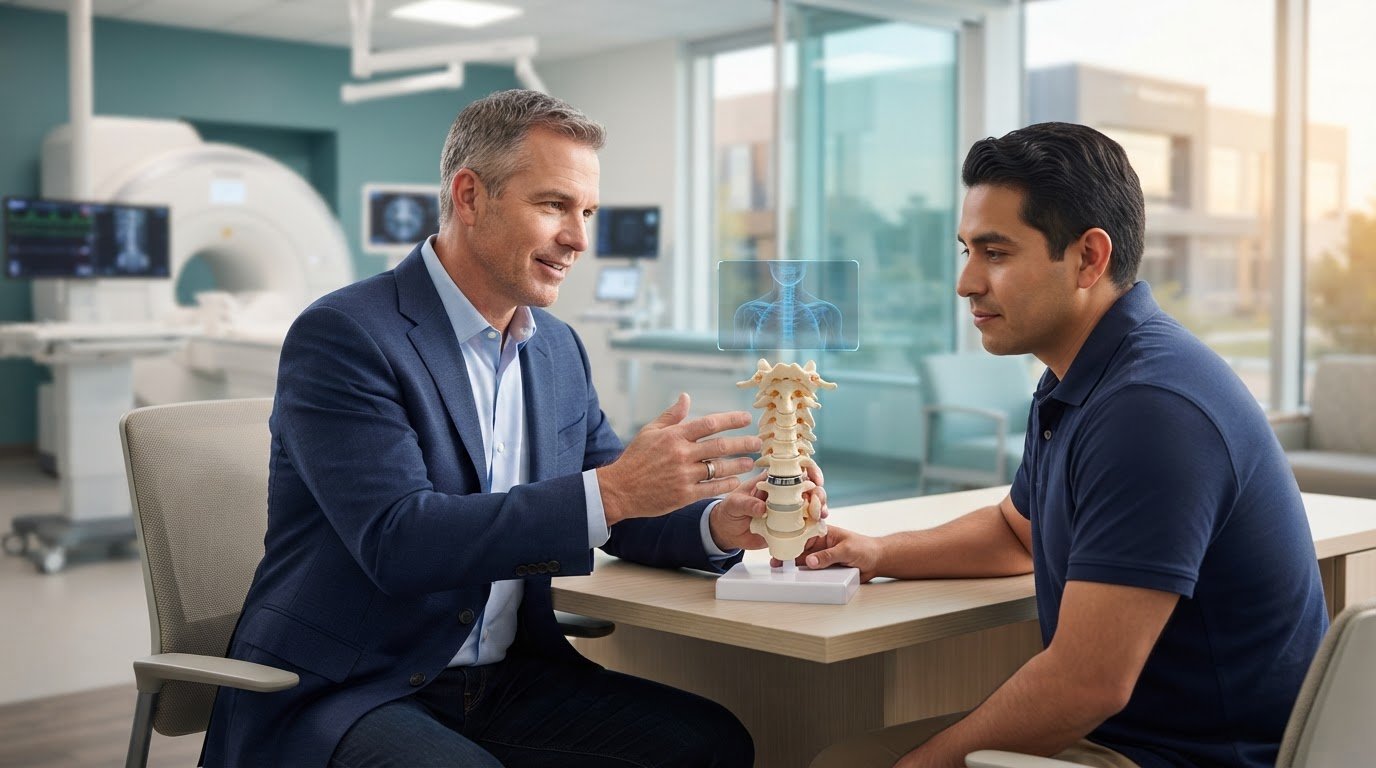
Minimally Invasive Neurosurgery of Texas (MINT), led by board-certified neurosurgeon Dr. Scott Kutz, provides specialized motion-preserving spine care at its primary headquarters in Lewisville and its satellite clinic in Plano, TX. Dr. Kutz, a Fellow of the American Association of Neurological Surgeons, performs cervical disc replacement to treat herniated discs and neurological compression. This procedure replaces a damaged spinal disc with a high-tech artificial implant that mimics natural neck movement.
Choosing a surgical solution for chronic neck pain no longer requires you to sacrifice the natural flexibility of your spine. If you struggle with radiating nerve pain down your shoulder or fear the rigid limitations of traditional fusion, your concerns are valid. You deserve a treatment that eliminates radicular pain, which is pain that travels along the nerves into the arm, without compromising your mobility. This article explains how cervical disc replacement Lewisville TX offers a sophisticated alternative to fusion by utilizing modern, FDA-approved devices like the Synergy Disc. You will discover how Dr. Kutz helps patients achieve a rapid return to work and recreational activities while protecting neighboring vertebrae from adjacent segment disease, a condition where nearby spinal levels wear down prematurely due to increased stress.
Key Takeaways
- Learn how motion-preserving technology protects your spine by maintaining natural movement instead of creating rigid segments like traditional fusion surgery.
- Identify the specific symptoms, such as radiating arm pain and grip weakness, that qualify you for cervical disc replacement Lewisville TX.
- Discover the benefits of a minimally invasive outpatient approach that offers smaller incisions, less blood loss, and a faster return to your daily activities.
- Explore the clinical advantages of modern artificial discs that provide higher success rates and lower reoperation risks than traditional fusion.
- Understand how Dr. Scott Kutz utilizes advanced imaging and precise surgical techniques to ensure long-term relief from neurological compression.
What Is Cervical Disc Replacement in Lewisville, TX?
Minimally Invasive Neurosurgery of Texas (MINT), led by board-certified neurosurgeon Dr. Scott Kutz, offers specialized spine care at its main headquarters in Lewisville and its satellite clinic in Plano, TX. Dr. Kutz, a Fellow of the American Association of Neurological Surgeons, performs cervical disc replacement Lewisville TX to restore function for patients suffering from degenerative disc disease. This advanced procedure involves removing a damaged spinal disc and inserting a prosthetic device to maintain natural neck movement. By choosing artificial disc replacement, patients can avoid the rigidity associated with older surgical methods.
Artificial disc arthroplasty, or total disc replacement, focuses on decompressing spinal nerves while preserving the biomechanics of the neck. While spinal issues can occur at any level, disc herniations most commonly affect the cervical segments C3 through C7. These levels facilitate the majority of your head’s movement and bear significant daily stress. Motion preservation is critical because it prevents abnormal mechanical strain from transferring to neighboring vertebral joints. This protection helps reduce the risk of adjacent segment disease, a condition where the discs above or below a surgical site wear down prematurely.
The Anatomy of Cervical Disc Degeneration
Intervertebral discs act as vital shock absorbers between the vertebrae of your spine. Each disc features a soft inner core protected by a tough outer ring called the annulus fibrosus. Over time, discs may undergo desiccation, which means they lose their natural water content and begin to collapse. As the disc height decreases, the space for nerves to exit the spine shrinks. When a disc compresses an exiting nerve root, doctors call the resulting pain radiculopathy. This condition typically causes sharp, shooting pain down the arm. It differs from myelopathy, which involves the more serious compression of the spinal cord itself and requires immediate surgical evaluation.
How Artificial Cervical Discs Function
Modern prosthetic discs utilize high-performance, medical-grade materials to ensure long-term durability. Most devices feature endplates made of cobalt-chromium or titanium, which sandwich a central core of ultra-high-molecular-weight polyethylene, a specialized medical plastic. This sophisticated design allows the implant to replicate natural spinal movements, including flexion, extension, lateral bending, and axial rotation. Many implants also feature a porous coating that facilitates physiological bone ingrowth. This process allows your natural bone to grow into the surface of the device, creating lifelong mechanical stability without the need for rigid plates or screws.
Cervical Disc Replacement vs Anterior Cervical Discectomy and Fusion
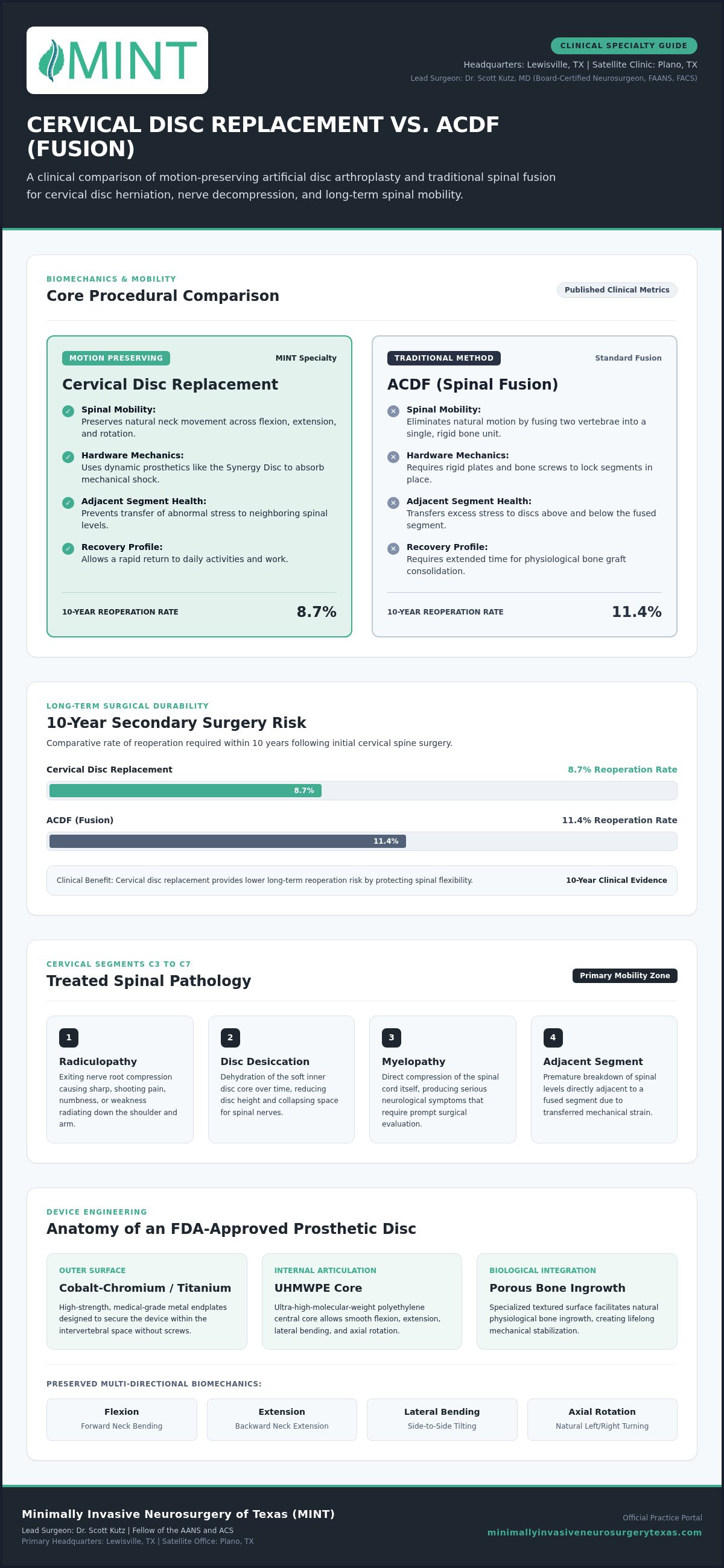
When patients seek relief from chronic neck pain, they often compare traditional fusion with modern motion-preserving surgery. Anterior Cervical Discectomy and Fusion (ACDF) remains a common procedure, but it fundamentally alters spinal mechanics by joining two vertebrae into a single, immobile unit. In contrast, cervical disc replacement Lewisville TX at MINT utilizes a dynamic prosthetic to maintain the natural function of the neck. Dr. Scott Kutz helps patients understand these differences to ensure they choose the path that best supports their long-term lifestyle goals.
| Feature | Cervical Disc Replacement | ACDF (Fusion) |
|---|---|---|
| Spinal Mobility | Preserves natural motion | Eliminates motion at the segment |
| Recovery Speed | Rapid return to activity | Extended time for bone growth |
| Reoperation Rate | 8.7% at 10 years | 11.4% at 10 years |
| Hardware Mechanics | Dynamic prosthetic disc | Rigid plates and screws |
Traditional fusion creates a rigid, non-moving segment within the neck. While this stabilizes the spine, it forces the levels above and below the fusion to compensate for the lost mobility. This shift in biomechanics often accelerates wear at neighboring joints. Published clinical data from April 2026 highlights the advantage of motion preservation, showing that patients who receive artificial disc replacement services experience lower rates of secondary operations compared to those who undergo fusion. By maintaining natural movement, Cervical disk replacement surgery offers a more physiological solution for active individuals.
Preserving Natural Range of Motion
Maintaining neck motion supports everyday activities like checking blind spots while driving or participating in recreational sports. Artificial discs provide dynamic mechanical rotation that closely mimics a healthy human disc. This contrast stands in sharp relief against the fixed immobility of fusion plates, which lock the spine in a static position. By preserving natural kinematics, or the way the body moves, the procedure reduces mechanical strain across the entire cervical spine.
Adjacent Segment Disease Prevention
Adjacent segment disease refers to the rapid degeneration of spinal discs located directly next to a fused level. When one part of the neck stops moving, the neighboring discs must absorb extra kinetic shock and stress. Artificial disc implants function like shock absorbers, protecting these neighboring joints from excessive wear. This preservation of motion significantly reduces the likelihood that a patient will need secondary spine operations in the future. If you want to explore your options for motion preservation, you can request a consultation with our Lewisville team to discuss your diagnostic imaging.
Who Qualifies for Cervical Artificial Disc Surgery in North Texas?
Can any neck pain patient get disc replacement? No, candidates must meet specific clinical criteria before undergoing cervical disc replacement Lewisville TX. Dr. Scott Kutz evaluates each patient to determine if a motion-preserving implant will provide effective relief. The ideal candidate suffers from specific nerve-related symptoms rather than generalized muscle soreness. If a patient does not qualify for an artificial disc, MINT offers alternate options through advanced minimally invasive spine techniques.
Qualifying symptoms primarily stem from nerve root or spinal cord compression. Patients frequently report severe radicular arm pain, which is sharp pain that travels down the shoulder and arm. Other common indicators include numbness, persistent tingling, and grip weakness that interferes with daily tasks. To confirm candidacy, Dr. Kutz requires detailed pre-surgical diagnostic imaging. This process includes high-resolution cervical MRI scans to view soft tissues, CT scans to assess bone architecture, and dynamic X-rays to evaluate the stability of the neck during movement.
Before recommending surgery, insurance guidelines and clinical protocols require a trial of non-surgical conservative care. Patients must typically participate in at least six weeks of targeted physical therapy. They must also try anti-inflammatory medications or localized epidural injections to manage symptoms. When these conservative treatments fail to provide adequate relief, surgical intervention becomes the next logical step.
Clinical Indications for Disc Arthroplasty
Disc arthroplasty, another term for disc replacement, works best for single-level and select two-level symptomatic cervical disc herniations. Persistent neurological deficits, like progressive muscle weakness or loss of reflexes, justify surgical intervention over continued observation. When intractable nerve pain remains refractory, meaning it does not respond to conservative care, it confirms that the patient needs direct physical decompression of the nerve root.
Contraindications That Require Alternative Procedures
Certain medical conditions make motion preservation painful and counterproductive. For example, severe facet joint osteoarthritis, which is the degeneration of the small stabilizing joints in the back of the spine, means the patient cannot tolerate continued movement at that level. Other clear contraindications include advanced spinal instability, severe osteoporosis that weakens the bone, and ossification of the posterior longitudinal ligament, a condition where a spinal ligament turns into bone. Additionally, severe multi-level spondylotic myelopathy, which involves widespread spinal cord compression from bone spurs, may necessitate traditional decompression and fusion to ensure complete stabilization.
The Outpatient Procedure and Recovery Timeline in Lewisville
Minimally Invasive Neurosurgery of Texas (MINT) utilizes a streamlined outpatient pathway to ensure patients return home quickly after surgery. Dr. Scott Kutz performs cervical disc replacement Lewisville TX at our state-of-the-art facility, focusing on precision and tissue preservation. The surgical journey begins with a meticulous review of your diagnostic imaging and ends with complete tissue remodeling, which is the biological process where your body heals and strengthens the surgical site.
Dr. Kutz uses a gentle anterior approach, which means he accesses the spine through the front of the neck. By placing the incision within natural skin creases, he minimizes visible scarring and muscle trauma. During the procedure, he employs specialized microsurgical instruments and high-magnification visualization to decompress nerve roots with extreme accuracy. This high-tech approach allows for the removal of the damaged disc while sparing the surrounding healthy structures. Unlike traditional fusion, patients rarely need rigid cervical collars following this procedure because the artificial disc provides immediate mechanical stability.
Step-by-Step Surgical Walkthrough
- Step 1: The surgical team administers gentle general anesthesia, a medication that puts you into a deep sleep, and positions you for optimal anterior exposure.
- Step 2: Dr. Kutz creates a minimal horizontal incision within an existing neck skin fold to ensure a cosmetic result.
- Step 3: He carefully mobilizes soft tissue planes, which involves gently moving aside the esophagus and trachea, without cutting through the vital cervical neck muscles.
- Step 4: The surgeon removes the degenerated disc, excises bone spurs, and inserts the artificial device to restore proper disc height and motion.
Recovery Milestones from Day 1 to Week 6
Modern surgical protocols at MINT prioritize rapid mobilization to prevent stiffness and promote healing. Data shows that outpatient spine procedures in the Medicare population increased by 193 percent between 2010 and 2021 because they offer a safe alternative to long hospital stays. Most patients experience significant improvement in arm pain immediately after the procedure.
- Day 1: Most patients mobilize within hours after surgery and return home the very same day.
- Weeks 1 to 2: You will manage minor incisional discomfort and typically resume light walking and desk-based work duties.
- Weeks 3 to 4: Patients begin gentle cervical stretches and usually discontinue all prescription pain relievers as the nerves heal.
- Week 6 and Beyond: Once you achieve full bone integration, you may resume unrestricted exercise and return to athletic pursuits.
If you are ready to start your journey toward a pain-free life, you can schedule a surgical evaluation at our Lewisville clinic today.
Why Choose Minimally Invasive Neurosurgery of Texas for Cervical Disc Replacement?
Choosing the right surgical partner represents a critical step in your journey toward a pain-free life. Minimally Invasive Neurosurgery of Texas (MINT) provides a highly personalized alternative to massive, impersonal hospital systems where patients often interact with rotating staff. Our practice operates under the direct leadership of board-certified neurosurgeon Dr. Scott C. Kutz. MINT opened its primary headquarters in Lewisville in January 2026, expanding our ability to deliver specialized spine care alongside our established satellite clinic in Plano.
Our patient-first philosophy guides every interaction at MINT. We focus on comprehensive diagnostics, clear communication, and personalized care plans that treat you as an individual rather than a chart number. Dr. Kutz combines advanced surgical technologies with a compassionate approach, ensuring you understand every aspect of your upcoming cervical disc replacement Lewisville TX. To learn more about our commitment to excellence, you can read about our team on our about our practice page.
Dr. Scott C. Kutz: Board-Certified Neurosurgical Precision
Dr. Scott C. Kutz brings more than 20 years of specialized neurosurgical spine experience to patients in North Texas. He completed his prestigious fellowship training at Rush University Medical Center, focusing specifically on complex spine techniques. Dr. Kutz maintains active memberships in elite medical organizations, including the American Association of Neurological Surgeons and the North American Spine Society. His specialized expertise spans minimally invasive spine surgery, motion preservation, and advanced endoscopic techniques. During thorough, pressure-free consultations, patients sit down directly with Dr. Kutz to review their high-resolution MRI scans and discuss realistic recovery outcomes. You can explore real success stories from individuals who regained their mobility on our patient testimonials page.
Accessible Care Across Lewisville, Plano, and North Texas
MINT ensures that top-tier spine care remains highly accessible across the entire Dallas-Fort Worth metroplex. Our primary Lewisville clinic sits in a convenient geographic location that easily serves residents in Denton, Flower Mound, Southlake, and Carrollton. For patients living further east, our Plano satellite facility supports communities across Collin County, including Allen and McKinney. Both locations offer seamless diagnostic evaluations, comprehensive imaging reviews, and dedicated post-operative support. Contact Minimally Invasive Neurosurgery of Texas today to schedule your comprehensive evaluation with Dr. Kutz and take your first step toward a full return to normal activity.
Take the Next Step Toward Lasting Neck Pain Relief
Regaining your quality of life starts with choosing a treatment that respects your body’s natural mechanics. Cervical disc replacement preserves spinal mobility and protects the health of neighboring vertebrae. This motion-preserving approach prevents the accelerated wear often seen with traditional fusion. Dr. Scott C. Kutz brings over 20 years of specialized neurosurgical spine experience to every patient evaluation. As a board-certified neurosurgeon and Fellow of the AANS and ACS, he provides the precision necessary for modern spine care.
Our modern Lewisville headquarters opened in 2026 to serve patients across Denton County alongside our established Plano clinic. By prioritizing minimally invasive techniques, we ensure you return to your favorite activities with minimal downtime. Don’t let chronic neck pain or radiating arm symptoms dictate your future. When you choose cervical disc replacement Lewisville TX, you select a path to recovery that maintains your flexibility and long-term spinal health. You can achieve lasting relief through a personalized care plan designed for your specific needs.
Schedule an expert spine consultation with Dr. Scott Kutz at our Lewisville or Plano office to discuss your diagnostic imaging and recovery goals.
Frequently Asked Questions
Is cervical disc replacement better than spinal fusion for chronic neck pain?
Cervical disc replacement offers distinct advantages over spinal fusion for many patients. The procedure preserves the natural motion of your neck, which protects the adjacent segments, meaning the neighboring spinal joints, from rapid degeneration. Clinical data shows that patients who choose disc replacement experience lower long-term reoperation rates compared to fusion patients. Dr. Scott Kutz evaluates each individual to determine if motion preservation provides a better long-term outcome than a rigid fusion.
How long does an artificial cervical disc implant last after surgery?
Modern artificial cervical disc implants demonstrate exceptional durability in long-term clinical studies. Research tracking patients for 10 years shows that nearly 99 percent of individuals remain highly satisfied with their implants. The medical-grade materials, including titanium and specialized polyethylene plastic, resist wear under daily kinetic stress, which is the structural force generated by movement. These devices facilitate physiological bone ingrowth to establish permanent mechanical stability in the neck.
Can I move my neck immediately after cervical disc replacement surgery?
Yes, you can gently move your neck immediately after surgery. Dr. Scott Kutz utilizes advanced outpatient protocols at MINT that encourage early mobilization, meaning gentle movement, to prevent muscle stiffness and promote tissue healing. Because the artificial implant provides immediate mechanical stability, you don’t need to wear a rigid cervical collar, which is a stiff neck brace. Patients easily perform normal daily tasks like eating and looking forward on day one.
What is the typical recovery time after outpatient cervical disc replacement in Lewisville?
Most patients experience a rapid recovery following cervical disc replacement Lewisville TX. You will return home the same day as your outpatient procedure. Within one to two weeks, you can typically resume driving and return to light desk work. By week four, you will start gentle stretching exercises. Most individuals achieve full bone integration and return to unrestricted exercise or active recreational hobbies by week six.
Will private medical insurance or Medicare cover cervical disc arthroplasty in Texas?
Major private insurance carriers like Blue Cross Blue Shield of Texas and UnitedHealthcare routinely cover single-level and two-level cervical disc arthroplasty, which is the medical term for artificial disc replacement. Medicare coverage depends on local determinations, which require patients to fail at least six weeks of conservative care. The team at our Lewisville and Plano clinics helps you verify your specific pre-authorization requirements and diagnostic imaging criteria before scheduling surgery.
What happens if I am not a suitable candidate for cervical disc replacement?
If you don’t qualify for an artificial disc due to severe facet joint osteoarthritis, meaning advanced joint arthritis, Dr. Scott Kutz provides alternative treatments. MINT specializes in a full spectrum of spine surgery options. Dr. Kutz may recommend endoscopic spine surgery or a minimally invasive anterior cervical decompression and fusion. Our team designs a personalized care plan to eliminate your radicular arm pain while minimizing tissue trauma.