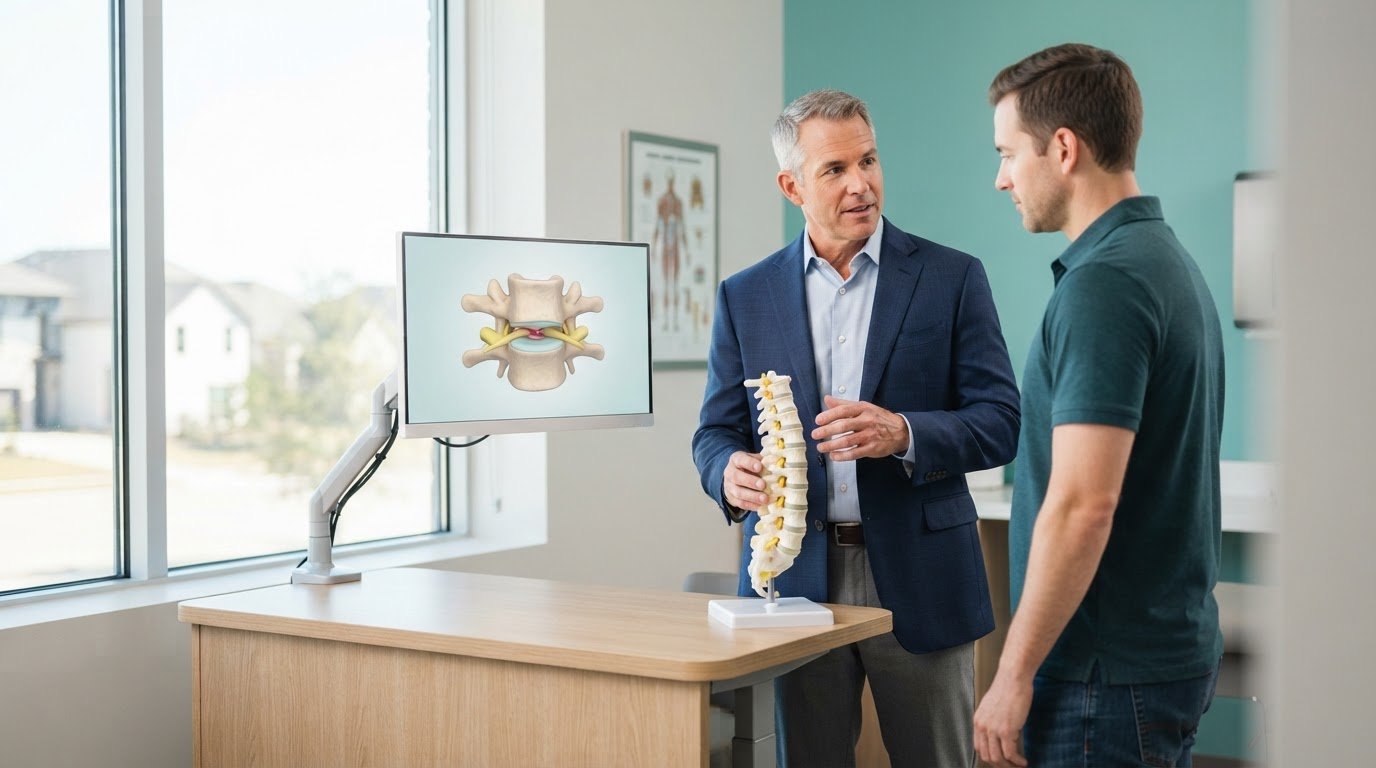
Minimally Invasive Neurosurgery of Texas (MINT), led by Dr. Scott Kutz, provides minimally invasive spine surgery and lumbar foraminotomy care in Lewisville and Plano, TX. If you’re searching for lumbar foraminotomy Lewisville TX, learn more about MINT’s spine care and minimally invasive spine techniques.
Could the source of your leg pain matter more than the amount of back pain you feel? A compressed nerve in the lower spine can cause pain, tingling, numbness, or weakness in the leg, making everyday activities harder. You may wonder whether surgery fits your symptoms or whether another treatment makes more sense.
A lumbar foraminotomy enlarges the opening where a nerve root exits the lower spine. Narrowing of this opening, called foraminal stenosis, can press on the nerve. Dr. Kutz considers your symptoms, physical exam, and imaging when discussing options. This guide explains what the procedure may address, how surgeons assess nerve compression, and which questions you can bring to a spine consultation.
Key Takeaways
- A lumbar foraminotomy enlarges the opening where a spinal nerve exits. Your anatomy and diagnosis guide the surgical approach.
- Imaging that shows narrowing doesn’t automatically mean you need surgery. A surgeon considers your symptoms, exam, and scan together.
- Compare treatment options by their purpose and how well they address the source of your symptoms, rather than assuming one approach suits everyone.
- For a lumbar foraminotomy Lewisville TX consultation, prepare questions about your symptoms, imaging, treatment goals, medical history, and individual recovery expectations.
- MINT provides spine-focused care in Lewisville and Plano with Dr. Scott C. Kutz, a board-certified neurosurgeon with more than 20 years of experience treating spinal disorders.
Lumbar Foraminotomy in Lewisville, TX: What It Treats and When It May Help
Minimally Invasive Neurosurgery of Texas (MINT), led by Dr. Scott Kutz, provides spine care and minimally invasive spine surgery in Lewisville, TX, and Plano, TX.
A lumbar foraminotomy is surgery that widens the opening where a lower-spine nerve exits to ease pressure on that nerve. The procedure targets nerve compression, not back pain in general. Patients considering lumbar foraminotomy Lewisville TX care can learn more about MINT’s minimally invasive spine techniques.
What does lumbar foraminal narrowing mean?
Lumbar refers to the lower-back region. Each spinal nerve leaves the spine through a small opening called a neural foramen. Foraminal narrowing, or foraminal stenosis, means that opening has become smaller. If the narrowed space irritates or compresses a nerve, symptoms may include pain that travels from the back into a leg, tingling, numbness, or weakness.
Different conditions can cause these symptoms, so symptoms alone don’t establish a diagnosis. A clinician considers your health history, examination, and imaging to determine whether a narrowed nerve opening matches what you feel.
When might a surgeon discuss foraminotomy?
A surgeon may discuss the procedure when your symptoms and examination suggest nerve compression, imaging shows narrowing in a corresponding area, and the clinician has considered your prior care. The goal is to widen the nerve’s exit pathway and reduce pressure. A Foraminotomy can involve different surgical approaches. Your anatomy and diagnosis shape the details.
Dr. Scott Kutz connects your symptoms with examination findings and imaging when considering treatment options. A scan that shows narrowing doesn’t automatically mean surgery makes sense. The surgeon considers your full clinical picture, individualizes the plan, and discusses potential benefits and risks without promising a particular result. MINT also explains endoscopic spine surgery, a minimally invasive approach that uses a small camera to view the surgical area.
How Lumbar Foraminotomy Relieves Nerve Compression in the Lower Back
A lumbar foraminotomy aims to reduce pressure on a spinal nerve by widening the passage it uses to leave the spine. The foramen is this exit passage. If narrowing presses on a nerve, the surgeon may create more space around the affected nerve, depending on your anatomy and diagnosis.
What happens during the decompression?
Decompression means reducing pressure on a nerve. During a foraminotomy, the surgeon may remove a limited amount of bone or other tissue that narrows the nerve’s exit pathway, if your findings call for it. The exact steps vary. A surgeon may use different incisions or instruments depending on the location and extent of the narrowing, so one technique doesn’t fit every patient.
A minimally invasive approach describes how the surgeon reaches and treats the affected area. It doesn’t guarantee a particular result or recovery experience. The MedlinePlus Medical Encyclopedia offers additional patient-focused information about foraminotomy and its purpose.
How does a surgeon plan the procedure?
Planning connects three parts of your evaluation: the physical examination, the pattern of your symptoms, and imaging such as an MRI, which creates detailed pictures of spinal structures. The surgeon looks for agreement between the nerve that appears compressed and your symptoms or examination findings. For example, a scan may show narrowing, but that finding alone doesn’t establish that the narrowing causes your symptoms.
Dr. Scott C. Kutz, MD, uses this individualized approach to guide discussions about whether decompression fits your diagnosis and goals. The precise plan depends on what your examination and images show, where the nerve faces pressure, and what the surgeon needs to address. If you’re researching lumbar foraminotomy Lewisville TX, understanding this connection can help you focus your consultation. MINT also explains its minimally invasive spine techniques. You can discuss your symptoms and evaluation with the practice.
Lumbar Foraminotomy vs. Other Options: How Lewisville Patients Can Compare
Imaging that shows a narrowed nerve opening doesn’t automatically mean you need surgery. A scan gives the surgeon information, but the recommendation also depends on your symptoms, examination, diagnosis, and how symptoms affect daily life. Comparing each option’s clinical purpose can make treatment discussions clearer for patients exploring lumbar foraminotomy Lewisville TX care.
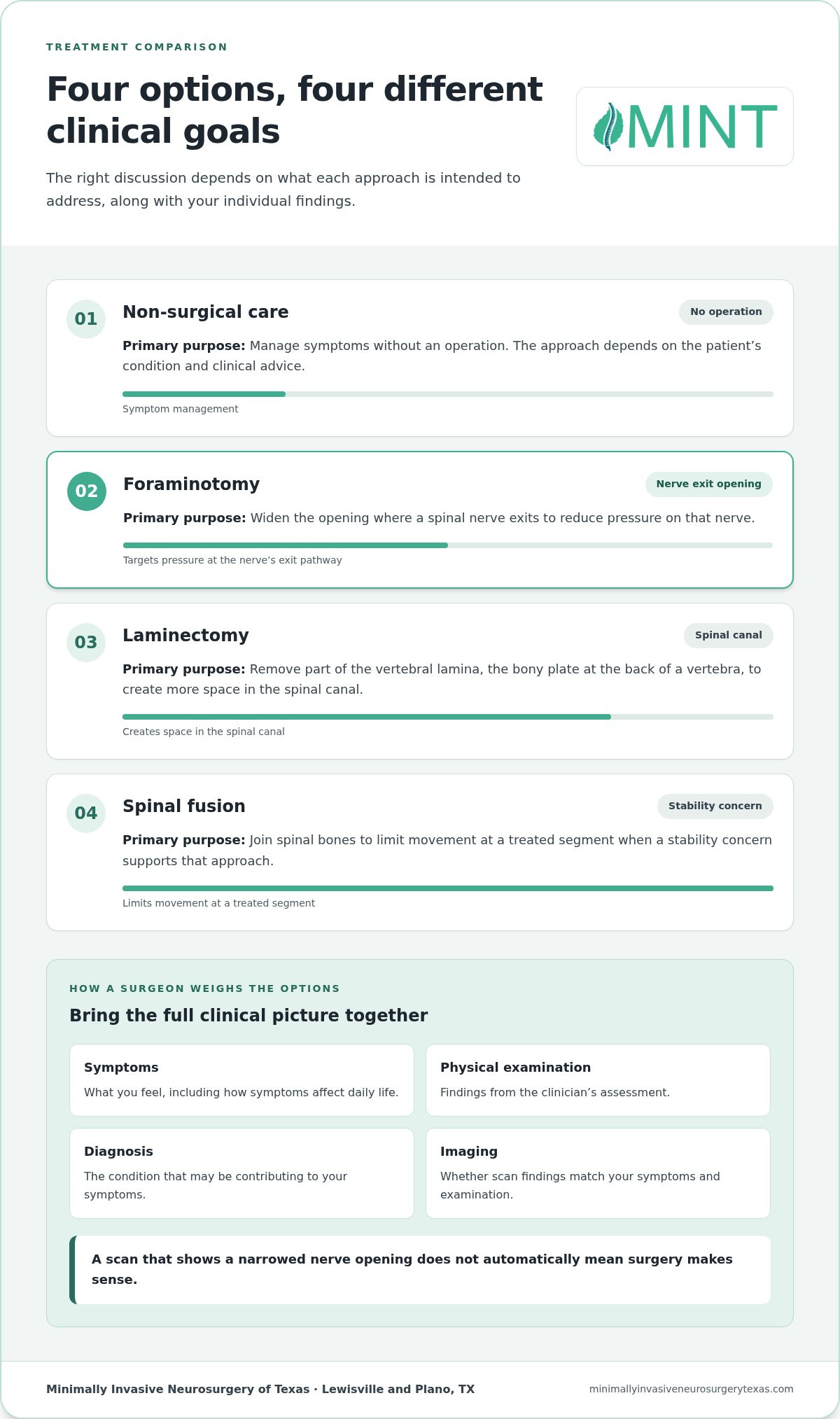
Non-surgical care may help manage symptoms, while a procedure may address a structural source of nerve pressure. A spine surgeon weighs these choices against your individual findings. The table outlines the main differences:
| Option | Primary purpose |
|---|---|
| Non-surgical care | Manage symptoms without an operation; the approach depends on the patient’s condition and clinical advice. |
| Foraminotomy | Widen the opening where a spinal nerve exits to reduce pressure on that nerve. |
| Laminectomy | Remove part of the vertebral lamina, the bony plate at the back of a vertebra, to create more space in the spinal canal. |
| Spinal fusion | Join spinal bones to limit movement at a treated segment when a stability concern supports that approach. |
How does foraminotomy differ from laminectomy?
A foraminotomy focuses on the nerve’s exit opening. A laminectomy targets the lamina and creates more room in the spinal canal, the passage that contains spinal nerves. These procedures address different patterns of compression. A surgeon chooses an approach based on where the pressure occurs and what the evaluation shows. The procedure name alone doesn’t determine whether it fits your diagnosis.
How does decompression differ from spinal fusion?
Decompression means reducing pressure on a nerve. Foraminotomy and laminectomy use different routes to create space. Fusion serves another purpose: it joins bones to limit movement at a spinal segment when the surgeon identifies a stability concern. A surgeon considers whether your clinical findings support decompression alone or a different plan. MINT’s guide to minimally invasive spine techniques offers broader context on surgical approaches.
Dr. Scott C. Kutz, MD, connects your symptom pattern with examination findings and imaging when discussing options. This individualized review keeps the decision focused on the suspected cause of your symptoms, not an imaging finding alone.
Preparing for Lumbar Foraminotomy in Lewisville: Evaluation and Recovery Questions
A focused consultation connects your symptoms, imaging, health history, and treatment goals. If you’re preparing for a lumbar foraminotomy Lewisville TX evaluation, organize a few details in advance so you can explain what you’ve experienced and understand the options your surgeon discusses.
What should patients bring to a spine evaluation?
Bring the information you already have, and make notes before your visit. These details can help the clinician understand how your symptoms affect daily activities:
- Symptom timeline: Note when your back or leg symptoms began, how they changed, and which activities worsen or ease them.
- Imaging and records: Bring available imaging reports and relevant medical records. If you have imaging files, ask the office how to share them before your appointment.
- Medication list: Write down your current medications and supplements.
- Questions and goals: List what you hope to improve, what concerns you about treatment, and what you want to know about options and risks.
Use clear examples. Note whether standing, walking, sitting, or bending changes your symptoms, and whether pain, tingling, numbness, or weakness limits a particular activity. Your clinician will consider those details alongside your examination and imaging.
What should patients ask about recovery?
Recovery varies from person to person. Your health, the details of the procedure, and your clinician’s instructions all shape activity guidance. Instead of relying on a general timeline, ask how your care team will tailor recommendations to your planned treatment and progress.
- Which activities should I limit at first, and how will I know when to increase them?
- What symptoms should I report during recovery?
- How should I manage my regular medications around the procedure?
- When should I follow up, and whom should I contact with recovery questions?
Seek urgent medical assessment for new severe weakness or new bowel or bladder changes. These symptoms need prompt attention rather than a routine follow-up.
Preparing these questions can support a clear conversation about your diagnosis, options, and next steps. Discuss your spine concerns with MINT in Lewisville or Plano, TX.
Discussing Lumbar Foraminotomy Care in Lewisville and Plano, TX
Minimally Invasive Neurosurgery of Texas (MINT) provides spine-focused care in Lewisville, Plano, and surrounding North Texas communities. If you’re considering lumbar foraminotomy, start by understanding what may cause your symptoms and which treatment options match your evaluation.
What can patients expect from a spine-focused consultation?
Dr. Scott C. Kutz, MD, is a board-certified neurosurgeon and Fellow of the AANS and ACS, with more than 20 years of experience treating spinal disorders. During an evaluation, he reviews your symptoms, examination findings, imaging, medical history, and treatment goals. He considers how these details fit together rather than treating a scan as the full explanation for your symptoms.
This discussion can clarify whether a narrowed nerve opening may explain your symptoms and which options could address the suspected cause. Dr. Kutz can explain your diagnosis, outline relevant treatment choices, and discuss how minimally invasive spine surgery may fit when clinically appropriate. You can read more about his training and background in his neurosurgeon biography.
How can Lewisville and Plano patients take the next step?
A consultation gives you space to describe how back or leg symptoms affect daily activities and understand how your findings guide care. Patients from Lewisville, Plano, and nearby North Texas communities can discuss whether continued non-surgical care or a surgical approach makes sense for their situation. MINT’s minimally invasive spine techniques page offers broader context on surgical approaches.
Contact MINT to discuss your spine care and take an informed next step toward understanding your symptoms, diagnosis, and treatment options.
Take the Next Step Toward a Clearer Spine Care Plan
A lumbar foraminotomy widens the opening where a spinal nerve exits the lower spine, with the goal of easing pressure on that nerve. But imaging that shows narrowing doesn’t automatically mean surgery makes sense. A spine surgeon weighs your symptoms, examination, imaging, health history, and treatment goals before discussing options.
If you’re considering lumbar foraminotomy Lewisville TX, MINT provides spine-focused care in Lewisville and Plano. Dr. Scott C. Kutz, MD, holds board certification from the American Board of Neurological Surgery and has more than 20 years of experience treating spinal disorders. He can help you understand how your findings relate to your symptoms and whether minimally invasive spine surgery may fit your situation.
Bring your questions and discuss what matters most in your daily life. Contact MINT to discuss your spine care and take an informed next step toward a plan that fits your needs.
Frequently Asked Questions
What is lumbar foraminotomy?
Lumbar foraminotomy is a procedure that enlarges the opening where a nerve exits the lower spine. The surgeon may remove a limited amount of bone or tissue to reduce pressure on that nerve. Clinicians consider it when symptoms, examination findings, and imaging point to nerve compression. The goal is to address pressure on a nerve, not nonspecific back pain alone. Your anatomy and diagnosis guide the surgical plan.
Who may be a candidate for lumbar foraminotomy?
A clinician may discuss foraminotomy when your symptoms and examination findings align with compression near a lumbar nerve opening. Imaging can help identify the anatomy, but a scan alone doesn’t determine treatment. The clinician also considers your health, symptom history, prior care, and goals. For patients considering lumbar foraminotomy in Lewisville, TX, an individualized evaluation can clarify whether surgery belongs among the options and which alternatives may fit.
Is lumbar foraminotomy the same as laminectomy?
No. A foraminotomy widens the opening where a spinal nerve exits, while a laminectomy removes part of the vertebral lamina, the bony plate at the back of a vertebra, to create space in the spinal canal. Both procedures can relieve pressure in selected cases, but they address different anatomy. A surgeon considers the location and source of compression, your findings, and treatment goals when discussing an approach.
How does lumbar foraminotomy differ from spinal fusion?
A lumbar foraminotomy aims to reduce pressure on a nerve by widening its exit opening. Spinal fusion joins bones at a spinal segment to limit movement and address selected stability concerns. These procedures serve different purposes, so they aren’t interchangeable. A surgeon considers your diagnosis, symptoms, imaging, spinal stability, and goals when discussing options. The clinician can explain whether your evaluation supports one approach or another.
What should I expect during recovery from lumbar foraminotomy?
Recovery varies with your overall health and the details of your surgical plan. Follow your treating clinician’s instructions for activity, wound care, medication, and follow-up. A general timeline may not match your needs, so ask which activities you should limit and how to increase them safely. Also ask which symptoms you should report and whom to contact if pain, weakness, or other concerns change after the procedure.
Can lumbar foraminal stenosis improve without surgery?
Some patients manage symptoms without surgery, depending on the cause, severity, overall health, and response to care. A clinician can review appropriate non-surgical options after evaluating you and considering relevant imaging. A scan that shows narrowing doesn’t automatically mean you need an operation. If symptoms persist or interfere with daily activities, a spine evaluation can help clarify the likely cause and the treatment choices that fit your situation.
When should back or leg symptoms receive urgent medical attention?
Seek urgent medical assessment for new bowel or bladder changes, numbness in the saddle area, meaning the region that would touch a saddle, or rapidly worsening leg weakness. These symptoms can signal serious nerve compression and need prompt evaluation. Severe or quickly progressing symptoms also warrant timely medical attention. This guidance can’t diagnose a condition. Contact emergency services for an emergency, and follow a clinician’s advice about your symptoms.