Minimally Invasive Neurosurgery of Texas (MINT), led by Dr. Scott C. Kutz, provides spine care in Lewisville, TX, and Plano, TX. If you’re searching for endoscopic discectomy Lewisville TX, this guide can help you understand the procedure and prepare questions for a spine specialist.
Could a targeted procedure address nerve symptoms linked to a herniated disc, or might another option fit better? A herniated disc occurs when disc material extends beyond its usual boundary and may press on a nearby nerve. If persistent lower back pain or pain that travels into your leg interrupts daily activities, it’s understandable to want clear answers. A specialist can assess whether your symptoms and clinical findings point to a disc, then discuss which treatment options may fit.
This guide explains what lumbar endoscopic discectomy aims to treat, what clinical details may shape candidacy, and what questions to bring to a specialist in Lewisville or Plano. You’ll also learn how to discuss potential benefits, risks, and recovery expectations so you can make an informed decision about your care.
Key Takeaways
- A lumbar herniated disc can irritate a nerve and contribute to pain, numbness, or weakness in the lower back or leg.
- A smaller surgical approach does not make surgery right for everyone. A specialist considers your symptoms, clinical findings, imaging, and response to prior care.
- Prepare for an appointment by gathering imaging reports, treatment history, medication details, and notes about your symptoms.
- When considering endoscopic discectomy in Lewisville or Plano, ask how the proposed approach and potential risks apply to your situation.
- MINT provides endoscopic spine surgery and herniated disc care in Lewisville and Plano. Dr. Scott C. Kutz is a board-certified neurosurgeon with more than 20 years of experience treating spinal disorders.
What Is Endoscopic Discectomy for a Lumbar Herniated Disc?
Minimally Invasive Neurosurgery of Texas (MINT), led by Dr. Scott C. Kutz, provides spine care in Lewisville, TX, and Plano, TX. Dr. Kutz is a board-certified neurosurgeon who specializes in spinal disorders and minimally invasive spine surgery. An endoscopic discectomy uses a small camera to guide the removal of targeted disc material in the lower back. A specialist must assess whether this specific procedure is appropriate for your needs.
A herniated disc occurs when disc material extends beyond the disc’s usual boundary. If that material presses on a nearby nerve, it may trigger symptoms along the nerve’s path. “Lumbar” means the lower back, and “discectomy” means removing targeted disc material. The Discectomy overview offers a general explanation of the procedure and its different approaches.
How can a herniated disc cause lower back or leg symptoms?
Nerve root compression occurs when disc material or another structure presses on a nerve root, the part of a nerve that branches from the spinal cord. Pressure or irritation may contribute to pain that travels from the lower back into a leg, numbness, or weakness. Symptoms differ from person to person, so a clinician needs to assess the full picture rather than rely on symptoms alone.
What does endoscopic discectomy aim to address?
Endoscopic discectomy aims to remove the portion of a herniated disc that contributes to nerve irritation or compression. An endoscope is a small camera that lets the surgeon view the operative area through a minimally invasive approach. The goal is to address targeted disc material, not to remove the entire disc.
Endoscopic spine surgery describes a broader group of procedures that use an endoscope. A discectomy specifically addresses disc material. The terms overlap, but not every endoscopic spine procedure removes a herniated disc. MINT offers endoscopic spine surgery and herniated disc care. Ask a spine specialist whether lumbar endoscopic discectomy is available and appropriate for your case. The answer depends on your symptoms, clinical assessment, and imaging, which helps the clinician examine the spine and the disc’s relationship to nearby nerves.
How Does Lumbar Endoscopic Discectomy Work?
Lumbar endoscopic discectomy uses a small camera to help a surgeon see targeted spinal anatomy and consider whether to remove disc material linked to nerve symptoms. The exact approach depends on the patient’s anatomy, clinical findings, and the surgeon’s plan. The American Academy of Orthopaedic Surgeons explains the general approach in its patient guide to endoscopic diskectomy.
What happens before the surgeon recommends a procedure?
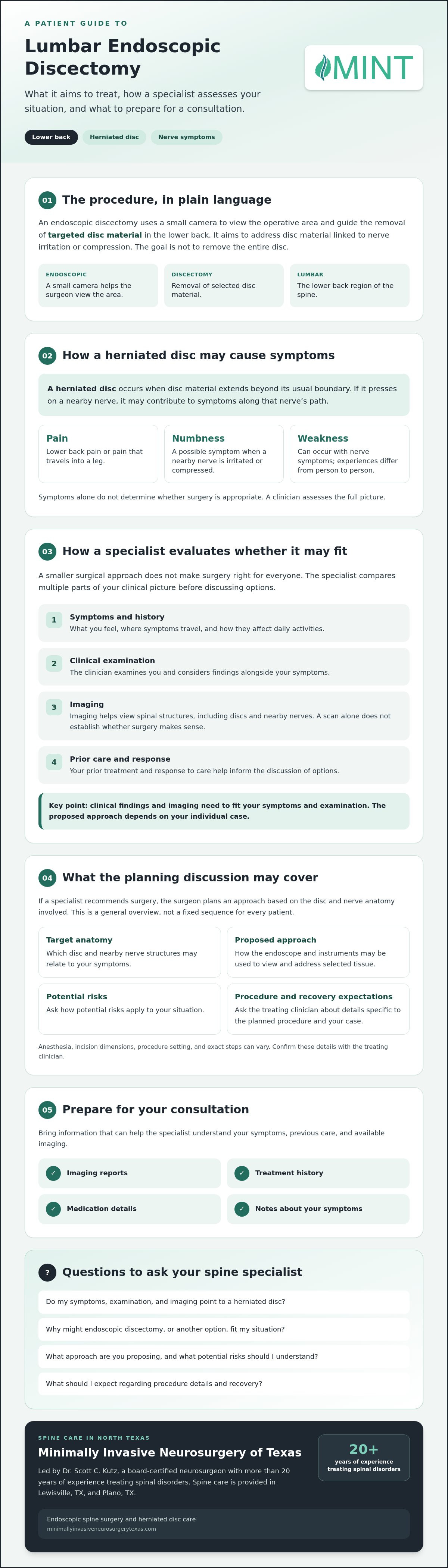
A spine specialist reviews your symptom history, examines you, discusses prior care, and considers relevant imaging. Imaging helps the clinician view spinal structures, including discs and nearby nerves. The clinician compares those findings with your symptoms and examination. A scan alone does not establish whether surgery makes sense. The findings need to fit the clinical picture.
What happens during the procedure?
If a specialist recommends surgery, the surgeon plans an approach based on the disc and nerve anatomy involved. The surgeon uses the endoscope’s camera to view the operative area and instruments to work on selected tissue. Disc material is removed only when the clinical assessment supports that step. Ask the treating clinician to explain the planned technique and how it applies to your diagnosis.
Here’s a general overview, not a fixed sequence for every patient:
- Review the clinical picture. The surgeon considers symptoms, examination findings, prior care, and imaging together.
- Identify the target anatomy. The surgeon determines which disc and nearby nerve structures may relate to the symptoms.
- Choose an approach. The surgeon selects a technique based on the individual case. Endoscopic discectomy uses a camera to visualize targeted spinal anatomy, while instruments allow the surgeon to address selected disc material.
- Discuss procedure details. The surgeon explains the planned steps, potential risks, and what to expect. Anesthesia, incision dimensions, procedure setting, and exact steps can vary, so confirm those details with the treating clinician.
If you’re searching for endoscopic discectomy Lewisville TX, ask a spine specialist whether this specific procedure is available and appropriate for your situation. MINT provides endoscopic spine surgery and herniated disc care in Lewisville and Plano, but ask the team directly about lumbar endoscopic discectomy. You can contact MINT to discuss spine care options and what information to bring to an evaluation.
Who May Be a Candidate, and What Are the Limits?
A smaller access approach does not make surgery suitable for every patient. A clinician considers whether a lumbar herniated disc, meaning disc material extending beyond its usual boundary in the lower back, matches the patient’s symptoms and examination. The clinician also reviews imaging, health history, symptom duration, and response to prior care. These details inform a discussion; they do not determine the decision automatically.
Which clinical details may shape candidacy?
A specialist looks for a connection between the suspected disc problem and symptoms such as pain that travels into a leg, numbness, or weakness. The clinician compares that pattern with examination findings and imaging, which helps show the disc and nearby nerves. A scan alone cannot determine candidacy. Only a qualified clinician who evaluates the whole clinical picture can discuss whether endoscopic discectomy may suit an individual patient.
Persistent symptoms and limited benefit from prior care may prompt a conversation about surgical options, but neither factor guarantees a recommendation. The clinician also considers general health and whether the proposed procedure addresses the likely source of symptoms. For someone researching endoscopic discectomy in Lewisville or Plano, a consultation can clarify which findings support or argue against this approach.
What alternatives and risks should patients discuss?
Ask which nonsurgical options may still fit your diagnosis and how the clinician compares endoscopic discectomy with other surgical approaches. Discuss potential benefits and risks in the context of your health and treatment goals. Minimally invasive describes the surgical approach, not a risk-free procedure. Complications can occur, and symptoms may not improve as expected. Your surgeon can explain the uncertainties that apply to your case without promising a particular result or recovery pace.
Bring questions about the reason for the recommendation, the specific disc material the surgeon would target, and what other options remain. You can also ask how the care team will assess progress and what symptoms should prompt follow-up. MINT provides endoscopic spine surgery and herniated disc care in Lewisville and Plano, where a spine specialist can discuss options based on your individual evaluation.
When should symptoms receive urgent attention?
A routine consultation can help you assess ongoing back or leg symptoms. Seek urgent medical assessment for new loss of bladder or bowel control, numbness around the groin or inner thighs, or rapidly worsening leg weakness. These symptoms need prompt evaluation rather than a routine procedure discussion.
How Should You Prepare for a Discectomy Consultation in Lewisville?
A little preparation can help you get clear answers about a suspected or diagnosed lumbar herniated disc, which occurs when disc material in the lower back extends beyond its usual boundary. If you’re researching endoscopic discectomy Lewisville TX, bring information that helps the clinician connect your symptoms with your diagnosis and discuss appropriate options. Use this checklist for a consultation in Lewisville or Plano.
What information should you bring to the appointment?
Bring what you have. You don’t need to organize every detail perfectly. Notes can help you describe changes that may be hard to recall during an appointment.
- Symptom notes: Record where pain, numbness, or weakness occurs, when it began, whether it travels into a leg, and which activities make it better or worse.
- Imaging information: Bring available imaging reports and, if you have them, the images or instructions for accessing them. The clinician can review how the findings relate to your symptoms.
- Prior care: List treatments you’ve tried, how long you tried them, and whether they helped. Include relevant appointments or procedures.
- Health and medication details: Prepare a summary of your medical history and a current list of prescription medicines, over-the-counter medicines, and supplements.
What questions can help you compare treatment options?
Ask the clinician to explain the reasoning behind each option in plain language. These questions can guide the conversation:
- How does the suspected disc problem explain my symptoms and examination findings?
- What evidence supports each option, including appropriate nonsurgical care?
- What goals would treatment aim for, and what risks or uncertainties should I weigh?
- What alternatives should I consider, and how would you compare them with the proposed approach?
- Are you recommending a discectomy, which removes selected disc material, or another endoscopic spine technique?
- What follow-up should I expect, and whom should I contact with questions about changes in my symptoms?
A useful consultation should leave you with a clear understanding of the diagnosis, the options under consideration, and the next steps. MINT provides spine care in Lewisville and Plano. Contact MINT to discuss your spine care questions.
Discuss Endoscopic Spine Surgery With MINT in Lewisville or Plano
Minimally Invasive Neurosurgery of Texas (MINT) provides endoscopic spine surgery and care for herniated discs. Dr. Scott C. Kutz is a board-certified neurosurgeon specializing in spinal disorders and minimally invasive spine surgery, with more than 20 years of experience treating spinal disorders. MINT’s primary office is in Lewisville, TX, and its satellite office serves patients in Plano, TX.
What should patients expect from a patient-first evaluation?
A useful evaluation starts with your concerns and a careful review of your symptoms, health history, examination findings, prior care, and relevant imaging. Dr. Kutz and the clinical team can explain what the findings may mean, which treatment options they’re considering, and why a recommendation may fit your situation.
MINT prioritizes minimally invasive options when they make clinical sense. A consultation does not guarantee a specific procedure or result. If you’re considering endoscopic discectomy, ask whether MINT offers that specific procedure for your diagnosis and how it differs from other endoscopic spine surgery options. You can also review MINT’s minimally invasive spine techniques as you prepare questions for your clinician.
How can local patients take the next step?
Patients can discuss spine care at MINT’s primary Lewisville office or its satellite location in Plano. Bring relevant imaging reports, a list of treatments you’ve tried, medication details, and notes about your symptoms. Ask about treatment goals, risks, alternatives, and follow-up.
Contact MINT to discuss your treatment options.
Take the Next Step Toward Clearer Spine Care Answers
Endoscopic discectomy focuses on selected disc material that may irritate or compress a nerve, but a smaller surgical approach does not make it right for everyone. A specialist weighs your symptoms, examination, imaging, health history, and response to prior care. Before deciding, ask how the diagnosis explains your symptoms, what alternatives exist, and what risks and follow-up the proposed treatment involves.
If you’re researching endoscopic discectomy Lewisville TX, MINT provides endoscopic spine surgery and herniated disc care through its primary office in Lewisville and satellite office in Plano. Dr. Scott C. Kutz is board-certified by the American Board of Neurological Surgery and has more than 20 years of experience treating spinal disorders. A consultation can help you understand your options without assuming a specific procedure or result.
Contact MINT to discuss your spine care options and prepare questions for a specialist. A clear, individualized conversation can help you take your next step with greater confidence.
Frequently Asked Questions
What is an endoscopic discectomy?
An endoscopic discectomy is a procedure that uses a small camera, called an endoscope, to help a surgeon view the spine and remove selected disc material. A disc is a cushion between the bones of the spine. “Lumbar” refers to the lower back. The surgeon considers this approach when specific disc material appears connected to nerve symptoms, but the procedure and its suitability depend on each patient’s clinical evaluation.
Is endoscopic discectomy used to treat a herniated disc?
Yes. A surgeon may use endoscopic discectomy to remove selected material from a herniated disc, which occurs when disc material extends beyond its usual boundary. The procedure may address material that irritates or presses on a nearby nerve. A clinician first checks whether the patient’s symptoms, examination, and imaging findings point to that disc as a likely cause. A herniated disc alone does not mean surgery is appropriate.
Who may qualify for lumbar endoscopic discectomy?
A person may discuss lumbar endoscopic discectomy when symptoms, examination findings, and imaging suggest that a lower back disc contributes to nerve symptoms. The clinician also considers overall health, symptom history, and response to prior care. A scan alone cannot determine whether surgery fits. Only a qualified clinician can assess individual candidacy and explain whether this procedure, another approach, or nonsurgical care makes sense for the diagnosis.
How long does it take to recover from endoscopic discectomy?
Recovery time varies, so a spine specialist should explain what to expect for the specific procedure and patient. The exact technique, individual health factors, and activity demands can affect recovery guidance. Ask the surgeon when to resume everyday tasks, work, driving, and exercise, and what symptoms should prompt follow-up. Ask the treating clinician for guidance specific to your procedure rather than relying on a general estimate.
What are the risks of endoscopic discectomy?
Endoscopic discectomy, like other surgery, carries risks, and a minimally invasive approach does not eliminate them. The specific risks depend on the procedure and patient. Ask the surgeon to explain possible complications, how the team works to reduce risk, and the chance that symptoms may not improve as expected. Also discuss alternatives and follow-up plans. Your treating clinician can provide risk information that reflects your health and proposed surgical approach.
Does MINT offer endoscopic discectomy in Lewisville, TX?
MINT offers endoscopic spine surgery and herniated disc care. Ask the team directly whether it performs lumbar endoscopic discectomy and whether the procedure may fit your diagnosis. MINT serves patients through its primary Lewisville office and satellite office in Plano. Dr. Scott C. Kutz is a board-certified neurosurgeon with more than 20 years of experience treating spinal disorders.