Minimally Invasive Neurosurgery of Texas (MINT), led by Dr. Scott Kutz, provides minimally invasive spine surgery in Lewisville and Plano, TX. Learn about MINT’s minimally invasive spine surgery care.
What if persistent sciatica, pain that travels along the sciatic nerve, calls for more than another round of conservative care? If chiropractic care hasn’t eased your symptoms, spinal decompression surgery Plano TX may offer a targeted option when a compressed nerve causes ongoing pain or limits movement.
It’s understandable to worry that spine surgery means a large incision or a long hospital stay. Dr. Kutz evaluates the cause of your symptoms, including a herniated disc or spinal stenosis, a narrowing of the space around spinal nerves, and explains whether decompression may fit your needs. Explore MINT’s endoscopic spine surgery to learn about a minimally invasive option. This article covers how decompression works, when surgeons consider it, and how minimally invasive techniques may support recovery and a return to normal activities.
Key Takeaways
- Learn how minimally invasive decompression can relieve pressure on spinal nerves through smaller incisions.
- Explore whether spinal decompression surgery Plano TX may be an option when conservative treatments haven’t eased your symptoms.
- Understand how procedure choice depends on the cause of your pain and your individual needs.
- See how Dr. Scott Kutz’s neurosurgical experience and robotic navigation technology inform MINT’s approach in Plano and Lewisville.
- Discover how smaller incisions may reduce disruption to nearby muscles and support your recovery and return to normal activities.
Understanding Spinal Decompression Surgery in Plano TX
Minimally Invasive Neurosurgery of Texas (MINT), led by Dr. Scott C. Kutz, MD, a board-certified neurosurgeon and Fellow of the AANS and ACS, provides minimally invasive spine surgery for patients in Plano and Lewisville, TX. Dr. Kutz specializes in procedures that relieve pressure on spinal nerves.
Spinal decompression surgery Plano TX describes surgery that removes or reshapes bone, disc material, or other tissue pressing on the spinal cord or nerve roots. Nerve roots are the nerves that branch from the spinal cord. The surgeon selects an approach based on what causes the compression and where it occurs. For a general overview of spinal decompression surgery, readers can review the procedure’s common surgical methods.
One cause is spinal stenosis, a narrowing of the spinal canal, the passage that holds the spinal cord and nerve roots. Narrowing can leave less room for nerves and contribute to pain, tingling, numbness, or weakness. The goal of decompression is to reduce pressure on affected nerves. The specific procedure and expected benefits depend on each patient’s anatomy and diagnosis.
Surgical Decompression vs. Decompression Therapy
“Decompression therapy” often refers to non-surgical traction, which uses controlled pulling to stretch the spine. This approach does not remove bone or disc material. Surgical decompression physically removes or reshapes tissue that crowds a nerve. It addresses the structural source of compression, though it can’t guarantee that symptoms will disappear or never return. A neurosurgeon weighs imaging findings, symptoms, and overall health when considering surgery.
MINT also offers endoscopic spine surgery, which uses a small camera and specialized instruments to access the spine through a small incision. Dr. Kutz determines whether this or another minimally invasive technique fits the patient’s condition.
Conditions Treated with Decompression in Plano
A herniated disc occurs when the soft center of a spinal disc pushes through a tear in its tougher outer layer. If the displaced material presses on a nerve, it may cause radiating pain, numbness, or weakness. Neural foraminal stenosis means the openings where nerves exit the spine have narrowed, which can also pinch a nerve.
Spondylolisthesis occurs when one vertebra, a bone in the spine, slips over the vertebra below it. This condition may accompany nerve compression, but the slip can also affect spinal stability. Dr. Kutz evaluates both concerns before recommending a treatment plan. A diagnosis alone doesn’t determine whether surgery makes sense. The decision depends on how the condition affects nerve function, pain, and daily activity.
Common Minimally Invasive Decompression Techniques
Minimally invasive spine surgery gives Dr. Scott Kutz access to the spine through small incisions rather than a large opening. He uses specialized instruments to reach the area pressing on a nerve while limiting disruption to nearby muscles and soft tissues. Preserving these tissues can reduce surgical impact and support recovery, though each patient’s results and risks vary.
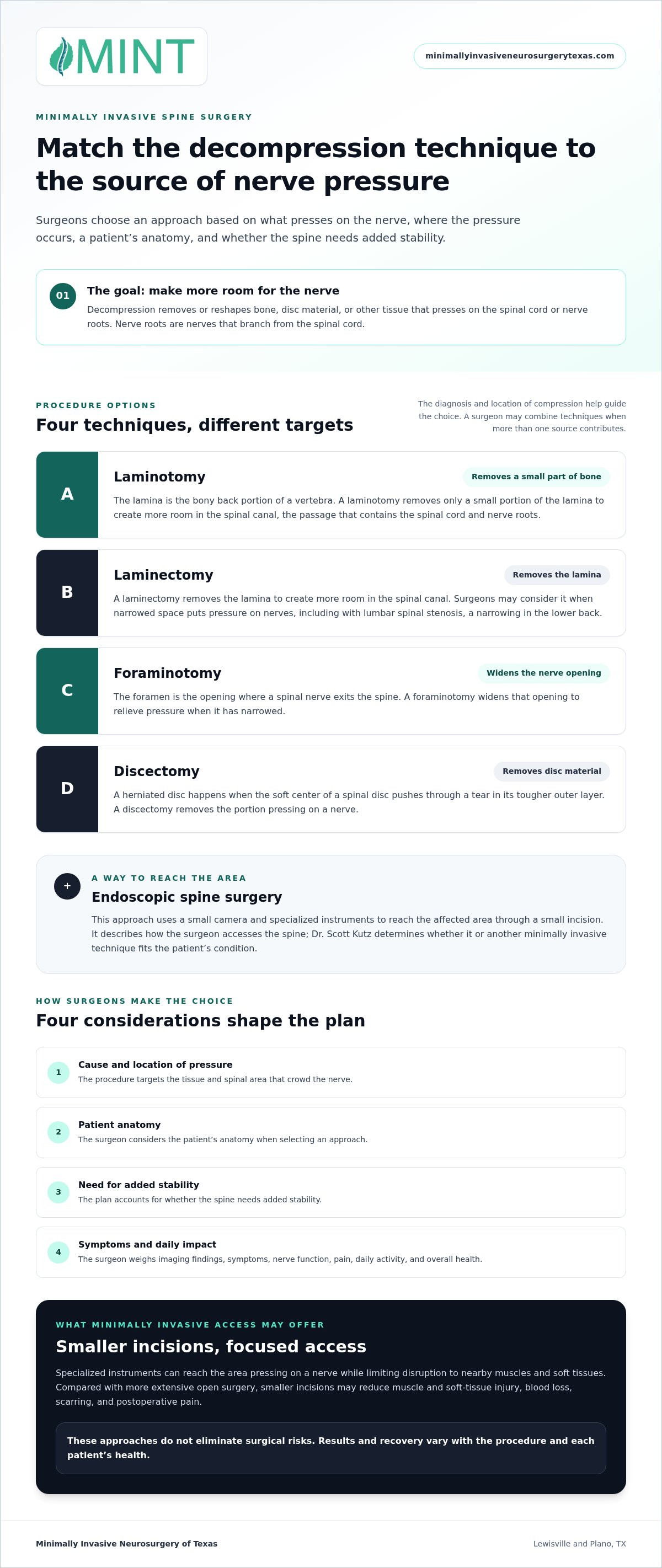
Smaller incisions may also help reduce blood loss and lower the risk of infection compared with more extensive open surgery. They don’t eliminate these risks. Dr. Kutz chooses a technique based on the source and location of nerve pressure, the patient’s anatomy, and whether the spine needs added stability. MINT also prioritizes motion-preserving approaches when appropriate, with the goal of maintaining spinal flexibility.
Laminotomy and Laminectomy
The lamina is the bony back portion of a vertebra, one of the bones that form the spine. A laminectomy removes the lamina, while a laminotomy removes only a small portion. Either procedure can create more room in the spinal canal, the passage that contains the spinal cord and nerve roots. Surgeons may consider these approaches when narrowed space puts pressure on nerves, including in lumbar spinal stenosis, a narrowing in the lower back. The American Association of Neurological Surgeons explains lumbar spinal stenosis treatment options, including decompression procedures.
Foraminotomy and Discectomy
A foraminotomy widens the foramen, the opening where a spinal nerve exits the spine. This can relieve pressure when the opening has narrowed. A discectomy removes the portion of a herniated disc that presses on a nerve. A herniated disc occurs when the disc’s soft center pushes through a tear in its outer layer. Surgeons may combine techniques when a patient has more than one source of compression.
For some patients, endoscopic spine surgery uses a small camera and specialized instruments to reach the affected area through a small incision. Explore MINT’s endoscopic spine surgery approach to learn more about this technique. For spinal decompression surgery Plano TX patients, Dr. Kutz matches the procedure to the diagnosis rather than relying on a one-size-fits-all method.
Benefits of Choosing Minimally Invasive Surgery in North Texas
For patients in Plano and Lewisville, minimally invasive spine surgery can address nerve compression while limiting the disruption associated with a larger open operation. Surgeons use small incisions and specialized instruments to reach the affected area. This approach may reduce muscle and soft-tissue injury, blood loss, scarring, and postoperative pain. It doesn’t eliminate surgical risks, and each patient’s recovery depends on the procedure and personal health factors.
Many decompression procedures take place on an outpatient basis, which means the patient goes home the same day rather than staying overnight in a hospital. Dr. Scott Kutz determines the appropriate setting based on the operation and the patient’s needs. A smaller incision can make movement more comfortable as healing begins, but it doesn’t mean patients should rush back to normal activities. Following the surgeon’s recovery instructions remains essential.
Reduced Tissue Disruption
In a muscle-sparing approach, the surgeon gently dilates, or gradually separates, muscle fibers to create a path to the spine instead of cutting through the muscles. Traditional open surgery may require the surgeon to detach or strip muscle from the bone to reach the surgical area. Limiting muscle disruption may help reduce postoperative soreness and stiffness. It can also preserve more of the tissue that supports movement, though no technique can guarantee a specific result.
Smaller incisions also mean less skin area needs to heal, which can limit visible scarring. For Plano residents considering spinal decompression surgery Plano TX, the procedure’s overall impact matters alongside nerve relief. MINT emphasizes minimally invasive and motion-preserving approaches when they fit the patient’s condition.
A Faster, Individualized Path to Recovery
Recovery doesn’t follow one fixed timeline. The surgeon considers the specific procedure, the extent of nerve compression, and the patient’s health when discussing when to resume activities. Many patients can begin walking on the day of surgery, while they gradually return to daily routines according to their care instructions. Walking soon after an operation doesn’t mean the spine has fully healed or that patients can immediately resume strenuous activity.
Patients in Lewisville and Plano can discuss what recovery may involve for their individual procedure with Dr. Kutz. Read MINT patient testimonials to hear patients describe their care and experiences. These stories offer personal perspectives, while your own expected outcome depends on your diagnosis and treatment plan.
Are You a Candidate for Spinal Decompression Surgery?
Back pain alone doesn’t mean you need surgery. Dr. Scott C. Kutz, MD, takes a patient-first approach by weighing your symptoms, examination, imaging, and response to nonsurgical care before discussing spinal decompression. For some patients, surgeons consider an operation after conservative treatments haven’t helped over six to twelve weeks. That timeframe serves as a general guide, not a rule. Progressive weakness or other serious symptoms may call for earlier evaluation.
Candidates may have sciatica, pain that travels from the lower back into the buttock or leg, because a spinal nerve faces pressure from a herniated disc or narrowed space. An MRI, which uses magnetic fields to create detailed images of soft tissues, or a CT scan, which uses X-rays to create cross-sectional images, can help show the spine’s structure. Imaging findings matter most when they match a person’s symptoms and examination.
Signs You Should Consult a Neurosurgeon
Consider a neurosurgical evaluation if symptoms persist, limit daily activity, or worsen despite conservative treatment. Seek prompt medical assessment for progressive muscle weakness in the legs or feet, or numbness and tingling that disrupt balance or walking. These symptoms can signal nerve involvement, but a clinician needs to assess their cause.
Loss of bowel or bladder control requires immediate emergency care. Don’t wait for a routine appointment or an imaging review. Sudden changes in these functions alongside back or leg symptoms can indicate serious nerve compression.
The Diagnostic Process at MINT
At a consultation in MINT’s Plano or Lewisville office, Dr. Kutz reviews your medical history, symptoms, and physical function. He considers where pain travels, whether you have numbness or weakness, and how symptoms affect movement. He then compares that information with relevant imaging, including MRI or CT results, to assess whether a structural problem could explain your symptoms.
Bring previous imaging reports and, if available, the images themselves. They can help Dr. Kutz review changes in the spine and connect scan findings with your experience. This careful assessment helps guide a discussion of treatment options, including whether surgery makes sense for your situation. If persistent nerve symptoms affect your daily life, request an evaluation with MINT.
Why Plano Residents Trust Dr. Scott Kutz and MINT
Choosing a spine surgeon means trusting someone to explain both the diagnosis and the options clearly. Dr. Scott C. Kutz, MD, is a board-certified neurosurgeon with over 20 years of experience. He is a Fellow of the American Association of Neurological Surgeons and the American College of Surgeons. At Minimally Invasive Neurosurgery of Texas (MINT), he creates treatment plans around each patient’s condition, symptoms, and goals.
MINT serves patients in Plano and Lewisville, as well as communities across North Texas, including Dallas, Frisco, and McKinney. For people considering spinal decompression surgery Plano TX, access to local neurosurgical care can make it easier to discuss symptoms, understand imaging results, and review a treatment plan close to home.
Technology to Support Surgical Planning
MINT uses the Globus Excelsius robotic navigation system. Robotic navigation combines surgical planning with imaging guidance to help the surgeon orient instruments during a procedure. Dr. Kutz remains in control of the operation and uses his clinical judgment throughout. Learn more about Globus Excelsius robotic navigation.
MINT also uses Augmedics augmented reality, a technology that can display a three-dimensional view of spinal anatomy in the surgeon’s field of view. This real-time mapping can support orientation during surgery. These tools assist the surgeon, but they don’t guarantee a particular result or remove the risks of surgery. Dr. Kutz considers each patient’s anatomy and diagnosis when deciding how technology fits the plan.
Local Care in Plano and Lewisville
Plano residents can access MINT’s satellite office in their community, while the practice’s Lewisville headquarters opened in January 2026. Both locations serve patients seeking specialized care for spinal conditions. Dr. Kutz discusses the recommended approach, what the procedure aims to address, and how recovery may fit into a patient’s daily life.
Relief from nerve pain and a return to normal activities can feel within reach when you understand your options and have a plan tailored to your needs. Dr. Kutz and the MINT team focus on clear communication and individualized care to help patients move forward with confidence.
Take the Next Step Toward Moving More Comfortably
Spinal decompression surgery aims to relieve pressure on spinal nerves when a structural problem, such as a herniated disc or spinal stenosis, causes persistent symptoms. Minimally invasive techniques use smaller incisions to reach the affected area while limiting disruption to surrounding tissue. Surgery isn’t right for everyone, so a careful evaluation helps match treatment to the diagnosis, symptoms, and goals.
For people considering spinal decompression surgery Plano TX, MINT provides care in Plano and Lewisville. Dr. Scott C. Kutz, MD, is a board-certified neurosurgeon with over 20 years of clinical experience who specializes in minimally invasive techniques. He can review your symptoms and imaging, explain your options, and help you understand what a treatment plan may involve.
Persistent nerve pain doesn’t have to define your daily routine. Schedule a consultation with Dr. Scott Kutz at MINT to discuss your concerns and explore an informed path toward relief, mobility, and a return to normal activities.
Frequently Asked Questions
How long does spinal decompression surgery take to perform?
The procedure time depends on the type of decompression, the number of areas treated, and the complexity of your condition. A focused discectomy, which removes disc material pressing on a nerve, differs from a procedure that removes bone to create more room in the spinal canal. Dr. Kutz can discuss the expected operating time after reviewing your diagnosis and proposed surgical plan.
What is the success rate of minimally invasive decompression surgery?
Success varies with the procedure, diagnosis, and outcome being measured. Research cited for this article estimates a 75% to 95% success rate for minimally invasive discectomy, a procedure that removes herniated disc material pressing on a nerve. That range doesn’t apply to every type of decompression or guarantee an individual result. Your surgeon can explain the likely benefits and risks for your specific condition.
Will I need physical therapy after my surgery in Plano?
Not everyone needs physical therapy after decompression surgery. Your recovery plan depends on the procedure, your strength and mobility, and how you heal. Dr. Kutz can explain whether physical therapy may support your recovery and when you should begin it. Follow your personalized instructions for walking, activity, and exercises, and don’t start new exercises until your care team says they’re appropriate.
How soon can I return to work after a decompression procedure?
There isn’t one return-to-work date that fits every patient. Your timing depends on the procedure, your recovery, and your job duties. Someone with a desk-based role may have different demands from someone who regularly lifts, bends, or stands for long periods. Dr. Kutz can guide your return to work and daily activities based on your progress and the specific surgery you receive.
Is spinal decompression surgery covered by most insurance plans?
Coverage depends on your insurance plan, the specific procedure, and your policy’s requirements. Don’t assume that every decompression technique receives the same coverage. Before surgery, contact your insurer to ask about benefits, authorization requirements, and your share of costs. MINT can discuss the planned procedure with you, while your insurance company can explain how your individual policy applies.
What is the difference between a neurosurgeon and an orthopedic surgeon for spine care?
Neurosurgeons train to treat conditions involving the brain, spinal cord, and nerves. Orthopedic surgeons focus on the bones, joints, and other parts of the musculoskeletal system. Both specialties can include additional training in spine surgery. Dr. Scott C. Kutz is a board-certified neurosurgeon who specializes in spinal disorders and minimally invasive spine surgery, including procedures that relieve pressure on spinal nerves.
Can I drive myself home after the surgery?
Plan not to drive yourself home after surgery. Anesthesia, medicines used to prevent pain during surgery, and pain medicines can affect alertness, coordination, and reaction time, making driving unsafe. Arrange a responsible adult to take you home and follow the instructions from your surgical team about transportation and activity after the procedure. Your care team can explain any additional arrangements based on your surgery and recovery plan.
What are the risks associated with spinal decompression surgery?
Risks can include bleeding, infection, a reaction to anesthesia, nerve injury, persistent symptoms, or a tear in the protective covering around the spinal nerves. A tear can allow spinal fluid to leak. Some patients may also experience recurrent disc herniation, which means disc material presses on a nerve again. The risks vary by procedure and patient. Dr. Kutz can review the risks relevant to your treatment plan.