
Minimally Invasive Neurosurgery of Texas (MINT), led by Dr. Scott C. Kutz, MD, provides minimally invasive spine surgery in Lewisville and Plano, Texas.
What if returning to work safely depends less on the calendar and more on what your job asks your recovering spine to do? Returning to work after minimally invasive spine surgery takes an individualized plan because a desk role and a physically demanding job place different demands on your body.
It’s understandable to wonder whether lingering symptoms mean you’re not ready, or whether returning too soon could set back recovery. This guide explains how to plan work around your duties, discuss possible adjustments with your surgeon, and organize leave or disability paperwork. Dr. Kutz is a board-certified neurosurgeon and Fellow of the American Association of Neurological Surgeons (AANS) and the American College of Surgeons (ACS).
Key Takeaways
- Plan returning to work after minimally invasive spine surgery around your healing and the specific demands of your role, not a fixed calendar.
- Review how sitting, driving, lifting, bending, and standing affect your workday so you can discuss practical limits.
- Consider usual duties, temporary work adjustments, or more time away as options to discuss in light of your clinical guidance.
- Gather job details and organize leave or disability forms so your care team can document relevant functional information.
- Keep medical work guidance separate from employer or benefit-program decisions about leave eligibility.
When Can You Return to Work After Minimally Invasive Spine Surgery?
Minimally Invasive Neurosurgery of Texas (MINT), led by Dr. Scott C. Kutz, MD, provides spine surgery care in Lewisville and Plano, Texas.
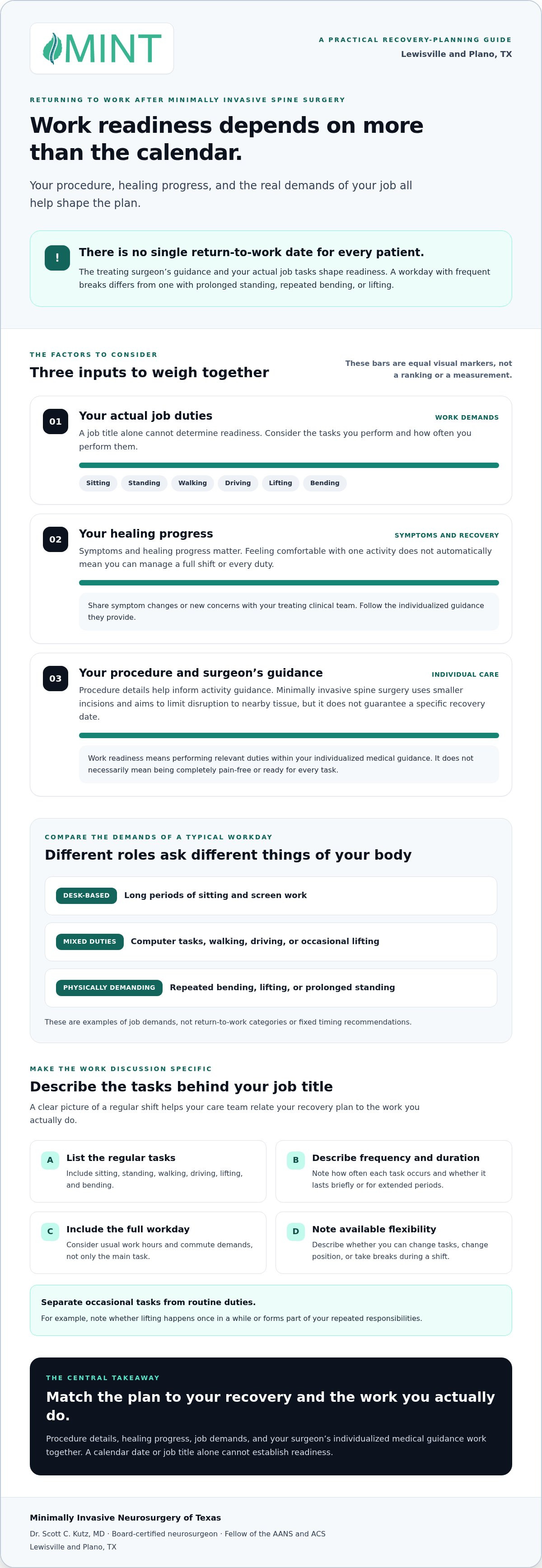
There’s no single return-to-work date that fits every patient. The timing depends on the procedure, your healing, and the tasks your job requires. Returning to work after minimally invasive spine surgery means matching your recovery to the real demands of your role, not following a universal calendar.
Your treating surgeon’s guidance and your actual job tasks shape your readiness to return to work. This distinction matters: the same recovery milestone may support one person’s duties but not another’s. A job that allows frequent breaks presents different demands from work that requires prolonged standing, repeated bending, or lifting.
Why minimally invasive spine surgery does not create one fixed return date
Minimally invasive spine surgery is an approach that uses smaller incisions and aims to limit disruption to nearby tissue. The general overview of minimally invasive spine surgery describes the range of techniques and procedures. Endoscopic spine surgery, which uses a small camera and specialized instruments through a small incision, is one example. Procedure details and individual healing shape how a surgeon guides activity progression.
Even when two patients have the same procedure, their recovery needs may differ. Symptoms, healing progress, and the movements required at work all matter. A procedure designed to limit tissue disruption doesn’t guarantee a specific recovery date or mean every task will feel manageable right away.
What your surgeon means by work readiness
Work readiness means you can perform the relevant duties within individualized medical guidance. It doesn’t necessarily mean you feel completely pain-free or ready for every task. You may notice improvement in everyday activities before you can safely manage a full shift, commute, or physically demanding assignment.
Dr. Scott C. Kutz, MD, is a board-certified neurosurgeon and Fellow of the American Association of Neurological Surgeons (AANS) and the American College of Surgeons (ACS). His spine-focused care considers the procedure and the patient’s specific needs when discussing recovery and activity. That conversation can help clarify which duties fit your current guidance and which may need adjustment.
For example, working at a computer may involve sitting for long stretches, while another role may require driving between locations or handling loads. Consider what a typical workday involves, including how often you change position and whether you can pause when symptoms increase. These details give your surgeon a clearer picture than a job title alone.
MINT’s endoscopic spine surgery care offers one example of how procedure details can inform recovery discussions. The right plan focuses on your healing and the demands you’ll face at work, helping you make decisions with your care team rather than rushing toward a date.
How Procedure, Healing, and Job Duties Shape Your Work Return
Your work category can offer a starting point, but it can’t determine a safe return date. A desk-based role may involve long periods of sitting and screen work. A mixed-duty position could combine computer tasks with walking, driving, or occasional lifting. Physically demanding work may require repeated bending, lifting, or prolonged standing. Each set of duties creates different demands, so returning to work after minimally invasive spine surgery calls for a plan based on your actual responsibilities.
Your job title alone cannot determine work readiness; your actual duties, healing progress, and surgeon’s guidance matter. The procedure also matters. For example, minimally invasive techniques aim to limit incision size and disruption to nearby tissue, but the details of the operation still shape your recovery plan. Individual symptoms and healing progress add another layer. These factors work together, not as separate rules that produce a guaranteed date.
Think through what a regular shift asks of your back. Sitting for extended periods may feel different from alternating between sitting and standing. Driving adds time in one position and requires you to manage the commute safely. Lifting and bending can place different physical demands on your body than walking or standing. Your surgeon can use these details to discuss which activities fit your individual medical guidance.
How to describe your job demands clearly
Bring a clear picture of your workday to your clinical discussion. Note your essential tasks, usual work hours, commute demands, and opportunities to change position or take breaks. Separate occasional tasks, such as lifting a box once in a while, from routine duties you perform repeatedly. An accurate job-duty description helps your care team relate your recovery plan to the work you actually do.
- List regular sitting, standing, walking, driving, lifting, and bending.
- Describe how often each task occurs and whether it lasts briefly or for extended periods.
- Note whether you can change tasks or positions during a shift.
How recovery progress affects the plan
Symptoms can improve as you heal, but feeling better doesn’t replace individualized medical guidance. Your comfort with one task doesn’t automatically show that you can manage a full shift or every duty. Share changes in your symptoms and any new concerns with your treating clinical team. Don’t add specific restrictions or milestones to your plan unless your clinician has discussed them with you.
Recovery guidance also depends on the procedure. A lumbar laminectomy, which removes part of the bone at the back of a vertebra to relieve pressure, has its own recovery considerations. MedlinePlus offers general information about recovery after lumbar laminectomy, including how surgery and job demands can affect work plans. Use general resources for background, then follow the guidance your treating surgeon gives for your situation.
For a more informed work discussion, describe your tasks alongside your symptoms and questions. MINT’s minimally invasive spine techniques provide context for how procedure details can shape individualized care conversations.
Full Duties, Modified Work, or More Time Away: Compare Your Options
After your surgeon discusses your recovery and work capacity, you can compare three possible arrangements: resume usual duties, adjust selected tasks for a time, or remain away from work longer. These are planning options, not guarantees or medical instructions. Your surgeon’s guidance must fit the actual responsibilities of your role, and any proposed adjustment needs to work in practice, not just on paper.
Procedure details also shape these conversations. MINT’s overview of minimally invasive spine techniques provides broader context for how surgical approaches differ. Your care team can connect your specific procedure and healing progress to the duties you hope to resume. The goal is a realistic plan that supports recovery while accounting for what your workplace can accommodate.
What modified duties can look like
Depending on your role and clinical guidance, you might discuss alternating between sitting and standing, working shorter periods, or temporarily setting aside selected tasks. These examples don’t create universal restrictions. Describe which essential responsibilities remain difficult, how often they occur, and whether another task or schedule could address the challenge. Your surgeon can then discuss whether a proposed adjustment fits your recovery.
Make the comparison specific. For each option, consider whether you can complete the essential parts of your job without exceeding the guidance you received. A temporary change only helps if your workplace can carry it out and the remaining duties match your current capacity. If no practical adjustment addresses the tasks that concern you, more time away may be worth discussing with your clinician.
How to compare a phased return with full duties
A phased return means resuming work gradually, such as starting with shorter work periods before taking on a fuller schedule. Compare that possibility with returning to usual hours and duties by considering schedule flexibility, commute demands, task intensity, and your ability to pause or change activities. Share these details with your clinician so the work plan reflects your recovery rather than a generic schedule.
Use a simple comparison to prepare for that conversation:
- Usual duties: Which tasks and hours would you resume, and what demands concern you most?
- Modified work: Which duties could change temporarily, and can your workplace make that adjustment?
- More time away: Which essential tasks still conflict with your current medical guidance?
None of these choices replaces clinical advice. Your clinician can help you consider how your procedure and recovery relate to each proposed arrangement, while your employer determines what work adjustments the role can support. If you’re preparing to discuss your recovery and work demands with MINT, you can contact the care team about your spine-care questions.
How to Plan Work Leave and Disability Paperwork After Spine Surgery
Leave and disability forms can feel like another burden during recovery. A simple sequence can make them easier to manage: gather your job details, organize the paperwork, discuss work limits with your treating clinician, then share updates as directed. For returning to work after minimally invasive spine surgery, accurate documentation can help explain what you can currently do, but it doesn’t decide whether an employer or benefit program will approve a request.
Prepare for a conversation about leave and work restrictions
Before your appointment, collect the forms you need completed, your role’s essential duties, relevant dates, and specific questions. Describe tasks that challenge you and the work adjustments you want to discuss. Ask what clinical details your care team can document and what information each form requests. Your clinician can report findings and recommendations, while the employer or benefit program makes its own eligibility decisions.
Use a short checklist to keep the paperwork organized:
- Gather employer forms and note when you need to submit them.
- Write down your usual duties, work schedule, commute demands, and any proposed adjustments.
- List the dates or periods the forms ask about, then bring questions about unclear fields.
- Keep your descriptions accurate and consistent with what you’ve discussed with your care team.
Forms should reflect the treating clinician’s documented findings and recommendations. Don’t ask a clinician to certify information that doesn’t match the medical record or their assessment. If a form asks about a decision outside the clinician’s role, ask the employer or benefit administrator who should complete that part.
Keep communication clear during a changing recovery
Recovery can change, so share relevant updates with your clinical team as directed. If symptoms change or you develop a new concern, seek clinical guidance instead of changing your work plan on your own. Keep copies of forms you submit and note when you sent them, whom you contacted, and any response or follow-up request. Clear records make it easier to track what you’ve shared.
Separate the medical and administrative questions. Your clinician can document how your condition affects function, meaning the activities you can manage, and describe recommendations within their clinical judgment. An employer or benefit program applies its own criteria to determine leave or disability eligibility. For information about the Family and Medical Leave Act (FMLA), a federal leave law, review the U.S. Department of Labor’s FMLA guidance and follow the instructions from your employer or benefit administrator. This article can’t determine your eligibility.
For help discussing how your spine-care plan relates to work demands, contact MINT’s care team.
Build Your Return-to-Work Plan With a Spine Specialist in Lewisville or Plano
A return-to-work plan works best when it reflects your procedure, healing progress, and real job demands. Minimally Invasive Neurosurgery of Texas (MINT) provides spine-focused care in Lewisville and Plano, Texas, for patients across the Dallas-Fort Worth region. Dr. Scott C. Kutz, MD, is a board-certified neurosurgeon who focuses on spinal disorders. His clinical discussions can help connect your recovery and work responsibilities without promising a specific return date.
That conversation should be practical. Bring a clear description of your regular duties, schedule, commute, and any tasks you find difficult. If you work at a desk, explain how long you typically sit and whether you can change positions. If your role involves driving, lifting, bending, or standing, describe how often those tasks occur. Specific examples help your care team understand the demands behind your job title.
Questions to bring to your next appointment
Prepare questions that connect medical guidance to your workday. You might ask:
- Which work duties matter most as we discuss my next stage of activity?
- What symptoms or changes in what I can do should prompt a follow-up?
- What work restrictions or functional details can the clinical team document based on this visit?
- What information should I share with my employer or benefit administrator?
These questions can clarify what your clinician can document and what you need to handle separately with your employer or benefit program. Keep the answers with your work-duty notes so you can refer to them as your recovery progresses.
How MINT supports patient-centered spine care
MINT’s spine-focused approach considers the procedure and your individual recovery when discussing work activity. For example, endoscopic spine surgery uses a small camera and specialized instruments to treat a spinal problem through a small incision. Reviewing the endoscopic spine surgery procedure can help you understand one approach your care team may discuss, while your surgeon guides decisions about your own recovery.
For patients in Lewisville, Plano, and the wider Dallas-Fort Worth area, the next step is to bring your work questions to a clinical conversation. Share changes in symptoms or function, and follow the guidance your treating team provides rather than adjusting your work plan on your own. A thoughtful discussion can help you understand what to address next and how to keep your return to normal activity aligned with your care.
Bring your job details and questions to your next MINT appointment to discuss a return-to-work plan shaped around your spine care.
Take the Next Step at a Pace That Fits Your Recovery
Your return to work can unfold as a series of informed decisions, not one pass-or-fail moment. As you consider returning to work after minimally invasive spine surgery, choose one practical next step: set aside time to review your current work expectations and note what you want to revisit at your next follow-up. That can help turn uncertainty into a focused conversation about your progress and priorities.
Keep your plan flexible as your recovery develops. Follow your treating clinician’s guidance, and revisit your work goals when your symptoms or abilities change. Small, thoughtful steps can help you move toward your usual activities with greater confidence.
Frequently Asked Questions
How long does it take to return to work after minimally invasive spine surgery?
There isn’t one timeline that applies to everyone. At a follow-up, ask your surgeon what they’ll assess before discussing your next work step, such as changes in symptoms or how you manage daily activities. You can also ask when to revisit the plan if your recovery changes. This gives you a clearer point for reassessment without treating a general estimate as personal clearance.
Can I return to desk work before physical work after spine surgery?
Desk work can still challenge your comfort, so consider the setup as well as the job category. Think about whether your chair, desk, and screen let you work comfortably, and whether your commute adds strain before the workday begins. If your role allows flexibility, ask your employer about options such as remote work or a schedule change, then discuss those arrangements with your care team.
Do I need my surgeon’s approval before returning to work after spine surgery?
Your surgeon can provide medical guidance about your recovery and work activity, but employers and benefit programs make their own administrative decisions. Ask whether your care team recommends a follow-up before you resume a particular duty and whether they can document that recommendation. If you receive a work-release form, read it carefully so you understand which duties or dates it addresses, and direct eligibility questions to the relevant administrator.
Can I ask for modified duties after minimally invasive spine surgery?
Yes, you can raise modified duties as an option, then discuss any proposed change with your clinician and workplace. Make the request specific: identify the task, explain how often it occurs, and describe the part that feels difficult. You might ask whether someone can temporarily reassign a particular task, if the role allows. Your clinician can discuss medical guidance, but the workplace determines what arrangements it can make.
What should I do if my symptoms worsen after I return to work?
If symptoms worsen, stop the activity that concerns you and follow the instructions your treating team gave you for that situation. Record when the change began and whether it continued after you stopped working. Share those details when you seek clinical guidance. Don’t restart a difficult task or alter your care plan based only on how you feel in the moment. Seek urgent medical care for symptoms that feel severe or urgent.
Can I use disability benefits while recovering from spine surgery?
You may apply for benefits, but only the relevant program or plan administrator can determine whether you qualify. Review the plan information for its definition of disability, required documents, and submission instructions. Then compare those requests with the medical information your clinician can provide. Keep a copy of the plan guidance and any correspondence so you can refer to the stated requirements if the administrator requests more information.
What should I include in paperwork for a return-to-work plan after spine surgery?
Start with the exact forms your employer or benefit administrator provided, and check each page for requested dates, signatures, and supporting records. Attach a separate job description if the form doesn’t leave enough room to describe your duties. Ask the care team to complete the medical portions based on your visit. Before submitting, review the packet for blank sections and keep a copy of the full version.
Is minimally invasive spine surgery guaranteed to get me back to work faster?
No. Minimally invasive techniques aim to limit tissue disruption, but they don’t guarantee a particular work-return date. If your surgeon discusses a procedure such as endoscopic spine surgery, ask how its specific goals relate to your condition and recovery plan. Focus the conversation on what your operation addresses and how your clinician will guide activity, rather than assuming the surgical approach alone predicts when you can work.