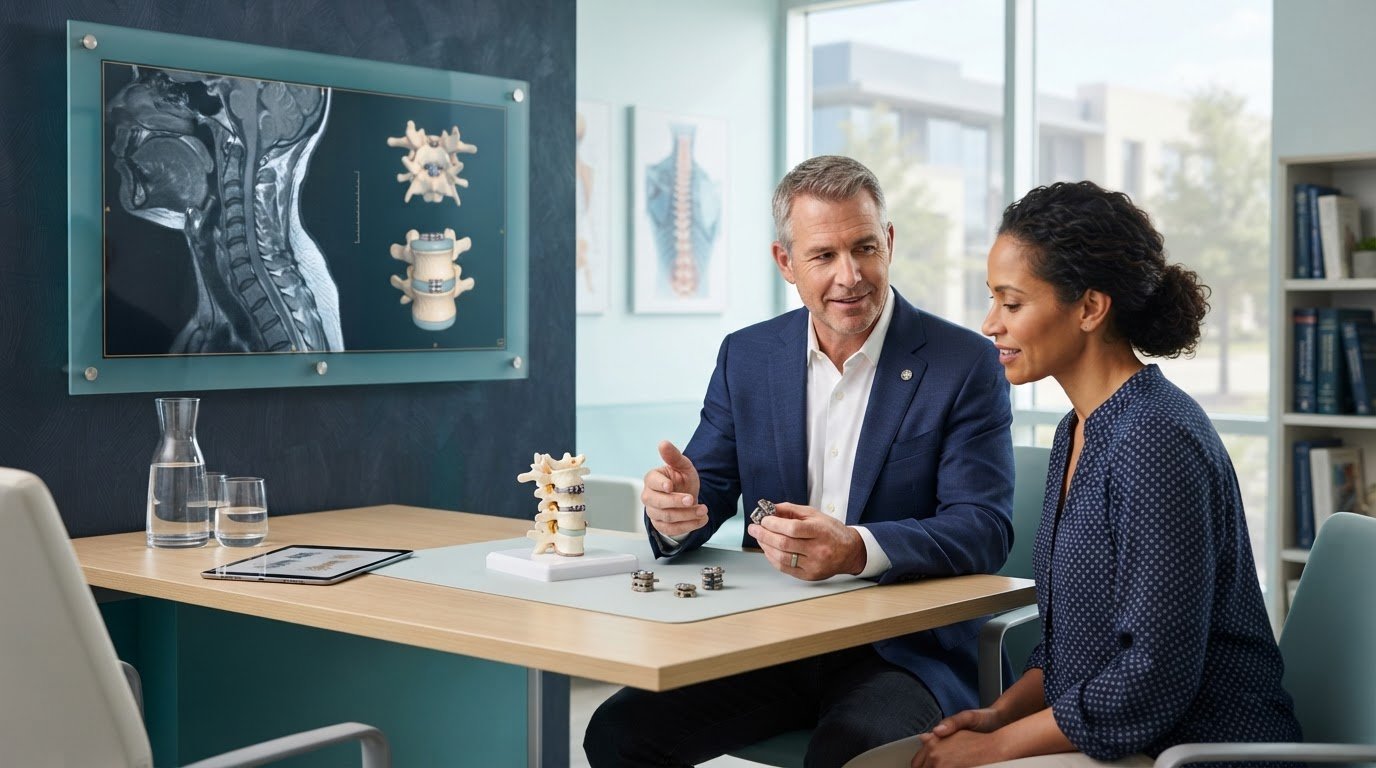
Minimally Invasive Neurosurgery of Texas (MINT), led by Dr. Scott C. Kutz, a board-certified neurosurgeon, provides artificial disc replacement in Lewisville and Plano, Texas. Use these questions to ask about artificial disc models to prepare for a conversation about your diagnosis, anatomy, and treatment goals.
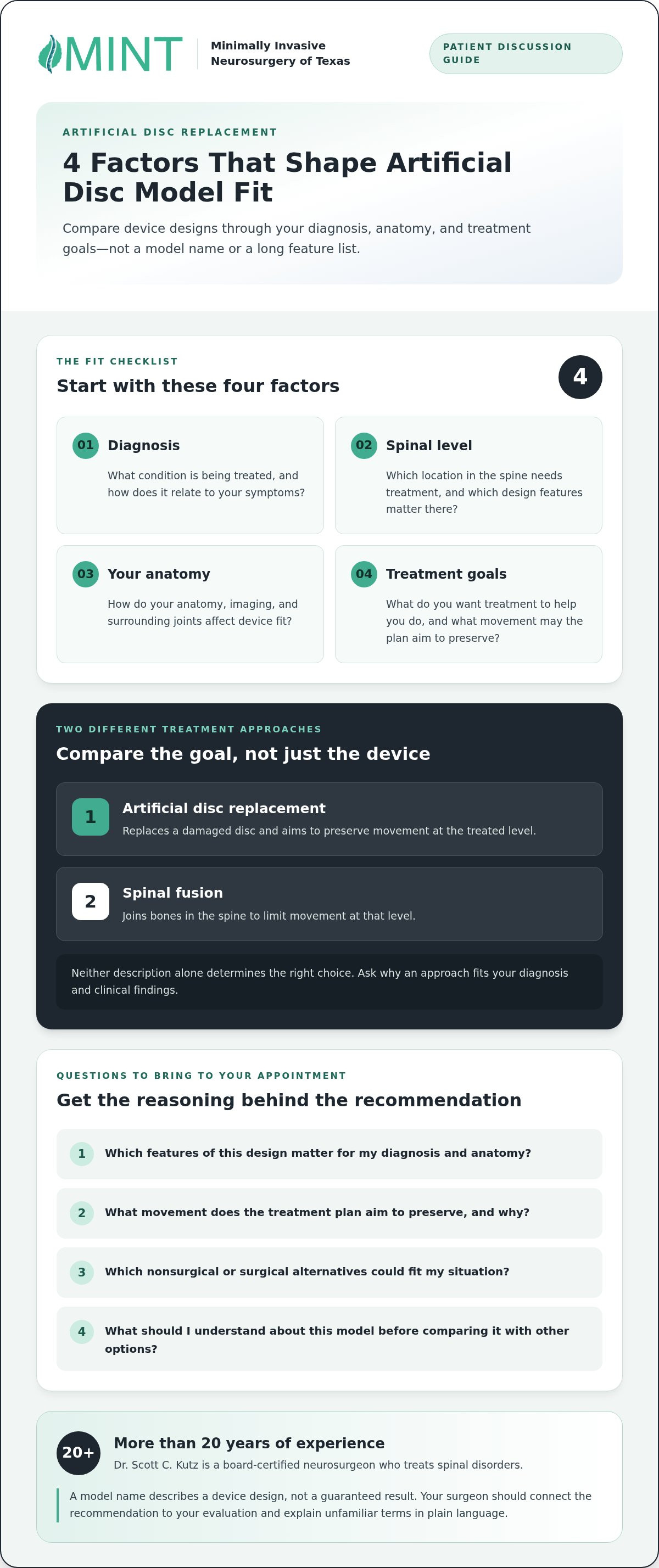
Choosing an artificial disc model starts with your clinical needs, not the device name or longest feature list. Model descriptions can feel difficult to compare, so ask how each relevant feature relates to your spine and the spinal level under discussion. No single model suits every patient.
Use this checklist to discuss device design and fit, whether artificial disc replacement aligns with your goals, and how it compares with options such as spinal fusion. Dr. Kutz has more than 20 years of experience treating spinal disorders. Your diagnosis and individual needs should guide the conversation.
Key Takeaways
- Use the questions to ask about artificial disc models checklist to focus your conversation with your surgeon on your diagnosis and treatment goals.
- Compare artificial disc replacement, which aims to preserve movement, with spinal fusion, which joins bones in the spine.
- Discuss how your imaging, spinal level, and anatomy shape the treatment plan and device fit.
- Ask your surgeon to explain the recommendation, supporting evidence, risks, alternatives, and follow-up in plain language.
- Learn how Dr. Scott C. Kutz and MINT discuss individualized artificial disc replacement and other spine care options in Lewisville and Plano, Texas.
What questions should you ask about artificial disc models before comparing them?
Before comparing device designs, use the questions to ask about artificial disc models to prepare for a shared decision with your spine surgeon. The goal isn’t to diagnose yourself or choose an implant from a list. It’s to understand the recommendation, how it relates to your situation, and which other treatment paths may fit.
Model suitability depends on your diagnosis, spinal level, anatomy, and treatment goals, not on a universal ranking. A model name describes a device design, not a guaranteed result. Ask your surgeon to connect each explanation to your case and define unfamiliar medical terms in plain English.
Start with questions about the diagnosis and treatment goal
First, clarify what condition the surgeon plans to treat and how it may relate to your symptoms. Ask what the evaluation shows and why the surgeon thinks the affected disc may contribute to your concerns. Then discuss the treatment goal. Preserving movement at the treated level may matter to you, but your surgeon should explain whether that goal fits your clinical situation.
- “What diagnosis are you treating, and how does it relate to my symptoms?”
- “What do you want treatment to help me do?”
- “Which nonsurgical or surgical alternatives could fit my situation, and why?”
These questions keep the discussion focused on your health rather than device names alone. The answers can also help you understand how disc replacement compares with spinal fusion, a procedure that joins bones in the spine. Your surgeon can explain which options fit your clinical circumstances.
Clarify what the word model means
In this discussion, a model means a specific device design. It doesn’t promise a particular outcome, and a longer feature list doesn’t automatically make a device a better fit. Total disc replacement (TDR), also known as artificial disc replacement (ADR), names the procedure. The implant design forms one part of the treatment discussion.
Ask which design features matter for your diagnosis and anatomy, and why. For example, ask how the surgeon considers the location of the affected disc and the movement the treatment plan aims to preserve. You don’t need to interpret technical descriptions on your own. Ask what a feature means for your case and whether it changes the recommendation.
- “Which features of this design matter for my diagnosis?”
- “How does the device fit my anatomy and the spinal level being treated?”
- “What should I understand about this model before we compare it with other options?”
Bring your questions to the appointment and take notes on the reasons behind the recommendation. A clear explanation should help you understand the treatment goal, the device’s role, and how the plan accounts for your needs. MINT’s artificial disc replacement care centers the discussion on your clinical evaluation.
Design and Motion Differences in Artificial Discs
An artificial disc replaces a damaged intervertebral disc, the cushion between neighboring bones in the spine. Its design aims to support movement at the treated level. Spinal fusion takes a different approach: it joins bones to limit movement at that level. Neither description alone determines which procedure fits a person’s diagnosis.
Device design describes how an implant works; patient-specific suitability depends on the diagnosis, spinal level, anatomy, and treatment goals. Models can differ, but a feature matters clinically only if it relates to the needs of the person receiving treatment. Avoid ranking devices by model name or by one feature in isolation.
Ask what design features matter clinically
Ask your surgeon how they evaluate a model’s intended spinal level and clinical use. The spinal level means the location in the spine that needs treatment. Then ask how the proposed device may relate to movement, stability, and the surrounding anatomy. Stability describes how well the spine supports controlled movement without unwanted shifting.
- “Which design features matter for the level you’re treating?”
- “How do my anatomy and the condition of the surrounding joints affect this discussion?”
- “What movement does the treatment plan aim to preserve, and why?”
Your surgeon can explain whether a design feature has practical importance in your case or simply describes the device. Ask for plain-language explanations of unfamiliar terms, and ask how each answer connects to your imaging and clinical assessment. Don’t assume that a material, dimension, or technical feature applies to every model. Your surgeon should explain relevant details using accurate information about the device under discussion.
Compare motion preservation with fusion carefully
Artificial disc replacement aims to preserve movement at the treated level, while fusion joins bones there. That distinction can help frame the conversation, but it doesn’t mean one approach suits everyone. The procedure and its goals should match the diagnosis and clinical findings. Ask why your surgeon recommends one approach over another and which factors shaped that recommendation.
For example, ask how each option relates to the symptoms being treated, the condition of nearby structures, and the movement your treatment plan seeks to maintain. Also ask which trade-offs the surgeon considers and how they affect your individual goals. The answers should clarify the reasoning, not promise a particular result.
During a discussion of artificial disc replacement, ask your surgeon to explain how the proposed implant supports the treatment plan. Bring your questions about device design, movement, and fusion to your appointment so you can follow the comparison and take part in the decision.
Which artificial disc model factors matter for your anatomy and goals?
A useful model discussion starts with your diagnosis, the spinal level involved, your anatomy, and what you hope treatment will help you do. A device feature alone cannot establish whether artificial disc replacement fits your case or predict your result. Model choice belongs within a complete clinical evaluation, not apart from it.
Ask how your diagnosis and anatomy shape the discussion
Your surgeon uses your medical history, physical examination, and imaging to understand the problem and assess possible treatment approaches. Imaging, such as scans that show spinal structures, can help the surgeon evaluate the affected disc and surrounding anatomy. Ask which specific findings support the recommendation and how those findings relate to your symptoms.
Clarify whether the discussion concerns the cervical spine, the neck portion of the spine, or the lumbar spine, the lower back portion. The spinal region and level help define the treatment under consideration. Ask the surgeon to explain what the examination and imaging show in terms you understand.
- “Which findings from my examination and imaging guide your recommendation?”
- “Which spinal region and level are we discussing?”
- “How does my anatomy affect the treatment options?”
Candidacy means a surgeon’s clinical judgment about whether a treatment may suit an individual patient. It depends on the complete case, not one scan, symptom, or device feature. Ask what factors support or limit the options under discussion and what additional information, if any, could help clarify the plan.
Connect model questions to personal priorities
Your goals help give the clinical discussion direction. Describe how pain affects your day, which activities matter most, and what you hope to regain or maintain. You can also share your preferences about treatment approaches. These details don’t replace the surgeon’s assessment, but they help connect the recommendation to your daily life.
Ask how the surgeon weighs artificial disc replacement against spinal fusion, which joins bones at the treated level. The comparison should address your diagnosis, anatomy, and goals rather than assume that preserving movement makes one option right for everyone. Ask which trade-offs matter in your case and how each approach aligns with your priorities.
- “How does my main goal affect the treatment options you recommend?”
- “What trade-offs do you consider between disc replacement and fusion for my case?”
- “How would the proposed plan relate to the activities I want to return to or maintain?”
If your questions concern a neck condition, MINT’s artificial disc replacement care offers relevant context for discussing the procedure. Bring your priorities and questions to the appointment. A focused conversation can help you understand how the recommendation fits your clinical findings and which choices you can consider together.
What should you ask your spine surgeon about risks, evidence, and alternatives?
A focused appointment can help you understand which artificial disc model your surgeon recommends and why it fits your case. Follow a clear sequence: recommendation, evidence, risks, alternatives, and follow-up. Ask the surgeon to explain medical terms as they arise and connect each answer to your diagnosis and clinical findings.
Use these questions to ask about artificial disc models to guide the conversation, not to predict an outcome on your own. Risks and potential benefits vary among patients. Your surgeon can discuss how your health and treatment plan shape the balance without promising a particular result or recovery course.
Ask about evidence, risks, and uncertainty
Start by asking why your surgeon recommends a particular approach. Then ask what clinical evidence supports it for your diagnosis. Clinical evidence means information from research and medical experience that helps guide treatment decisions. Your surgeon should explain how that information applies to your case rather than treat general findings as a guarantee.
- “Why do you recommend this approach for my diagnosis?”
- “What evidence supports this recommendation, and how does it relate to my situation?”
- “Which risks matter most in my case, and how do you evaluate them?”
- “What remains uncertain, and how does that affect the decision?”
Ask for plain-language definitions if terms feel unfamiliar. For example, ask the surgeon to describe a risk in practical terms and explain how your medical history or examination affects the discussion. If an answer doesn’t address your concern, restate the question or ask for an example tied to your treatment plan.
Ask about alternatives and next steps
Before deciding, ask which other options remain appropriate. Depending on your individual evaluation, the discussion may include nonsurgical care or spinal fusion, a procedure that joins bones at a treated level. Ask why the surgeon recommends one option over another and what trade-offs the alternatives involve for your goals.
Clarify the next steps if you need more information before making a decision. Ask whether additional evaluation would help, what follow-up would look like, and which changes in your symptoms should prompt you to contact the care team. Follow-up means the planned check-ins after a consultation or treatment to review your questions and care plan.
- “What alternatives are appropriate for me, including nonsurgical care or fusion?”
- “What further evaluation could help me make an informed decision?”
- “What should I expect at follow-up, and whom should I contact with questions?”
Prepare by bringing relevant imaging reports, a current medication list, and written questions. Notes can help you track the recommendation, evidence, risks, alternatives, and next steps without relying on memory alone. If you’re ready to discuss your spine-care questions, schedule a conversation with MINT.
How does MINT discuss artificial disc replacement in Lewisville and Plano?
At Minimally Invasive Neurosurgery of Texas, artificial disc replacement forms part of a broader conversation about your spine health, diagnosis, and treatment goals. Dr. Scott C. Kutz, a board-certified neurosurgeon with more than 20 years of experience treating spinal disorders, discusses options based on each patient’s clinical evaluation. MINT emphasizes evidence-based care and considers less invasive approaches when appropriate.
Explain the patient-centered decision process
A useful consultation connects what the evaluation shows, what treatment aims to address, and what matters in your daily life. Dr. Kutz considers your diagnosis, anatomy, and goals together rather than letting one device feature determine the plan. Recommendations depend on your individual clinical picture, and artificial disc replacement remains one option within a broader spine-care discussion.
Ask how the surgeon reached the recommendation and how other approaches compare in your case. MINT’s minimally invasive spine care considers less disruptive surgical techniques when they fit a patient’s needs. The discussion should explain why a treatment may align with your diagnosis, not promise a specific result.
Dr. Kutz’s neurosurgical background and experience inform these individualized conversations. Bring questions about how the proposed model relates to the spinal level under discussion and which alternatives the surgeon considers appropriate.
Help prepare for a local consultation
MINT provides spine care in Lewisville and Plano, Texas. To prepare for a consultation, organize information that can help the surgeon understand your case. Bring relevant imaging and reports, a summary of your medical history, a current medication list, and the model questions you want answered. Your notes can help you track the discussion and identify anything you’d like the surgeon to explain again.
- Write down your main symptoms and the activities they affect.
- List your treatment goals and any preferences or concerns.
- Bring questions about the recommendation, alternatives, risks, and next steps.
You don’t need to choose a device before the visit. The purpose of the conversation is to understand how the clinical evaluation guides the treatment discussion and which choices make sense for your situation. A clear, individualized explanation can help you take part in decisions with greater confidence.
To discuss your spine-care questions and arrange an individualized consultation, contact MINT.
Make Your Next Spine-Care Conversation Count
You don’t need to select a device before meeting with a surgeon. Start with one clear goal: understand how a treatment recommendation connects to your diagnosis and the life you want to return to. The questions to ask about artificial disc models can help you focus on your needs, what the surgeon recommends, and why.
Dr. Scott C. Kutz is board-certified by the American Board of Neurological Surgery and has more than 20 years of experience treating spinal disorders. He can discuss artificial disc replacement as part of an individualized spine-care evaluation, including whether another treatment approach better fits your situation.
Take the next step with your questions and concerns ready. Discuss your artificial disc replacement questions with MINT and move toward a clearer, more informed care decision.
Frequently Asked Questions
Is one artificial disc model better than all the others?
No. No single artificial disc model suits every patient. A design that fits one person’s diagnosis or spinal level may not fit another’s. Rather than rely on an online ranking, ask your surgeon to identify the feature they’re considering and explain how it relates to your findings. That explanation can help you compare options without treating a model name or popularity as proof that a device suits your case.
Can artificial disc replacement treat both neck and lower back conditions?
Surgeons may consider artificial disc replacement for selected conditions in the cervical spine, the neck, or the lumbar spine, the lower back. The appropriate treatment depends on your diagnosis and clinical evaluation. Ask which spinal region and level your care discussion addresses. A discussion about a neck disc doesn’t automatically apply to a lower back disc, so ask your surgeon to explain the recommendation for the specific area involved.
How does a surgeon decide which artificial disc model to discuss?
The surgeon considers your diagnosis, physical examination, imaging, spinal level, and treatment goals together. Questions to ask about artificial disc models become more useful when you connect them to specific findings. For example, ask which part of your examination or imaging supports the recommendation and how it affects the options. A scan provides information about spinal structures, but your surgeon interprets it alongside your symptoms and overall clinical picture.
What happens if I am not a candidate for artificial disc replacement?
If your evaluation doesn’t support artificial disc replacement, your surgeon can explain which finding affects the decision and discuss other appropriate options. Depending on your diagnosis, those options may include nonsurgical care or another surgical approach. Ask whether further evaluation could clarify the situation and how each alternative relates to your goals. One treatment decision doesn’t automatically rule out every other way to address your spinal condition.
Does artificial disc replacement preserve normal spinal movement?
Artificial disc replacement aims to preserve movement at the treated level, but it doesn’t promise normal movement or a specific result. Your surgeon can explain what motion preservation means for your diagnosis and treatment plan. Ask how the expected movement compares with fusion, which joins bones at the treated level, and which trade-offs matter in your case. Your individual anatomy and clinical findings help shape that discussion.
What information should I bring when discussing artificial disc models?
Bring relevant imaging reports, a current medication list, and notes about your medical history, symptoms, and daily activities. A brief symptom timeline, including when discomfort began and what affects it, can help you describe your experience clearly. Write down questions about the recommendation, alternatives, and decision steps. These materials give your surgeon useful context and help keep the conversation focused on your circumstances rather than a general device comparison.