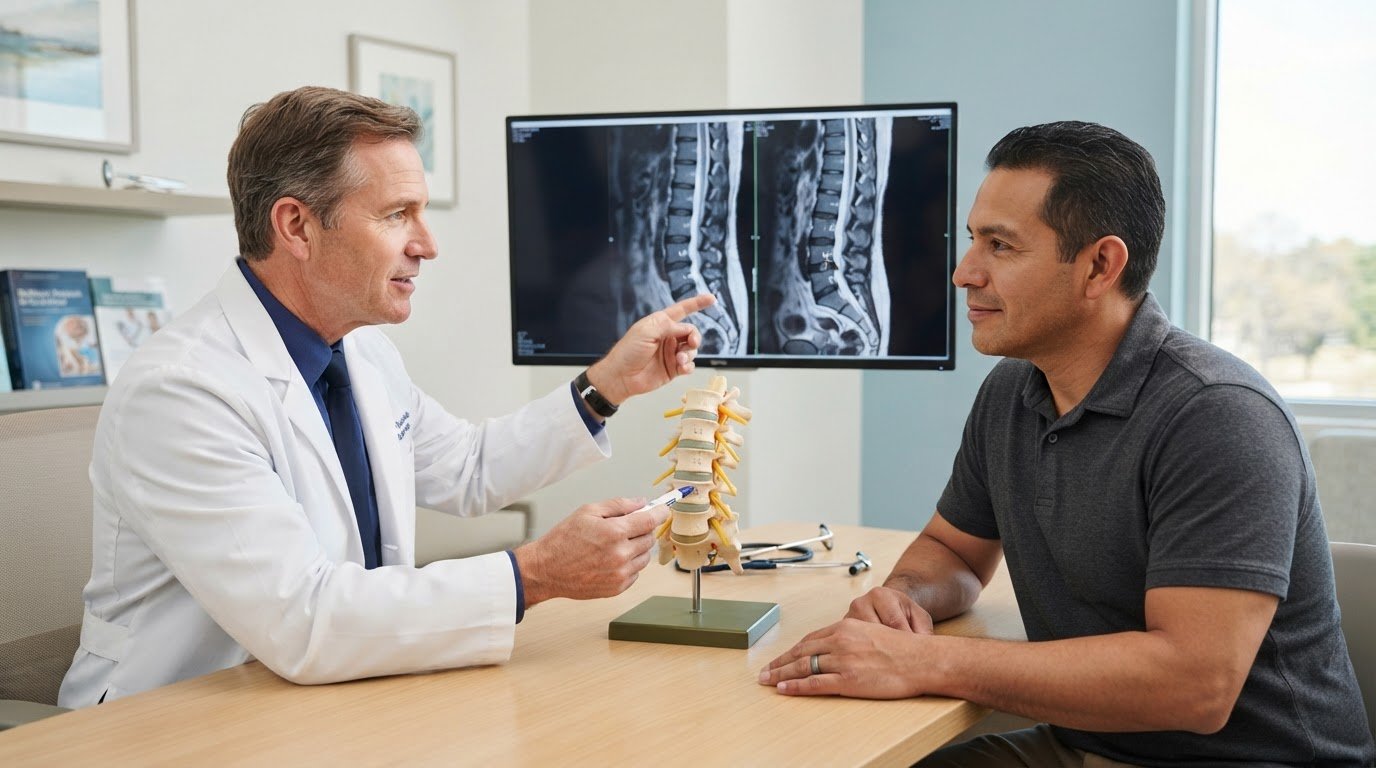
Minimally Invasive Neurosurgery of Texas provides minimally invasive spine surgery in Lewisville and Plano, TX, under the care of Dr. Scott Kutz, a board-certified neurosurgeon. When is revision spine surgery necessary? A surgeon may consider another operation when evaluation identifies a problem from an earlier procedure that surgery could address. Examples include nerve compression, pressure on a nerve, or adjacent segment disease, wear in spinal joints next to a previous fusion.
It’s understandable to feel concerned if recovery stalls or symptoms return. A focused evaluation considers your symptoms, medical history, prior operation, physical examination, and imaging. New or worsening numbness, tingling, or weakness, as well as changes in bladder or bowel control, need prompt medical attention.
This article explains what revision spine surgery involves and how persistent, returning, or new symptoms may shape an evaluation. It also discusses nerve changes and when minimally invasive techniques may be appropriate, helping you understand which findings can guide a conversation about next steps.
Key Takeaways
- Revision spine surgery may address a problem such as incomplete healing, hardware issues, or persistent nerve pressure after an earlier operation.
- Track symptoms that persist, return, or change, and share how they affect your daily activities during a medical evaluation.
- Adjacent segment disease describes wear in spinal joints near a previous fusion, which may contribute to new symptoms.
- New or worsening weakness, numbness, or changes in bladder or bowel control call for prompt specialist review.
- Minimally invasive techniques may be considered when they fit the cause of the problem and the needs of the revision procedure.
What is Revision Spine Surgery?
Revision spine surgery is a follow-up operation to address a complication, a later spinal problem, or an unsatisfactory result from an earlier procedure. Whether revision spine surgery is necessary depends on whether evaluation connects a treatable problem with ongoing or worsening symptoms.
Pseudoarthrosis and Failed Spinal Fusion
Pseudoarthrosis means the bones fail to join as intended after spinal fusion, an operation that connects vertebrae to stabilize part of the spine. This incomplete healing can leave the treated area unstable and contribute to persistent pain. X-rays or CT scans help assess bone healing and the condition of screws, rods, or plates. These findings help the surgeon determine whether another procedure could address the problem.
Causes of Failed Spinal Surgery
“Failed” surgery describes ongoing or returning symptoms, not one specific diagnosis. Possible causes include incomplete nerve decompression, when an operation does not relieve pressure on a nerve, or a recurrent herniated disc, when disc material presses on a nerve again. Scar tissue can irritate nerve roots. Hardware may loosen, break, or shift, and a new spinal deformity may develop.
A postoperative infection raises a different concern. The surgeon may need to remove infected tissue or hardware and then stabilize the spine. Whether revision spine surgery is appropriate depends on finding a problem that matches the symptoms and that another procedure can address. A fusion problem, for example, calls for a different plan than nerve compression or a shifted screw.
Alternatives can include medication, targeted injections, or physical therapy, depending on the underlying problem. These options may ease symptoms without another operation, but they do not correct every structural issue, such as unstable hardware or an incomplete fusion. Discussing alternatives helps clarify whether nonsurgical care can address the specific cause.
No single success rate applies to every revision procedure or spinal condition. Outcomes depend on the cause, the spinal region, and the operation required. Results for a hardware problem, for example, cannot predict results for failed fusion or recurrent disc herniation.
There is no universal waiting period before considering revision surgery. Persistent or worsening symptoms warrant evaluation, while progressive weakness or suspected hardware failure may need prompt attention. In other situations, there may be time to address health factors before another operation.
Revision procedures carry higher risks than first-time spine surgery because scar tissue and altered anatomy can complicate the operation. Costs and insurance coverage depend on the procedure, care setting, and insurance plan. To assess a surgeon, review board certification and experience with revision procedures. Minimally Invasive Neurosurgery of Texas offers endoscopic spine surgery, an approach that may suit some cases. The surgeon selects the route based on the identified problem.
Persistent, recurrent, or new symptoms after surgery
Persistent pain beyond the expected recovery period, returning pain, new radiating pain, or worsening symptoms can warrant evaluation. These changes may reflect nerve compression, a recurrent disc herniation, hardware failure, or another spinal problem, but persistent pain alone does not establish that revision surgery is needed. Patients often ask, “When is revision spine surgery necessary?” An evaluation looks for a treatable cause that matches the symptoms.
Persistent or Returning Pain
Persistent pain continues after surgery, while recurrent pain improves and later returns. The pattern and timing matter: pain that returns shortly after surgery may relate to nerve compression, while pain that returns much later may involve infection or continued spinal deterioration. Severe or increasing pain also warrants review, especially when it limits walking, sleep, or other daily activities.
Pain often improves within several months after an initial spine operation, but recovery varies by procedure and condition. Pain after spinal fusion, for example, may have a different cause than pain following a discectomy, which removes disc material pressing on a nerve. A symptom diary can help you track when pain began, where it travels, and which activities make it worse.
New Symptoms After Surgery
New symptoms are changes that did not occur before surgery, such as radiating pain, numbness, tingling, or weakness. Radiating pain travels from the spine into an arm or leg; numbness reduces sensation, and weakness makes movement or lifting harder. These changes can signal ongoing nerve involvement and deserve attention if they worsen or interfere with function.
A new symptom does not automatically mean the earlier operation failed or that another procedure is necessary. A recurrent herniated disc can be one reason symptoms persist or return after discectomy, but persistent symptoms do not always require another operation. Medication adjustments, targeted injections, or evidence-based physical therapy—such as the care approaches detailed at benchmarkphysio.com—may help some persistent symptoms without another operation.
Second Opinions for Persistent Symptoms
A second opinion gives another specialist the opportunity to review persistent symptoms, prior treatment, and the reasoning behind a proposed revision. Bring prior surgical reports and imaging if available, and describe changes in pain, sensation, strength, and daily function. This review can help clarify whether your symptoms match a treatable structural problem.
Ask what finding explains your symptoms, how imaging supports that explanation, and whether nonsurgical options remain appropriate. Ongoing leg pain after a lumbar procedure, for example, may prompt review for nerve pressure or a recurrent disc, while neck or arm symptoms after cervical surgery may require a different evaluation. A second opinion can help answer, “When is revision spine surgery necessary?” based on your specific symptoms and findings.
Adjacent segment disease
Adjacent segment disease describes degeneration in the spinal joints above or below a previous fusion. Fusion joins vertebrae to stabilize part of the spine. Afterward, nearby vertebrae can experience increased stress and wear. For example, a fusion in the lower back may leave the joints next to the fused area carrying more movement and load.
Adjacent segment degeneration refers to the physical wear itself. The term adjacent segment disease often describes degeneration associated with symptoms or a clinical problem. A scan may show changes near an initial fusion, but that finding alone does not explain every symptom or establish that another operation is needed. Patients and clinicians need to consider the location of the changes alongside symptoms and examination findings.
Patients may notice pain or other symptoms after an earlier operation, including a return of symptoms after a period of improvement. Location matters. Lower-back pain with symptoms traveling into a leg, for instance, may prompt evaluation of the lumbar spine, while neck pain with arm symptoms may lead clinicians to assess the cervical spine. These examples guide investigation but do not diagnose adjacent segment disease on their own.
Evaluation brings together your history, a physical examination, and imaging. The clinician reviews which spinal levels the initial procedure treated, when symptoms began, and whether they correspond with the segments above or below the fusion. X-rays show spinal alignment, while CT scans and MRI can help assess bones, discs, nerves, and existing hardware. Together, these details help distinguish adjacent degeneration from other possible causes, such as nerve compression or hardware complications.
A key question is whether the changes on imaging match your symptoms and affect daily function. A structural change without related symptoms does not, by itself, establish a reason for revision surgery. Persistent symptoms that correspond with degeneration near a prior fusion, however, may prompt closer review. The decision depends on the suspected cause, the extent of nerve involvement, and your response to nonsurgical care.
Revision surgery may be considered when adjacent segment disease causes significant symptoms and evaluation identifies a problem surgery can address. The plan depends on the affected spinal levels and the stability of the existing fusion. Surgeons may also consider nonsurgical options, such as medication, targeted injections, or physical therapy. The aim is to match treatment to the identified problem, not to assume every adjacent segment change requires another invasive procedure.
For patients whose symptoms return after spinal fusion, comparing prior and current imaging can help show whether nearby segments have changed. Sharing previous surgical reports and describing how symptoms affect walking, sleep, or other activities gives the evaluation useful context. These details help distinguish a possible adjacent segment complication from other causes and clarify whether further treatment merits consideration.
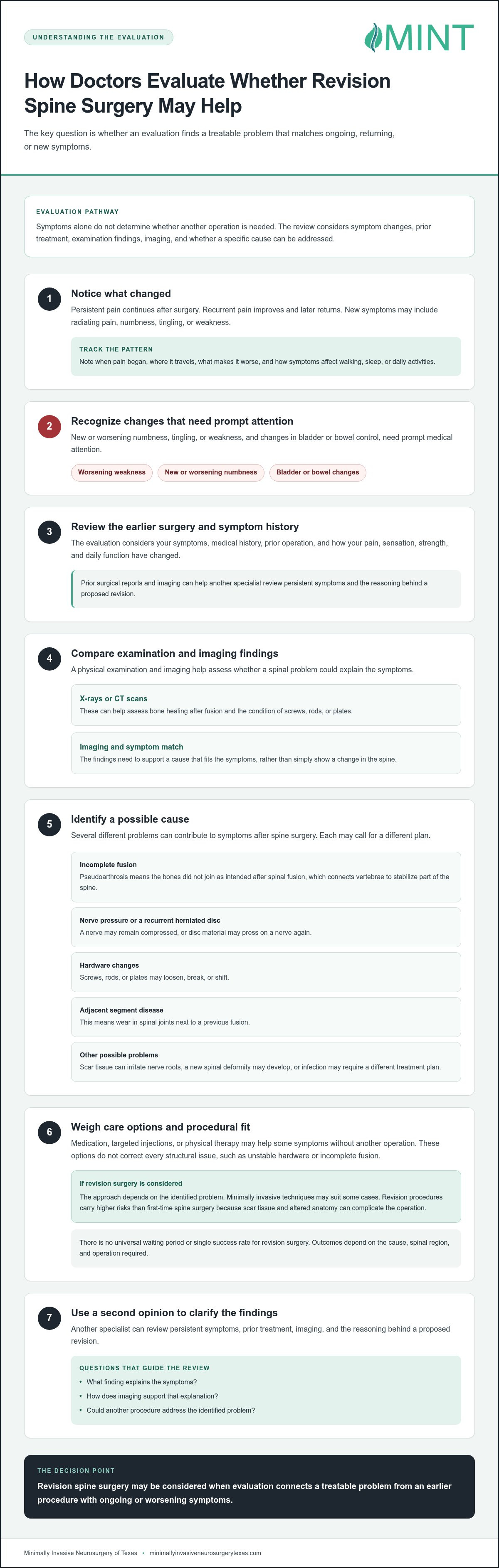
Evaluation of worsening neurologic symptoms
Doctors assess whether symptoms, examination findings, and imaging point to a correctable problem after spine surgery. They consider your medical history, prior surgical reports, a physical examination, and imaging such as X-rays, CT scans, and MRI.
New or Worsening Neurological Symptoms
Neurological symptoms involve changes in nerve function, including numbness, tingling, weakness, or difficulty holding objects. Worsening weakness after surgery, for example, may indicate progressive nerve compression, meaning increasing pressure on a nerve. Returning symptoms also matter because they may indicate that the original problem persists or a new spinal issue has developed.
Doctors compare the affected area with the prior surgical site and your operation history. For example, weakness in a hand after cervical surgery may prompt an examination of the neck and arm strength. Symptoms alone do not identify the cause, so clinicians look for corresponding findings on examination and imaging.
Symptoms Warranting Evaluation
Progressive weakness, spreading numbness, or tingling that interferes with walking or holding objects warrants specialist review. Changes in bladder or bowel function also require prompt imaging and specialist assessment. These symptoms can signal significant nerve involvement, and clinicians need to determine whether compression or another postoperative problem explains them.
Severe nerve compression or hardware failure with progressive weakness may require prompt intervention. In other cases, there may be time to address health factors before surgery. The difference depends on symptom progression, the suspected cause, examination findings, and whether imaging shows a problem surgery can correct.
A detailed evaluation starts with the timeline. The clinician reviews when symptoms began, whether they are improving or worsening, and how they affect daily activities. Prior surgical reports help identify the levels treated and the procedure performed. The clinician also considers whether conservative treatment, such as medication or physical therapy, changed your symptoms.
Imaging answers different questions. X-rays show alignment and hardware position; flexion-extension X-rays capture movement as you bend forward and backward, helping identify instability. CT scans show bone and hardware details, while MRI helps assess nerves and compression. Clinicians interpret these images alongside examination findings rather than treating a scan result as a diagnosis on its own.
Revision surgery becomes a consideration when symptoms match a correctable structural problem and evaluation supports intervention. A successful earlier recovery followed by new weakness, for example, calls for assessment of what changed. If severe compression causes progressive deficits, clinicians weigh the need for prompt treatment against the risks and complexity of another procedure.
Minimally invasive surgery may suit some revision cases, but scar tissue and altered anatomy can make access more challenging. The surgical plan depends on the affected spinal area, the cause of nerve symptoms, and the prior operation. A clear explanation of the findings helps patients understand why a surgeon recommends observation, nonsurgical care, or another procedure.
Minimally invasive revision surgery
Minimally invasive revision surgery uses a focused surgical approach to address a problem from an earlier spine operation. Surgeons consider it when they can reach and correct the identified cause without a broader exposure. The key question is whether the approach can safely address the problem, not simply whether it uses smaller access.
Revision procedures can involve scar tissue, changed anatomy, or hardware from the initial surgery. These factors make the operation more technically demanding than a first procedure. A surgeon plans for the specific issue, such as nerve compression, a loose screw, or a need to stabilize the spine. Imaging and prior surgical reports help map the treated area and guide the plan.
For nerve compression, the surgeon may need to create space around the affected nerve. If hardware failure causes symptoms, the plan may involve removing or replacing an implant. An incomplete fusion may require further stabilization. These procedures address different problems, so no single technique can correct every cause of persistent symptoms.
Minimally invasive techniques may suit some revision cases when the anatomy allows safe access and the procedure can meet its goal. Endoscopic Spine Surgery uses a small camera and specialized instruments to access the surgical area. When appropriate, this approach may support faster recovery, but scar tissue or the need for broader stabilization can affect the choice.
The route used for the prior surgery also shapes planning. For example, after an anterior procedure, meaning access from the front of the spine, a surgeon may use a posterior approach from the back when added stability is needed. Before selecting an approach, the surgeon considers the affected level, existing implants, bone health, nerve involvement, and the correction required.
Patients can ask what problem the proposed operation will correct, whether hardware needs removal, and why the chosen route fits the imaging findings. They can also ask how the plan accounts for scar tissue and altered anatomy. Clear answers connect the proposed technique to the actual cause, rather than making “minimally invasive” the deciding factor.
A smaller approach does not remove the complexity of revision surgery. The surgeon still needs to protect nearby nerves, manage scar tissue, and achieve the required decompression or stability. When endoscopic spine surgery fits the target problem, it offers one minimally invasive option. The best approach is the one that safely addresses the identified failure or nerve compression.
Minimally Invasive Neurosurgery of Texas: Minimally Invasive Spine Surgery
Minimally Invasive Neurosurgery of Texas provides Minimally Invasive Spine Surgery for patients whose spinal condition may need surgical treatment. If symptoms continue after an earlier operation, an evaluation can help connect your symptoms and prior procedure with imaging findings and possible next steps.
Dr. Scott Kutz, a board-certified neurosurgeon and Fellow of the AANS and ACS, focuses on spinal care. Revision planning depends on the problem identified, such as nerve compression, hardware concerns, or changes near a previous fusion. Minimally invasive techniques may suit some cases, while others call for a different surgical approach. An evaluation helps clarify which options address the underlying cause.
If persistent or returning symptoms affect your daily activities, contact Minimally Invasive Neurosurgery of Texas to discuss an evaluation.
Take the Next Step With a Clearer Plan
Deciding when revision spine surgery is necessary starts with understanding what changed and how it affects your daily life. Before a specialist visit, gather prior surgical reports and imaging, then note when symptoms began, what makes them worse, and which activities they limit. This preparation can help focus the conversation on your concerns and the findings that matter.
Dr. Scott Kutz, a board-certified neurosurgeon and Fellow of the AANS and ACS, evaluates spinal conditions with attention to each patient’s history and treatment goals. For patients in Lewisville and Plano, a focused discussion can clarify whether further evaluation or a surgical approach merits consideration. Revision surgery is not the only possible next step, and careful review helps connect treatment decisions to the underlying problem.
If ongoing or changing symptoms raise questions about your spine, contact Minimally Invasive Neurosurgery of Texas to discuss your concerns. A clearer plan can help you move forward with informed confidence.
Frequently Asked Questions
How do I know if I’ve damaged my spinal fusion?
You can’t confirm damage to a spinal fusion from symptoms alone; imaging and clinical assessment help identify changes. Contact your treating clinician if pain worsens, symptoms return, or you notice new weakness after an activity or fall. Share when the change began and which movements affect it. X-rays or CT scans can help assess bone healing and the position of fusion hardware.
Is It Possible To Avoid Failed Back Surgery?
You can reduce some risks by discussing nonsurgical options and proceeding with an operation only when its expected benefit justifies it. After surgery, follow the activity and medication instructions in your recovery plan. If your procedure involved fusion, avoid nicotine because it can interfere with bone healing. Report new symptoms early so your care team can assess them before they disrupt daily function.
What are the potential causes of a failed spinal surgery?
Persistent or returning symptoms can have several causes, including remaining nerve pressure, a recurrent herniated disc, incomplete bone healing, or an implant problem. Scar tissue may also irritate nearby nerves. Renewed leg pain after a lower-back procedure, for example, could have a different cause than discomfort near shifted hardware. An examination and imaging help connect symptoms with a likely source.
What does a failed spinal fusion feel like?
An incomplete fusion may cause ongoing or returning pain near the treated area, sometimes with symptoms that affect movement or daily activities. Some people also experience pain traveling into an arm or leg if a nerve remains irritated or compressed. These sensations do not prove that a fusion failed. A clinician compares your symptoms with examination findings and imaging to assess bone healing.
What percentage of spinal surgeries fail?
No single percentage describes every spinal operation, because procedures and definitions of failure differ. After discectomy, repeat surgery may be needed in up to a quarter of patients, often because a disc herniates again. That figure applies to repeat surgery after discectomy, not to all spine procedures. This information is educational and is not a substitute for professional medical advice; the website is provided “as is.”
What are the risks and complications of revision spine surgery?
Revision surgery carries higher risks than first-time surgery because scar tissue and altered anatomy can make the operation more complex. The specific risks depend on the problem and procedure.
What are the success rates of revision spine surgery compared with first-time surgery?
There is no single success rate for revision spine surgery. Outcomes depend on the cause, spinal region, and procedure. Revision surgery carries higher risks than first-time surgery because scar tissue and altered anatomy can complicate the operation.