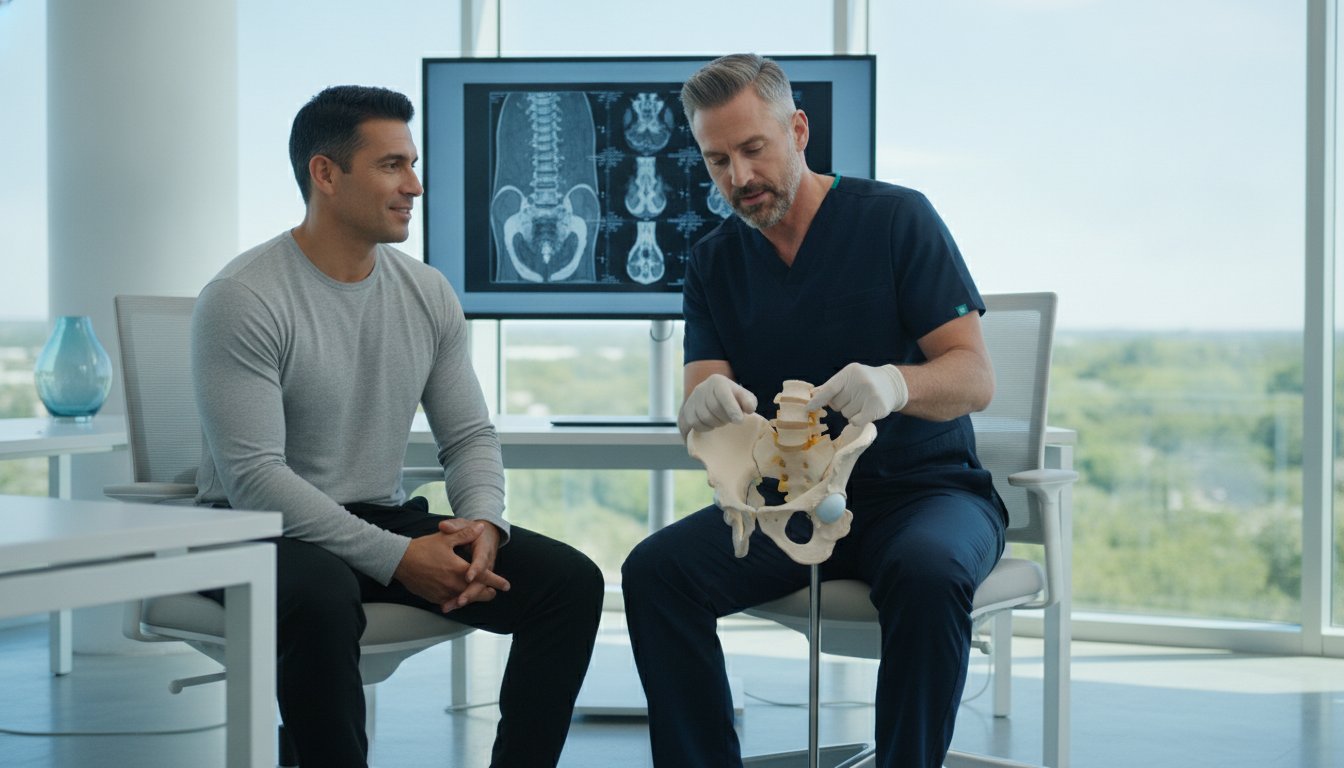
Minimally Invasive Neurosurgery of Texas (MINT) serves the North Texas community under the leadership of Dr. Scott Kutz, a board-certified neurosurgeon and Fellow of the AANS and ACS. Dr. Kutz provides expert sacroiliac joint disorder treatment Lewisville TX and Plano, TX, from our state-of-the-art facilities. Our team specializes in motion-preserving spine surgery, which stabilizes the spine while maintaining natural movement. We focus on helping patients regain their quality of life through precise diagnosis and advanced surgical techniques.
Research indicates that the sacroiliac joint causes 15% to 30% of chronic lower back pain cases, yet many patients receive a misdiagnosis of a lumbar disc issue. You likely feel exhausted by the inability to sit or stand for long periods without sharp pain. Dr. Kutz understands these frustrations and offers a path toward a return to normal activity. This article explores how our team identifies the true pain generator, or the specific source of your discomfort. You will also learn about our minimally invasive surgical options that offer faster recovery times than traditional open procedures.
Key Takeaways
- Learn how Dr. Scott Kutz provides specialized sacroiliac joint disorder treatment Lewisville TX and Plano to address chronic lower back and pelvic pain.
- Discover why physicians often misdiagnose sacroiliac joint dysfunction as a lumbar disc issue and learn how to identify the correct source of pain.
- Explore conservative care options like specialized physical therapy and see how they compare to motion-preserving surgical interventions.
- Understand the benefits of minimally invasive SI joint fusion, which uses small titanium implants to stabilize the joint through a tiny incision.
- Find out how precise diagnosis and advanced surgical techniques help patients return to normal daily activities without the need for invasive open surgery.
What is Sacroiliac Joint Dysfunction?
Minimally Invasive Neurosurgery of Texas (MINT) and Dr. Scott Kutz provide specialized sacroiliac joint disorder treatment Lewisville TX for patients seeking relief from chronic pelvic and lower back pain. Dr. Kutz, a board-certified neurosurgeon and Fellow of the AANS and ACS, operates from our headquarters in Lewisville and our satellite office in Plano, TX. You can learn more about our high-tech healer approach on our about us page. The sacroiliac joint connects the sacrum at the base of the spine to the pelvis, specifically the iliac bone. This joint acts as a critical shock absorber between the upper body and the legs during movement.
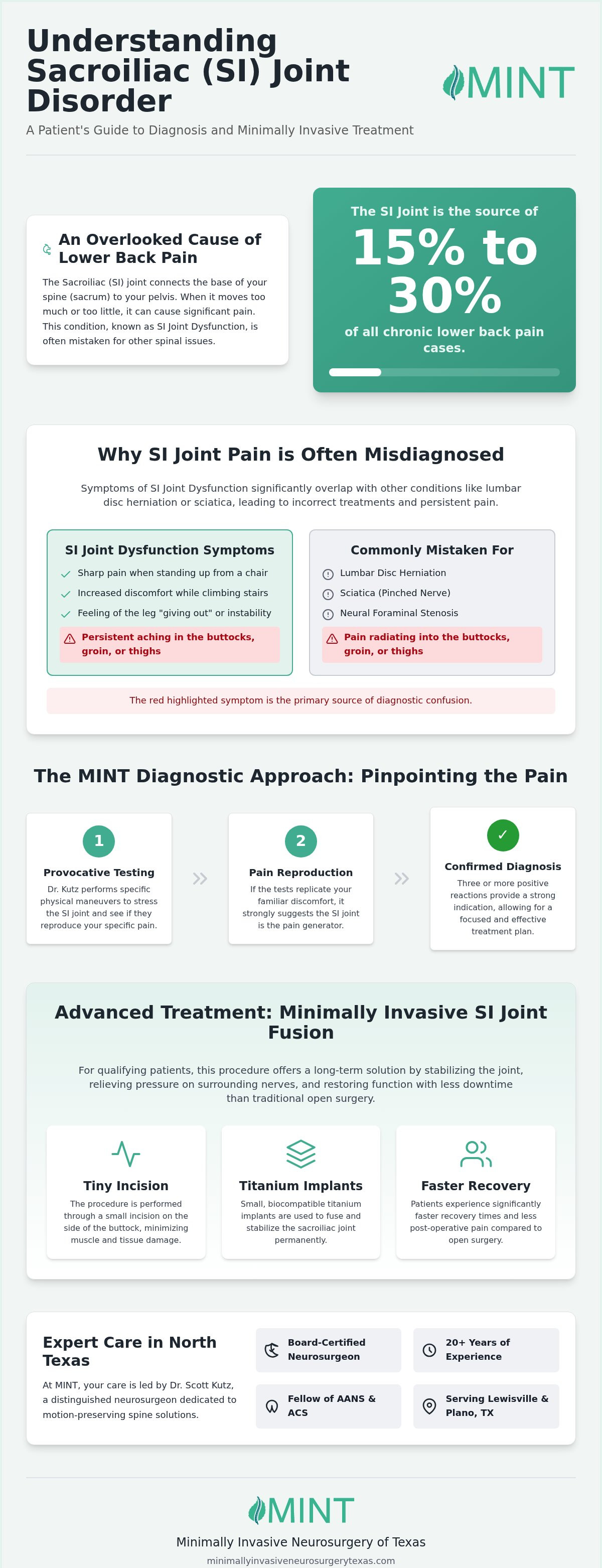
Sacroiliac Joint Dysfunction occurs when the joint moves too much, called hypermobility, or too little, called hypomobility. Both conditions trigger inflammation and irritate the small nerves surrounding the joint. This inflammation causes persistent discomfort that often limits a patient’s ability to walk, climb stairs, or sit for long periods. Research suggests that SI joint issues cause 15% to 30% of chronic lower back pain cases, making it a significant yet often overlooked condition for residents in Lewisville, Plano, and surrounding areas like Flower Mound.
The Anatomy of the Sacroiliac Joint
Strong ligaments encase the joint to provide essential stability and limit excessive motion. These connective tissues ensure the pelvis remains secure while you move. Small nerves surrounding the joint transmit pain signals directly to the brain when the joint becomes inflamed. During a consultation at MINT, Dr. Scott Kutz identifies the specific ligaments and nerves involved in your condition. He combines his 20 years of experience with minimally invasive spine surgery expertise to develop a precise recovery plan. This anatomical focus ensures that every patient receives care tailored to their unique physical structure.
Why SI Joint Pain is Often Misunderstood
Patients frequently confuse SI joint pain with lumbar disc herniation or sciatica because the symptoms overlap significantly. The pain often radiates into the buttocks, groin, and upper thighs, mimicking the patterns of a pinched nerve in the lower back. This confusion often leads to incorrect treatments that fail to resolve the underlying issue. Dr. Scott Kutz and his team utilize advanced diagnostic techniques to isolate the SI joint as the true pain generator. By confirming the exact source of your suffering, MINT prevents unnecessary procedures and focuses on motion-preserving solutions. Our boutique surgical practice prioritizes accurate diagnosis to ensure you return to normal daily activities as quickly as possible.
Recognizing Symptoms and Avoiding Misdiagnosis
Identifying the specific source of discomfort remains the most difficult part of sacroiliac care. Many patients in Lewisville and Plano suffer because doctors misidentify their pain as a lumbar disc issue. Dr. Scott Kutz, a board-certified neurosurgeon, notes that SI joint dysfunction causes up to 30% of chronic lower back pain cases. This condition often leads to “Failed Back Surgery Syndrome,” which occurs when a patient undergoes lumbar surgery but continues to experience pain because the surgeon missed the true generator. Dr. Scott Kutz provides expert sacroiliac joint disorder treatment Lewisville TX to help you avoid these diagnostic errors. You might notice specific symptoms that distinguish this condition from other spinal issues:
- Sharp pain when standing up from a seated position
- Increased discomfort while climbing stairs
- A sensation of the leg “giving out” or feeling unstable during a walk
- Persistent aching in the buttocks, groin, or upper thighs
Diagnostic Provocative Testing at MINT
Dr. Scott Kutz uses his 20 years of experience to perform specific physical maneuvers called provocative tests. These tests stress the SI joint to see if they reproduce your specific pain. If you react positively to three or more of these maneuvers, it strongly indicates that the joint requires medical attention. These exams help Dr. Kutz distinguish SI joint issues from other conditions like neural foraminal stenosis, which is the narrowing of the openings where nerves exit the spine, or bulging discs. You can read more about his diagnostic precision on our about us page. Our team ensures every patient receives an accurate diagnosis before discussing surgical options.
The Role of Diagnostic Injections
When physical tests suggest a problem, Dr. Kutz often recommends a diagnostic injection. During this procedure, Dr. Kutz injects a numbing agent directly into the joint. If the patient experiences immediate and significant pain relief, it confirms the SI joint as the primary culprit. MINT performs these injections using fluoroscopic guidance, which is a type of live X-ray imaging that ensures the needle reaches the exact target. This high-tech approach reflects the Sacroiliitis Diagnosis and Treatment standards established by major medical institutions. If you still struggle with unexplained lower back pain, you should schedule a consultation at our Lewisville or Plano office to find the relief you deserve.
Non-Surgical and Minimally Invasive Treatment Pathways
Dr. Scott Kutz always prioritizes conservative, evidence-based care. This philosophy guides every patient interaction at Minimally Invasive Neurosurgery of Texas (MINT). Those seeking sacroiliac joint disorder treatment Lewisville TX often start with non-operative pathways to manage their symptoms. Initial treatments typically include a combination of anti-inflammatory medications and specialized bracing. These tools provide temporary relief by reducing joint swelling and limiting painful micro-movements. For patients needing more than medication, Dr. Kutz offers radiofrequency ablation (RFA). This technique uses heat to disrupt the nerves around the joint, effectively blocking pain signals. RFA serves as an excellent middle-ground option for residents in Plano and Lewisville who aren’t ready for surgery but need lasting relief.
Conservative Management Strategies
Physical therapy focuses on stabilizing the pelvis through targeted exercises. A therapist helps you strengthen the core and pelvic floor muscles to support the weight-bearing load of the joint. Activity modification also plays a crucial role in the recovery process. You’ll learn to adjust your posture and avoid specific movements that trigger inflammation. Dr. Scott Kutz, a board-certified neurosurgeon, monitors your progress closely during this phase. He evaluates whether these conservative measures suffice or if the joint requires a more direct intervention. Our team at MINT provides personalized attention to ensure you understand every step of your care plan.
When to Consider Minimally Invasive Surgery
Patients who experience no significant relief after six months of conservative care often become candidates for surgery. Chronic pain that prevents you from sleeping or performing normal daily activities signals that the joint requires stabilization. Dr. Kutz utilizes minimally invasive spine surgery to address these issues with precision. These procedures preserve as much natural anatomy as possible while providing the stability you need. MINT relocated its headquarters to Lewisville in 2026 to better serve the growing North Texas community with these high-tech solutions. If you find that stretching and therapy no longer work, our boutique surgical center offers the expertise needed to restore your mobility and ensure a return to normal activity.
Minimally Invasive SI Joint Fusion: Procedure and Recovery
Dr. Scott Kutz provides advanced sacroiliac joint disorder treatment Lewisville TX for those who need a permanent solution to chronic pain. When non-surgical methods fail, minimally invasive SI joint fusion offers a path to stability. During this procedure, Dr. Kutz stabilizes the joint by placing small titanium implants across the gap between the sacrum and the ilium. Dr. Kutz uses advanced imaging to ensure perfect placement through a small incision in the buttock. This high-tech healer approach minimizes tissue damage and significantly reduces blood loss compared to traditional open fusion. Dr. Kutz typically completes the procedure in less than an hour and requires only a brief stay in the surgical center.
The Surgical Process at MINT
Dr. Kutz begins by making a small incision, usually about three centimeters long, to access the joint. He utilizes robotic navigation or fluoroscopic guidance to navigate the complex anatomy of the pelvis. Precision-guided instruments allow him to place the implants exactly where they stop painful, excessive motion. These titanium implants feature a porous surface that encourages your natural bone to grow onto the device. This process creates a permanent, biological bond over time. By focusing on motion preservation and structural integrity, MINT ensures that the procedure addresses the root cause of your instability.
Recovery Milestones and Timelines
Recovery from SI joint fusion at MINT follows a predictable, results-oriented rhythm. Most patients return home the same day or the following morning. Patients often begin walking with assistance within 24 hours of the surgery. This early movement prevents complications and helps the body adjust to the new stabilization. While every patient heals differently, most individuals return to light daily activities within two to four weeks. Patients typically achieve complete fusion and a full return to more strenuous activities within several months as the bone integrates with the implants. Our team in Lewisville and Plano provides detailed post-operative instructions to support your journey. If you are ready to move past chronic pain, contact MINT today to discuss your surgical options.
Expert Sacroiliac Care at MINT in Lewisville and Plano
Dr. Scott Kutz brings over 20 years of specialized experience to every sacroiliac joint disorder treatment Lewisville TX. As a board-certified neurosurgeon and Fellow of the American Association of Neurological Surgeons (AANS) and the American College of Surgeons (ACS), Dr. Kutz maintains the highest standards of neurosurgical care. Our practice, Minimally Invasive Neurosurgery of Texas (MINT), provides a boutique surgical experience. This environment prioritizes personalized communication and patient safety over the high-volume approach of large hospital systems. The Lewisville headquarters, which opened in January 2026, offers state-of-the-art technology for precision-based surgical planning. This facility allows our team to map out every detail of your procedure before you even enter the operating room. We also maintain a satellite office in Plano, TX, to ensure convenient access for patients throughout the region.
A Patient-First Philosophy in North Texas
MINT ensures every patient fully understands their diagnosis before we discuss surgical options. We believe that an informed patient feels more confident in their recovery journey. Our practice serves the entire DFW Metroplex, including surrounding communities like Flower Mound, Southlake, and Allen. Each patient receives a comprehensive care plan tailored to their specific mobility goals. Whether you want to return to competitive sports or simply walk through the park without pain, Dr. Kutz designs a pathway to help you achieve those results. We treat the person, not just the image on an MRI or X-ray. This dedication to the community defines our presence in both Lewisville and Plano.
Advanced Technology for Better Outcomes
Dr. Kutz continues to lead the field in motion-preserving surgical approaches for the spine and pelvis. MINT utilizes robotic navigation for unmatched accuracy during implant placement. This system allows for sub-millimeter precision, which reduces the risk of nerve irritation and ensures long-term stability. Additionally, the use of minimally invasive spine techniques results in smaller incisions, reduced blood loss, and faster healing times for our patients. These high-tech tools support our high-tech healer persona by combining robotic precision with the dedicated care of a local physician. By choosing MINT, you access the absolute forefront of modern surgical innovation right here in North Texas. Our focus remains on your return to normal activity through the safest and most effective methods available today.
Restore Your Mobility with Specialized SI Joint Care
Chronic pelvic and lower back pain shouldn’t dictate your daily life or limit your independence. You’ve learned how Dr. Scott Kutz, a board-certified neurosurgeon with over 20 years of experience, identifies the true pain generator through provocative testing and diagnostic injections. This precision ensures you receive the most effective sacroiliac joint disorder treatment Lewisville TX or Plano, TX. Whether you require conservative physical therapy or a minimally invasive SI joint fusion, MINT prioritizes your return to normal activity. Our high-tech healer approach combines robotic navigation with compassionate care to deliver smaller incisions and faster recovery times. You can find relief at our state-of-the-art headquarters in Lewisville or our satellite office in Plano. Don’t let misdiagnosis or the fear of invasive surgery keep you from the activities you love. Take the first step toward a pain-free future by partnering with a specialist who understands the complexities of the sacroiliac joint. Schedule a consultation with Dr. Scott Kutz at MINT today and rediscover the joy of movement.
Frequently Asked Questions
What are the first signs of sacroiliac joint disorder?
Sharp pain when standing up, climbing stairs, or turning in bed often signals the first stage of SI joint dysfunction. Pain usually sits in the lower back or buttocks. You might feel like your leg is giving out during a walk. This instability happens because the joint acts as a shock absorber. When it fails, you feel it during weight-bearing activities. Patients also report localized tenderness directly over the joint and discomfort when sitting for long periods.
How does Dr. Scott Kutz diagnose SI joint dysfunction in Lewisville?
Dr. Kutz uses a combination of physical exams and diagnostic injections. He performs provocative maneuvers, which are specific movements that stress the joint, to reproduce your pain. If three out of five tests cause discomfort, he confirms the SI joint as the likely source. He then uses a numbing injection under fluoroscopic guidance, or live X-ray imaging, to see if your pain disappears. This precise approach ensures an accurate sacroiliac joint disorder treatment Lewisville TX plan.
Is SI joint fusion surgery better than traditional back surgery?
Minimally invasive SI joint fusion offers distinct advantages over traditional open back surgery. The procedure requires smaller incisions, which leads to less tissue disruption and reduced blood loss. Dr. Scott Kutz focuses on motion-preserving techniques that stabilize the specific joint without the extensive recovery of a multi-level lumbar fusion. This surgical joining of lower back bones often requires more downtime. Our targeted approach results in less post-operative pain and lets you return to normal activity faster.
What is the typical recovery time after a minimally invasive SI fusion?
Most patients return home the same day or the following morning. You will likely begin walking with assistance within 24 hours of the procedure. Light daily activities usually resume within two to four weeks. Full integration of the bone with the titanium implants takes several months. Dr. Scott Kutz and the MINT team provide a specific timeline based on your health to ensure you regain mobility safely and effectively at our Lewisville or Plano locations.
Can SI joint pain return after surgical treatment?
Surgical fusion permanently stabilizes the joint, which prevents pain caused by excessive motion. While the fused joint itself typically stops being a pain generator, you may experience discomfort in adjacent areas. Doctors call this adjacent segment disease, where other joints work harder to compensate for the fusion. Dr. Kutz uses precision-based planning to minimize this risk. He also recommends core-strengthening exercises to maintain overall spinal and pelvic stability after your procedure at our North Texas facilities.
Does insurance cover sacroiliac joint disorder treatment in Texas?
Most commercial insurance plans and Medicare cover minimally invasive sacroiliac joint fusion when patients meet specific clinical criteria. As of January 1, 2026, Medicare provides coverage for these procedures with a national average co-payment of approximately $3,054 for outpatient care. You usually need to complete six months of conservative care before insurance approves surgery. Our team in Lewisville and Plano helps you navigate the prior authorization process, or the insurance approval requirement, with your provider.
How do I know if my pain is sciatica or an SI joint issue?
Sciatica involves a sharp, shooting pain that travels down the leg past the knee, often caused by a compressed nerve in the lumbar spine, or lower back. SI joint pain typically stays above the knee and concentrates in the buttocks or groin. Because the symptoms overlap, Dr. Scott Kutz uses provocative testing to isolate the sacroiliac joint. Distinguishing between these conditions is vital for receiving the correct sacroiliac joint disorder treatment Lewisville TX.
Why should I choose a neurosurgeon for SI joint pain instead of a chiropractor?
A board-certified neurosurgeon like Dr. Scott Kutz offers advanced diagnostic and surgical capabilities that go beyond temporary adjustments. Chiropractors provide manual manipulation, but they cannot perform the minimally invasive surgeries needed for permanent stabilization. Dr. Kutz utilizes his 20 years of experience and robotic technology to address the underlying structural issues. Choosing a neurosurgeon ensures you receive a comprehensive medical evaluation and access to the latest motion-preserving surgical innovations at our Lewisville and Plano offices.