What if the procedure meant to fix your back actually accelerates wear and tear on the rest of your spine? For years, patients have faced a difficult choice when comparing spinal fusion vs artificial disc replacement, often fearing that choosing stability means sacrificing their natural range of motion. You want to stop the pain without becoming a frequent visitor to the operating room due to Adjacent Segment Disease. It’s a common concern that we hear daily from our neighbors in Plano and Lewisville who are searching for a permanent solution to chronic neck or back pain.
This comprehensive medical comparison clarifies the clinical differences between preserving your natural movement and reinforcing your spinal structure. We’ll explore the latest 2026 healthcare shifts, including new FDA-approved motion-preserving implants and the transition toward outpatient surgical settings. You’ll learn how modern, minimally invasive techniques prioritize your recovery timeline, helping you return to an active, pain-free lifestyle with absolute confidence in your surgical path. Our goal is to move you from a state of uncertainty to a state of informed clinical clarity.
Key Takeaways
- Understand the clinical criteria used to decide between spinal fusion vs artificial disc replacement, focusing on whether your spine requires rigid stabilization or motion preservation.
- Recognize the specific medical scenarios, such as facet joint arthritis or osteoporosis, where spinal fusion remains the most reliable solution for long-term health.
- Explore the benefits of Artificial Disc Replacement for active individuals who prioritize maintaining a natural range of motion and reducing stress on neighboring vertebrae.
- Address the common fear of future surgeries by learning how modern surgical techniques help prevent Adjacent Segment Disease (ASD) following your procedure.
- Learn how the specialized expertise at MINT in North Texas utilizes minimally invasive technology to ensure a precise, patient-centered return to normal activity.
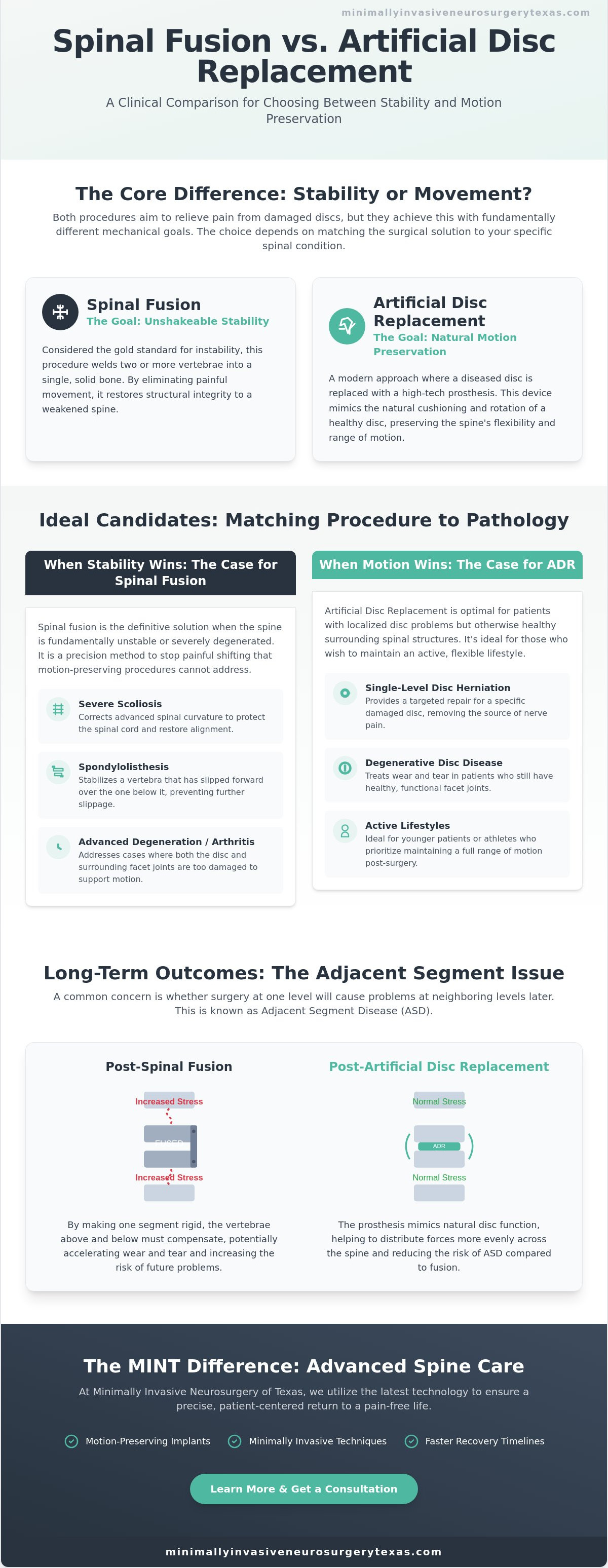
Spinal Fusion vs. Artificial Disc Replacement: The Core Difference
The decision to undergo spine surgery often begins with a fundamental question: do you need more stability or more movement? Both procedures serve as powerful tools to decompress pinched nerves and eliminate the debilitating pain caused by damaged discs. However, the mechanical end-state of each approach is vastly different. While one creates a solid foundation to prevent painful shifting, the other aims to replicate the fluid biomechanics of your original anatomy. Choosing between spinal fusion vs artificial disc replacement is about precision matching the surgical solution to your specific pathology.
As a high-tech healer, Dr. Scott Kutz views these procedures as specialized instruments in a modern surgical toolkit. The ultimate goal remains the same for every patient: a return to normal activity and the relief of physical suffering. Whether we are reinforcing a weakened segment or installing a motion-preserving prosthesis, the focus is on long-term clinical success and a significant improvement in your daily quality of life.
Understanding Spinal Fusion (Arthrodesis)
Spinal fusion is widely considered the gold standard for treating spinal instability. During this procedure, the surgeon uses bone grafts and specialized hardware to encourage two or more vertebrae to grow together into a single, immobile unit. By joining these bones, we effectively eliminate the grinding or shifting that causes nerve irritation and chronic discomfort. It’s a reliable method for restoring structural integrity when the spine’s natural support system has failed.
Conditions that typically require this stabilizing approach include:
- Spondylolisthesis: A condition where one vertebra slips forward over another.
- Severe Scoliosis: Advanced curvature that requires rigid correction to protect the spinal cord.
- Advanced Degeneration: Situations where the disc and surrounding joints have lost their structural ability to support weight.
Understanding Artificial Disc Replacement (Arthroplasty)
Artificial Disc Replacement (ADR) represents the modern frontier of motion preservation. Instead of fusing bones together, the surgeon removes the diseased disc and replaces it with a medical-grade prosthesis. These devices are typically constructed from cobalt-chrome alloys and high-density polymers, designed to mimic the natural cushioning and rotation of a healthy human disc. This allows the spine to bend and twist naturally, which can be a significant advantage for maintaining flexibility.
This technique is frequently the optimal path for:
- Single-Level Disc Herniation: Targeted repair for a specific damaged segment.
- Degenerative Disc Disease: Treating wear and tear in patients who still have healthy facet joints.
- Active Lifestyles: Younger patients or athletes who prioritize a full range of motion in their neck or back.
By understanding these core differences, you can better appreciate why a specialized diagnosis is essential. We don’t just treat the pain; we treat the underlying mechanical cause to ensure your spine remains healthy for years to come.
When Stability Wins: The Case for Spinal Fusion
In the evolving landscape of spine care, some patients worry that choosing a fusion procedure is a step backward. This is a significant misconception. While motion preservation is a major focus in modern medicine, spinal fusion remains the definitive solution for restoring structural integrity when the spine is fundamentally unstable. It isn’t a restrictive or outdated choice. It’s a precision-engineered method to stop painful, microscopic shifting that other procedures simply cannot address. For many in Plano and Lewisville, achieving a permanent return to normal activity begins with establishing a rock-solid foundation.
Clinical success in any spinal fusion vs artificial disc replacement debate depends entirely on the patient’s underlying anatomy. For instance, Artificial disc replacement is a remarkable technology, but it requires healthy facet joints and strong bone density to function correctly. If a patient suffers from advanced osteoporosis or facet joint arthritis, a moving prosthesis could actually cause more pain. In these cases, fusion provides the necessary support that a motion-preserving device cannot offer.
Clinical Indications for Fusion
Stability becomes the priority when the spine’s alignment is compromised. We typically recommend fusion for conditions such as:
- Spondylolisthesis: This occurs when a vertebra slips forward over the one below it, creating mechanical instability that requires rigid fixation.
- Severe Scoliosis: Structural realignment is necessary to correct significant curvature and prevent long-term neurological complications.
- Damaged Facet Joints: When the “hinges” of the spine are worn down by arthritis, preserving motion can lead to persistent discomfort, making stabilization the superior clinical path.
The Minimally Invasive Fusion Advantage
Modern advancements have completely revolutionized the fusion experience. At our practice, we utilize advanced techniques that prioritize the preservation of your natural muscle tissue. Unlike traditional open surgeries that required large incisions and significant muscle disruption, our approach uses specialized instruments to work through tiny openings. This results in less post-operative pain, minimal blood loss, and a much faster transition back to your daily life. If you are exploring your options, you can learn more about minimally invasive spinal fusion Texas to see how we’ve refined this process.
If you have been told you need surgery but fear a long recovery, it’s time to consult with a specialist who understands the balance of stability and technology. You can reach out to our team at Minimally Invasive Neurosurgery of Texas to schedule a detailed evaluation of your spine health.
When Motion Preservation Wins: The Case for Artificial Disc Replacement
For many patients, the primary goal of spine surgery isn’t just the elimination of pain; it’s the preservation of a natural, active lifestyle. When weighing the options of spinal fusion vs artificial disc replacement, the most compelling argument for replacement is the maintenance of your natural range of motion. Unlike fusion, which creates a rigid segment, Artificial Disc Replacement (ADR) utilizes a high-tech prosthesis to mimic the fluid movement of a healthy human disc. This approach is transformative for individuals who aren’t ready to accept the physical limitations often associated with traditional stabilizing procedures.
Choosing ADR is often a strategic, preventative measure for long-term spinal health. By maintaining motion at the treated level, we reduce the compensatory stress that usually falls on the discs above and below the surgical site. This mechanical advantage is particularly vital for younger, active patients who have decades of physical activity ahead of them. It’s a precision-engineered solution that treats the current pathology while protecting the integrity of the rest of your spine.
The Mechanics of Motion Preservation
The core function of an artificial disc is to act as a mechanical shock absorber. These devices are designed to support the weight of your body while allowing for natural bending, twisting, and rotation. There’s a distinct clinical difference between how we approach various areas of the spine. In the cervical spine, the focus is on maintaining the ability to tilt and turn the head smoothly. You can explore these nuances further in our specialized guide to neck disk replacement in Plano. In the lumbar spine, the prosthesis must manage much higher weight-bearing forces while still facilitating natural flexion and extension of the lower back.
Ideal Candidates for ADR
While ADR offers incredible benefits, it’s a “precision-matched” procedure that requires specific anatomical conditions for success. We look for patients who have maintained good bone density and possess healthy facet joints, which are the small stabilizing hinges located behind the discs. If these joints are already worn down by arthritis, a motion-preserving disc might not provide the relief you need. Ideal candidates typically present with single-level disc disease and a strong desire to return to high-impact activities or demanding physical work. It’s important to note that true candidacy for ADR requires the absence of facet arthropathy to ensure the joint remains pain-free during movement.
If you’re unsure if you fit this “candidacy window,” a detailed diagnostic evaluation is the only way to be certain. We use advanced imaging to look beyond the damaged disc and assess the health of your entire spinal environment. This ensures that when we recommend a motion-preserving path, it’s the one that will offer you the most reliable, long-term relief.
Comparing Long-Term Outcomes: The Adjacent Segment Issue
“Will I need another surgery in five years?” is the question that keeps many patients awake at night. It’s a valid concern. When we compare spinal fusion vs artificial disc replacement, we aren’t just looking at the next six months; we’re looking at the next decade of your life. The clinical goal is to ensure that the solution we provide today doesn’t become the source of a new problem tomorrow. While both procedures have high patient satisfaction rates when indicated correctly, their long-term impact on the rest of your spine differs significantly.
Recent clinical trends in 2026 show a steady growth in motion-preserving technology, largely driven by the desire to avoid repeat procedures. Data suggests that patients who receive an artificial disc often return to high-impact activities sooner than those who undergo fusion. This faster recovery is a hallmark of the high-tech healer approach, where we use advanced prosthetics to get you back to the sports and hobbies you love without unnecessary delay.
What is Adjacent Segment Disease?
Adjacent Segment Disease, or ASD, is a condition where the spinal levels directly above or below a surgical site begin to degenerate prematurely. Think of your spine as a chain. If you weld two links together, the remaining links must bend further and work harder to compensate for the lost movement. This increased mechanical stress can lead to accelerated wear, potentially requiring additional surgery in the future. ADR reduces the mechanical stress on neighboring discs by maintaining natural flexibility. By allowing the treated segment to move, we protect the “neighboring” links from the compensatory overload that often follows a traditional fusion.
ADR vs. Fusion Comparison Table
To help you visualize the different paths to recovery, we’ve outlined the primary clinical distinctions between these two methodologies. While “Stability” is the primary win for Fusion in complex cases involving deformity or multi-level instability, ADR offers distinct advantages for those who meet the candidacy criteria.
| Feature | Artificial Disc Replacement (ADR) | Spinal Fusion |
|---|---|---|
| Spinal Motion | Preserved natural movement | Restricted/Stabilized segment |
| Recovery Timeline | Faster return to impact sports | Moderate, structured recovery |
| ASD Risk | Lower risk to neighboring discs | Higher risk due to stress transfer |
| Primary Benefit | Motion preservation | Structural stability |
Choosing the right procedure requires a master’s touch and a deep understanding of spinal biomechanics. If you’re ready to find a permanent solution for your pain, contact Minimally Invasive Neurosurgery of Texas to schedule a comprehensive evaluation with our board-certified team.
The MINT Difference: Advanced Spine Care in North Texas
Choosing between spinal fusion vs artificial disc replacement is a significant clinical decision that shouldn’t be made in an impersonal hospital setting. At Minimally Invasive Neurosurgery of Texas (MINT), we provide a specialized, boutique environment where your health is the absolute priority. Dr. Scott Kutz and our board-certified team in Lewisville and Plano offer a sophisticated blend of high-tech innovation and local, patient-centered care. We understand that every patient’s spine tells a different story, and we’re here to ensure yours has a successful next chapter.
Our practice stands as a regional leader because we don’t believe in one-size-fits-all solutions. Whether we are preserving your motion or reinforcing your spinal stability, we utilize the most advanced surgical methodologies available in 2026. By focusing on the specific pathology of your condition, we’re able to deliver results that align with your long-term wellness goals.
Precision Through Robotic Navigation
One of the ways we distinguish our care is through the use of the Globus Excelsius robotic navigation system. This technology acts as a high-tech hallmark of our practice, providing a level of accuracy that traditional methods simply can’t match. For patients requiring fusion, the system creates a detailed, GPS-like map of the spinal anatomy. This allows Dr. Kutz to place hardware with sub-millimeter precision, which is vital for protecting delicate nerve structures. Plano residents frequently seek out these advanced options because they know that robotic precision leads to less tissue disruption, improved safety, and more predictable clinical outcomes.
Your Journey to Recovery in Lewisville and Plano
The transition from chronic pain to a state of informed confidence begins with a specialized consultation. We take the time to evaluate your bone density, joint health, and lifestyle needs to determine your candidacy for either procedure. We don’t just look at an MRI; we look at how your condition affects your daily life. Our signature value proposition is always your return to normal activity. We don’t consider our work done until you’re back to the hobbies and physical movements that define your quality of life.
If you’re ready to move past the confusion of conflicting recommendations, we invite you to explore our approach to minimally invasive neurosurgery. By combining the expertise of a dedicated local physician with cutting-edge technology, we provide a path to recovery that is both efficient and authoritative. Your journey back to health starts with a team that treats you like a neighbor, not just a case number.
Empowering Your Return to Normal Activity
The path to a pain-free life isn’t a one-size-fits-all journey. It’s a precision-matched clinical choice between establishing a rock-solid foundation and preserving your natural biomechanics. We’ve explored how modern stabilization techniques provide essential support for complex structural issues, while motion-preserving technology offers a transformative alternative for those with healthy joints. Both procedures, when indicated correctly, serve the same ultimate goal: the relief of suffering and a significant improvement in your daily quality of life.
Deciding between spinal fusion vs artificial disc replacement requires the expertise of a board-certified specialist who operates at the absolute forefront of modern innovation. Dr. Scott Kutz and the team at MINT utilize the Globus Excelsius robotic navigation system to ensure every procedure is performed with surgical excellence. We are proud to serve the Lewisville and Plano communities with a boutique, patient-centered approach that prioritizes your individual recovery. You deserve a treatment plan that is as unique as your anatomy.
Don’t let chronic back or neck pain dictate your future any longer. We invite you to Schedule Your Consultation with Dr. Scott Kutz at MINT today. Our team is ready to provide the clinical clarity and compassionate care you need to move forward with confidence. Better days are within reach, and we’re here to help you get there.
Frequently Asked Questions
Is artificial disc replacement safer than spinal fusion?
Both procedures are considered safe and FDA-approved when performed by a board-certified neurosurgeon. While artificial disc replacement is often associated with a lower risk of Adjacent Segment Disease, spinal fusion remains the safer clinical choice for patients with significant instability or deformity. The safety of the procedure depends entirely on matching the right technology to your specific anatomy and underlying pathology.
How long does the recovery take for a minimally invasive spinal fusion?
Most patients can return to light activity and office-based work within two to four weeks following a minimally invasive spinal fusion. Because we utilize smaller incisions and preserve muscle tissue, the initial healing phase is significantly shorter than traditional open surgery. However, the biological process of the bones growing together into a solid unit typically takes several months of structured recovery for total stability.
Can I have an artificial disc replacement if I’ve already had a fusion?
Yes, you can often receive an artificial disc at a level adjacent to a previous fusion. This is frequently done to treat Adjacent Segment Disease and preserve remaining mobility in the spine. While you cannot replace the specific segment that has already been fused into a solid bone, ADR is a powerful tool for protecting the rest of your spine from compensatory stress and further degeneration.
Will I lose my range of motion after a neck fusion?
You will lose motion at the specific vertebral level being fused, but many patients find their overall neck mobility remains quite functional. Because the rest of your cervical spine continues to move naturally, the loss of a single segment is often offset by the relief of debilitating pain. Our goal is to stabilize the painful joint while helping you maintain a productive and active lifestyle.
Does insurance typically cover artificial disc replacement in 2026?
As of 2026, many major payers, including Medicare and UnitedHealthcare, provide coverage for total artificial disc replacement when specific medical necessity criteria are met. New policies effective in early 2026 have clarified these requirements, though most plans still require prior authorization under models like the Wasteful and Inappropriate Service Reduction (WISeR) model. Our administrative team works closely with your provider to navigate these clinical requirements.
What happens if an artificial disc fails?
If a prosthesis fails due to wear or loosening, the most common clinical solution is to perform a revision surgery to convert the segment into a fusion. While these failures are statistically rare, converting to a fusion provides the stability needed to eliminate pain and secure the spinal segment permanently. We use advanced imaging to monitor the integrity of your implant during your long-term follow-up care for peace of mind.
How do I know if I am a candidate for ADR instead of fusion?
You are likely a candidate for ADR if you have single-level disc disease, healthy facet joints, and no significant spinal instability. When comparing spinal fusion vs artificial disc replacement, we use high-resolution imaging to ensure your bones are strong enough to support the prosthesis. A detailed diagnostic journey is the only way to determine which surgical path offers the most reliable long-term outcome for your back.
What is the success rate of minimally invasive spine surgery at MINT?
Our practice maintains high patient satisfaction rates by focusing on precision diagnostics and the use of advanced systems like Globus Excelsius robotic navigation. We measure success by our patients’ ability to achieve a return to normal activity with minimal post-operative discomfort. By prioritizing minimally invasive neurosurgery, we consistently help our North Texas neighbors find lasting relief from chronic spinal conditions through specialized care.