
Minimally Invasive Neurosurgery of Texas provides minimally invasive spine surgery in Lewisville and Plano, Texas, with care from Dr. Scott Kutz, a board-certified neurosurgeon and Fellow of the AANS and ACS.
Can I avoid a neck fusion? Sometimes. It depends on what is causing your symptoms, how well the affected area moves, and whether your spine needs added stability. For some people with a damaged neck disc, artificial disc replacement may preserve movement.
It’s understandable to worry that fusion could limit neck movement or involve a longer recovery. This article explains why surgeons consider fusion, how disc problems and earlier treatment can shape your options, and when disc replacement may not suit your diagnosis. You’ll also learn which symptoms can point to nerve pressure and why changes in strength need prompt attention.
Key Takeaways
- Neck fusion isn’t the only possible option; the cause of symptoms, disc condition, and need for spinal stability all shape the treatment plan.
- ACDF removes a damaged disc and stabilizes the space between the vertebrae, but fusion can affect nearby spinal levels.
- Artificial disc replacement may preserve movement, but existing loss of motion, a narrow disc space, or certain neck conditions can make it unsuitable.
- Neck and arm pain, tingling, numbness, or weakness can signal pressure on a nerve, so changes in strength deserve prompt medical attention.
- Understanding what imaging shows and how symptoms affect daily life can help clarify which treatment options fit your diagnosis.
Risks and concerns with ACDF
ACDF stands for anterior cervical discectomy and fusion. “Anterior” means the surgeon reaches the cervical spine through the front of the neck. “Discectomy” means removing a damaged disc. Fusion joins vertebrae, the bones that form the spine. The surgeon places bone or synthetic material in the space left by the disc, then secures the bones with screws and a plate. This stabilizes the treated area but stops movement between the fused vertebrae.
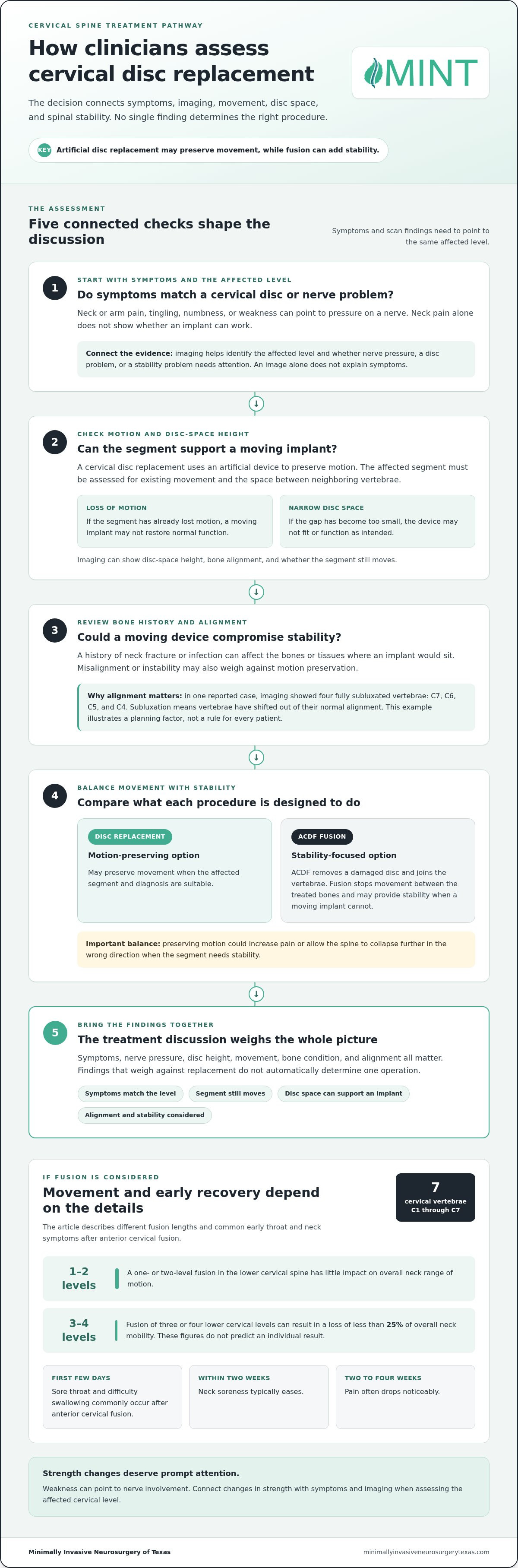
The cervical spine contains seven vertebrae, labeled C1 through C7. Each level contributes to neck motion, so the number and location of fused levels matter. A one- or two-level fusion in the lower cervical spine has little impact on overall neck range of motion. Fusion of three or four lower cervical levels can result in a loss of less than 25% of overall neck mobility. These figures describe different fusion lengths, not a prediction for every person.
Fusion also changes how nearby levels handle movement. When one section no longer moves, adjoining spinal levels may experience more stress, potentially increasing the chance of new damage. This does not mean every patient develops another problem. It helps explain why symptoms and imaging matter: the surgeon needs to identify which levels cause nerve pressure and whether each requires stabilization.
ACDF can also cause short-term throat symptoms because the surgeon works through the front of the neck. Sore throat and difficulty swallowing commonly occur during the first few days after anterior cervical fusion. Neck soreness typically eases within two weeks, while pain often drops noticeably between two and four weeks. These recovery details help patients distinguish expected early discomfort from symptoms that need attention.
Before considering fusion, patients usually try conservative care for weeks or months. The right approach depends on the diagnosis and symptoms, not simply on a disc change seen in an image. A neck sprain or strain, for example, often heals without fusion. Persistent nerve-related symptoms, such as arm pain or weakness, call for closer assessment of the disc and affected cervical level.
Useful questions to discuss include:
- Which cervical level causes the symptoms, and what scan finding supports that conclusion?
- How many levels would ACDF stabilize, and how could that affect movement?
- What explains the need for fusion instead of a motion-preserving option?
These distinctions connect potential risks to the actual diagnosis. A single-level problem differs from disease across several levels, and nerve symptoms differ from pain caused by a strain. Understanding those differences helps patients weigh ACDF’s stabilizing role against its effects on movement and nearby spinal levels.
When disc replacement may not be recommended
Cervical disc replacement preserves motion by replacing a damaged disc with an artificial device. Whether it is suitable depends on the affected segment, the spinal level between two vertebrae, and whether it can safely support movement. If the segment has already lost motion, a moving implant may not restore normal function. The condition of the bones and the space between them also matters.
A narrow disc space can make replacement unsuitable. The disc space is the gap between neighboring vertebrae where the implant sits. If the gap has become too small, the device may not fit or function as intended. Imaging helps show the space’s height, the bones’ alignment, and whether the segment still moves. These details help distinguish a disc problem from a stability problem.
A history of neck fracture or infection can also affect the choice. A fracture can change a vertebra’s shape or stability. Infection can damage tissue and compromise the area where an implant would sit. These conditions may make a motion-preserving device unsafe or ineffective. They require careful consideration during surgical planning, along with symptoms and scan findings.
Sometimes preserving motion could increase pain or allow the spine to collapse further in the wrong direction. In that situation, fusion may provide stability that a moving implant cannot. For example, a scan in one reported case showed four fully subluxated vertebrae: C7, C6, C5, and C4. Subluxation means that vertebrae have shifted out of their normal alignment. This example illustrates why alignment matters; it does not establish a rule for every patient.
Before comparing procedures, an assessment needs to connect symptoms with the affected level. Neck pain alone does not show whether an implant can work. Weakness, or reduced muscle strength, may point to nerve involvement and adds another factor to the decision. Imaging helps clarify whether the spine needs motion preservation, added stability, or treatment for pressure on nerves.
Key findings that can weigh against disc replacement include:
- Loss of motion at the affected segment.
- A disc space that has become too narrow for an implant.
- A history of neck fracture or infection.
- Alignment or instability that could worsen with a moving device.
These findings don’t automatically determine one operation. They explain why a surgeon evaluates disc height, alignment, movement, symptoms, and nerve pressure together. Reviewing the criteria for artificial disc replacement can help you understand which factors shape that discussion.
Bulging and herniated discs
A cervical disc sits between the neck vertebrae and cushions their movement. A bulging disc extends beyond its usual edge; a herniated disc occurs when disc material pushes through its outer layer. Either change can matter if it presses on a nerve, which carries signals between the spinal cord and the arm. An image alone does not explain symptoms. The disc’s location and any nerve pressure help connect scan findings with what a person feels.
Nerve pressure can cause neck or arm pain, tingling, numbness, or weakness. For example, a cervical disc pressing on a nerve that runs from the spinal cord into the arm may cause symptoms along that nerve’s path. Weakness deserves particular attention because pressure from a herniated cervical disc may call for urgent surgery to prevent permanent damage or paralysis. New or worsening weakness needs prompt medical assessment.
A cervical discectomy removes a herniated disc to relieve pressure on the nerves and spinal cord. The next decision concerns the space left behind. A surgeon may consider fusion to stabilize that space, or disc replacement, which removes the damaged disc and inserts an artificial disc designed to restore height and movement. The choice depends on the affected segment, spinal alignment, and whether the area needs stabilization or can preserve motion.
Diagnosis requires more than identifying a bulge or herniation. The clinician compares symptoms with the disc’s location and the nerves involved. A CT scan in one case showed three cervical disc herniations. This illustrates why clinicians assess each affected level rather than treating every scan abnormality as the cause of symptoms. A herniation that matches arm symptoms may have different significance from one that does not explain them.
For someone asking, “Can I avoid a neck fusion?” the diagnosis helps frame the answer. Disc replacement may offer a motion-preserving alternative when the damaged disc causes symptoms and the spinal segment can support movement. Fusion may still be appropriate when the spine needs stability. Scan terminology alone, or the wish to preserve movement, does not settle the choice.
During an evaluation, clarify these points:
- Which cervical disc matches the pain, tingling, numbness, or weakness?
- Does the disc press on a nerve or the spinal cord?
- Does the affected segment need stabilization, or can it preserve movement?
These distinctions help move the discussion from a scan finding to the reason for treatment. They also separate a disc’s appearance from the injury or nerve pressure that may explain symptoms. A clear explanation of the affected level, the nerve involved, and the purpose of surgery makes the options easier to understand.
Reasons patients may want to avoid fusion
A patient may hesitate about fusion because it permanently joins vertebrae. That concern often centers on movement, recovery, and the bone graft used to support healing. Cervical fusion may require a graft, and graft-related pain can be another concern. Artificial disc replacement avoids a bone graft and the associated graft pain. It also uses a device designed to preserve movement when the patient’s anatomy supports that option.
Recovery expectations can influence the discussion, too. Traditional spinal fusion techniques can involve recovery lasting more than 6 months. That figure describes a possible recovery period, not a guaranteed timeline for every procedure or patient. The recovery process depends on the operation, the treated levels, and the person’s healing. Ask which activities recovery may affect, and which milestones guide a safe return to daily routines.
What questions should I ask a spine surgeon before deciding on neck fusion? Ask which finding connects your symptoms to the proposed cervical level, why fusion fits the diagnosis, and whether a motion-preserving option suits your anatomy. Also ask whether the planned approach is anterior, through the front of the neck, or posterior, through the back.
A clear answer should connect the scan, symptoms, and proposed procedure. Ask the surgeon to identify the affected level on the imaging and explain what fusion would stabilize. Then ask what the operation aims to address: nerve pressure, spinal stability, or both. This helps you understand the reason for surgery rather than focusing only on the procedure’s name.
Use these questions to make the comparison specific:
- Would the operation use a bone graft, and what role would it serve?
- Could disc replacement address the same problem while preserving movement?
- Which cervical level or levels need treatment, and why?
- What recovery milestones apply to the proposed surgery and daily activities?
The surgical approach also deserves a plain explanation. “Anterior” describes an approach through the front of the neck; “posterior” describes an approach through the back. Ask why the surgeon recommends one for your diagnosis and how it relates to the treatment goal. The approach alone does not tell you whether the surgeon plans fusion or another procedure.
Patients may want to avoid fusion because they value neck movement, want to understand graft-related pain, or worry about a recovery that may extend beyond 6 months. Those concerns deserve direct answers. A useful discussion compares the proposed procedure with realistic alternatives, explains the reason for each, and ties the decision to the patient’s diagnosis and treatment goals.
What conditions commonly lead to cervical spinal fusion?
A herniated cervical disc can press on a nerve or the spinal cord, the bundle of nerves inside the spine. This pressure may cause neck or arm pain, tingling, numbness, or weakness. A surgeon may consider surgery when symptoms persist despite conservative care, which patients often try for weeks or months. Fusion can stabilize the space after disc removal when the affected area needs added support.
Weakness changes the urgency of the discussion. Pressure from a herniated cervical disc can damage nerves, and weakness may signal a need for urgent surgery to prevent permanent harm or paralysis. The key question is whether the disc problem matches the patient’s symptoms and examination. A scan finding alone does not show which treatment will address the cause.
More than one damaged level can complicate the decision. A CT scan in one case showed three cervical disc herniations. The number of herniations does not automatically determine how many levels need treatment. The surgeon compares each disc’s location with symptoms and nerve pressure, then determines whether removing a disc will leave an area that needs stabilization.
Vertebral misalignment can also lead surgeons to consider fusion. Subluxation means one vertebra has shifted out of its normal position. In one reported case, imaging showed four fully subluxated vertebrae: C7, C6, C5, and C4. That example shows why alignment matters. A motion-preserving implant may not provide the support needed when the spine’s position creates a stability concern.
Fusion may be considered when the surgeon needs to stabilize the space after removing a damaged disc. Anterior cervical discectomy and fusion, or ACDF, removes the disc through the front of the neck and joins neighboring vertebrae. The surgeon considers the affected level, nerve pressure, alignment, and whether the spine needs stability. These details connect the diagnosis to the proposed procedure.
Common findings that may prompt a fusion discussion include:
- A herniated cervical disc that presses on nerves or the spinal cord.
- Weakness linked to pressure from a herniated disc.
- Several herniated discs, such as the three shown on one patient’s CT scan.
- Subluxated vertebrae that affect spinal alignment and stability.
These findings do not make fusion automatic. The surgeon weighs symptoms, imaging, and the stability required after disc removal. If weakness appears or worsens, prompt assessment matters because nerve pressure can threaten lasting function. For a focused discussion of symptoms and imaging, schedule a cervical spine consultation.
Minimally Invasive Neurosurgery of Texas: Minimally Invasive Spine Surgery
Minimally Invasive Neurosurgery of Texas provides minimally invasive spine surgery in Lewisville and Plano, Texas. Dr. Scott Kutz, a board-certified neurosurgeon and Fellow of the AANS and ACS, evaluates how the diagnosis, affected spinal level, and need for stability shape treatment options. This assessment guides a discussion of approaches that fit the findings.
Minimally Invasive Spine Surgery and Endoscopic Spine Surgery address spinal problems with minimally invasive techniques. For suitable patients, artificial disc replacement offers a motion-preserving option. Explore spine care at Minimally Invasive Neurosurgery of Texas to learn about the practice’s approach.
If you’re weighing neck surgery options, contact Minimally Invasive Neurosurgery of Texas to discuss your diagnosis and next steps.
Make your next decision with clarity
If you’re still asking, “Can I avoid a neck fusion?”, focus your next conversation on what the proposed treatment needs to accomplish. Ask how the recommendation relates to your symptoms, what outcome matters most in daily life, and how each option supports that goal. Clear answers can help you take part in the decision with greater confidence.
The right plan should reflect your diagnosis, priorities, and evaluation findings. A specialist can explain the recommendation and whether another approach may suit your situation. If questions remain, a focused conversation can help you understand your choices before moving forward.
Contact Minimally Invasive Neurosurgery of Texas to discuss your neck symptoms and treatment options. Take the next step at a pace that feels informed and comfortable.
Frequently Asked Questions
Is Neck Fusion Surgery Necessary?
No. A neck disc problem does not automatically require fusion surgery. The decision depends on whether the diagnosed condition explains your symptoms and whether the affected spinal area needs added stability. For example, someone with symptoms that match a compressed nerve may have different options from someone whose vertebrae have shifted out of alignment. Ask your surgeon to connect each recommended procedure to a specific finding.
What is causing my neck and arm pain?
A cervical disc pressing on a nerve can cause pain that travels from the neck into the arm. Tingling, numbness, or weakness may also follow the affected nerve’s path. A clinician compares those symptoms with your examination and imaging to identify a likely cause. Make that discussion more useful by noting where symptoms travel, which activities affect them, and whether your strength or sensation has changed.
Fusion or Artificial Disc?
The choice depends on whether the affected level needs stability or can retain useful movement. Artificial disc replacement removes the problem disc and uses a device intended to preserve motion. Fusion stabilizes the treated area instead. Ask the surgeon which goal matters in your case and how the scan supports that choice. Your symptoms, spinal alignment, disc space, and existing movement all inform the comparison.
How Painful Is It?
Pain after neck surgery varies with the procedure, treated area, and healing. ACDF may cause throat soreness or difficulty swallowing during the first few days, and neck soreness typically eases within two weeks. Tell your care team where the pain occurs and whether it changes. That detail can help distinguish expected recovery discomfort from a new symptom that needs evaluation.
What is a spinal fusion?
Spinal fusion is an operation that joins vertebrae to stabilize a section of the spine. In the neck, a surgeon may use it after removing a damaged disc when the remaining space needs support. The treatment goal matters: fusion limits motion at the joined level while addressing the diagnosed problem. Ask which vertebrae the proposed operation would join and what finding makes that stabilization useful.
Will You Lose Neck Movement?
Fusion limits movement at the vertebrae it joins, but its effect on overall neck mobility depends on the levels involved. A fusion involving one or two lower cervical levels has little impact on overall range of motion. Longer fusions can affect movement more noticeably. Ask your surgeon to show the planned levels on your imaging and explain how their location relates to everyday head turning.
What symptoms or imaging findings make cervical fusion necessary or urgent?
Progressive weakness linked to a herniated cervical disc can signal nerve pressure that needs urgent evaluation. Imaging findings such as disc herniation or vertebral misalignment matter when they match the patient’s symptoms and examination. A scan alone does not establish the need for surgery. Seek prompt medical assessment for new or worsening weakness, and ask how the imaging explains the symptoms and proposed treatment.
What alternatives to cervical fusion are available, such as cervical disc replacement or laminoplasty?
Cervical disc replacement can offer a motion-preserving alternative when the affected disc and spinal segment suit that approach. Laminoplasty is another procedure name patients may encounter; ask the surgeon what condition it addresses and how it differs from the proposed operation. The key comparison is not just the procedure names. Ask which option treats the diagnosed problem, what findings support it, and whether it meets the spine’s stability needs.