
Minimally Invasive Neurosurgery of Texas provides minimally invasive spine surgery in Lewisville and Plano, TX. Dr. Scott Kutz, a board-certified neurosurgeon and Fellow of the AANS and ACS, leads the practice’s spinal care.
A spine surgery denial doesn’t automatically end the process. To understand how to appeal an insurance denial for spine surgery, identify the reason in the denial notice: correct a coding error and resubmit the claim, or appeal when the insurer disputes medical necessity, meaning whether the procedure meets its coverage criteria. You can also ask your surgeon to discuss your case directly with the insurer’s medical director.
A coverage decision that disrupts plans for care can be frustrating. To respond, start with the insurer’s stated reason for denial, then gather relevant medical records and explain why the recommended procedure fits your condition. Your surgeon can also help assess whether your case aligns with North American Spine Society (NASS) guidance for spine procedures.
This guide covers how to review a denial, organize supporting records, request a conversation with the insurer’s medical director, and communicate clearly with your insurer. These steps can help you approach the appeal with greater clarity.
Key Takeaways
- Use the denial notice to pinpoint what the insurer needs before you prepare your response.
- Compare your clinical records and treatment history with the relevant NASS guidance and coverage criteria.
- Ask your surgeon to discuss the medical rationale for your procedure directly with the insurer’s medical director.
- Keep insurer communications calm, organized, and focused on the records and questions that matter.
- Track appeal deadlines carefully so you can plan each step of the internal and external review process.
Requesting a conversation with the insurer’s medical director
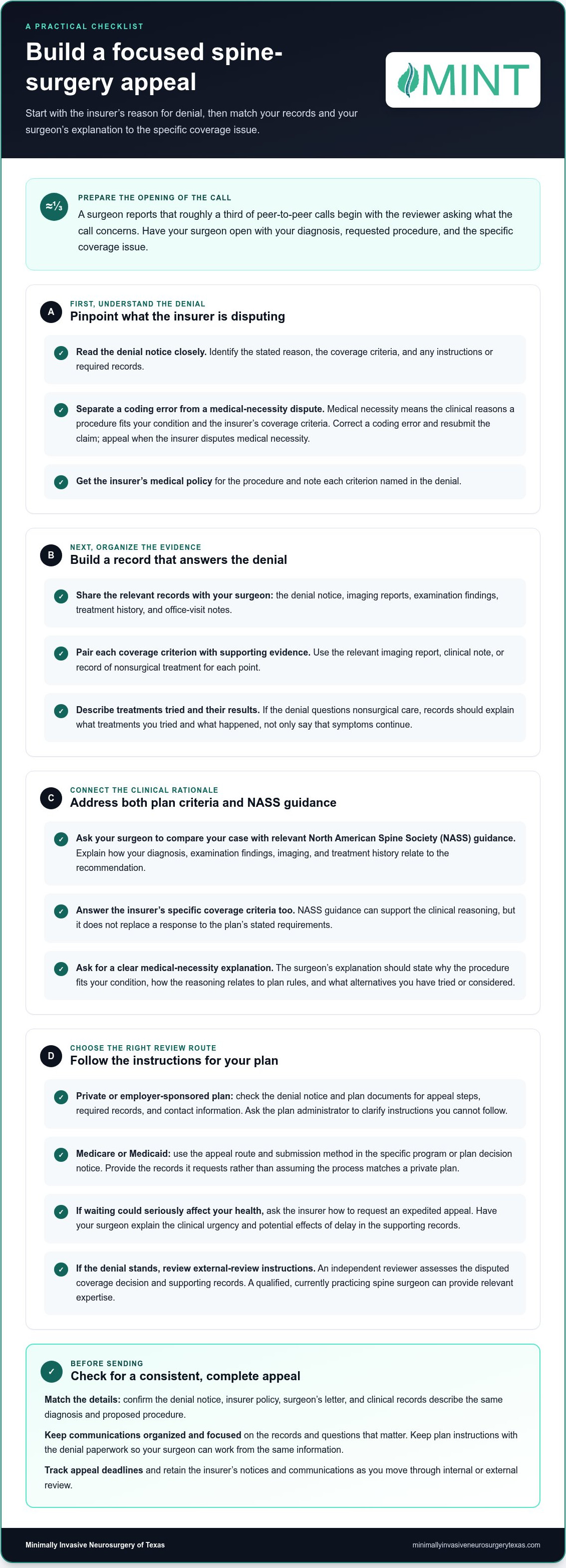
- Ask your surgeon to request a peer-to-peer conversation with the insurer’s medical director. This clinician-to-clinician discussion focuses on the procedure and denial rationale. A surgeon reports that roughly a third of these calls begin with the reviewer asking what the call concerns. Have your surgeon begin with your diagnosis, requested procedure, and the specific coverage issue.
- Prepare the medical-necessity case before the call. Medical necessity means the clinical reasons a procedure fits your condition and the insurer’s coverage criteria. Share the denial notice, imaging reports, examination findings, treatment history, and office-visit notes with your surgeon. For a lumbar fusion denial, ask the surgeon to connect the records to the insurer’s stated criteria.
- Ask your surgeon to explain why nonsurgical care did not resolve the problem when the denial raises that issue. The records should describe treatments tried and their results, not simply state that symptoms continue. If the proposed procedure is endoscopic spine surgery, the appeal should identify the planned approach and clinical rationale, as explained in endoscopic spine surgery information.
- For Medicare or Medicaid, follow the instructions in the specific program or plan decision notice. The appeal route depends on the program and the decision being challenged. Use the applicable submission method and provide the requested records rather than assuming the process matches a private plan.
- For an employer-sponsored plan, review the denial notice and the plan documents it identifies. Use them to find the appeal steps, required records, and contact information. Ask the plan administrator to clarify any instruction you cannot follow. Keep the response with the denial paperwork so your surgeon can work from the same information.
- If waiting could seriously affect your health, ask the insurer how to request an expedited appeal. Have your surgeon explain the clinical urgency and potential effects of delay in the supporting records. The insurer’s appeal contact can tell you which channel to use and what information to submit for urgent review.
- If the insurer upholds the denial, review the decision notice for external-review instructions. An independent reviewer assesses the disputed coverage decision and supporting records; a qualified, currently practicing spine surgeon can provide relevant expertise. A patient advocate or attorney who handles medical claims may help organize the appeal. If the review is unfavorable, ask the insurer and care team about the next steps and how to manage outstanding bills while reviewing coverage options.
Checking whether a case fits NASS guidelines
- Ask your surgeon to compare the proposed procedure with guidance from the North American Spine Society (NASS), a professional organization that publishes guidance for spine procedures. NASS guidelines are widely accepted in the medical community. They can help frame the clinical reasoning behind a recommendation, but your appeal should also address the insurer’s specific coverage criteria.
- Get the exact denial rationale and the insurer’s medical policy for the procedure. For a lumbar spine fusion, which joins vertebrae to stabilize the spine, identify each coverage criterion the insurer cites. Ask your surgeon to explain how your diagnosis, examination findings, imaging, and treatment history relate to those points.
- Ask your surgeon to state whether your case fits the relevant NASS guidance and explain why. Avoid relying on a general statement that surgery is appropriate. For example, the appeal can connect your documented symptoms and clinical findings to the proposed lumbar fusion, then explain how the NASS guidance supports that reasoning.
- Build a criterion-by-criterion record. Pair each relevant insurer requirement with supporting evidence, such as an imaging report, office-visit note, or record of nonsurgical treatment. If the insurer says the documentation is insufficient, ask your surgeon to identify the missing clinical detail and explain it clearly where the records support it.
- Request a medical-necessity explanation from your surgeon. This should state the clinical reasons for recommending the procedure and how it meets the plan’s coverage rules. For a denied lumbar fusion, ask the surgeon to address why it fits your condition, how NASS guidance relates, and what alternatives you have tried or considered.
- Review the appeal for consistency before submission. Confirm that the denial notice, insurer policy, surgeon’s letter, and clinical records describe the same diagnosis and proposed procedure. If the policy and NASS guidance use different wording, ask your surgeon to explain the clinical connection rather than assume they use identical terms.
- Keep the NASS discussion specific to your case. A guideline can support the clinical rationale, but the appeal still needs to answer the insurer’s stated reason for denial. Ask your surgeon to clarify any gap between the guideline and the plan’s criteria, and organize the explanation around records that address that gap.
A focused question can keep the appeal grounded in whether the individual case fits the relevant NASS guidance, rather than treating the guidance as a general endorsement. Because the North American Spine Society’s guidelines for spine procedures are widely accepted within the medical community, the surgeon’s case-specific view can make the role of that guidance clear.
Common reasons spine surgery requests are denied
- Read the denial notice and identify its stated reason before choosing your response. Insurers increasingly deny spine procedures, especially lumbar fusions, as approval criteria and guidelines change. A notice may say the procedure lacks medical necessity and explain the clinical rationale. It may also cite the insurer’s corporate medical policy for lumbar fusion. Mark each reason and policy reference so your response addresses the decision directly.
- Check for clerical or coding errors, such as an incorrect procedure code or mismatched diagnosis. Compare the denial notice with the submitted claim and the surgeon’s records. If the insurer denied the claim because of a coding error, ask the billing team to correct the code and resubmit the claim. A coding correction addresses that specific problem, not a separate medical-necessity dispute.
- Check whether the submission documents unsuccessful nonsurgical treatment. An insurer may question a spine surgery request if the records do not show what nonsurgical care you tried or how it affected your symptoms. Ask the surgeon to include relevant treatment history and visit notes. For example, a note can clarify which treatment you tried and whether symptoms continued, when the medical record supports that account.
- Compare the denial rationale with the records sent for review to identify documentation gaps. Insufficient documentation can leave the insurer without the clinical details it says it needs. Gather office-visit notes, relevant imaging reports, examination findings, and treatment records. Ask your surgeon to explain how these materials support the proposed procedure and address the specific concern in the denial.
- Match the insurer’s medical policy to your case rather than responding with a general statement that surgery is needed. For a lumbar fusion denial, list the policy criteria cited in the notice. Then ask your surgeon to connect each relevant criterion to your diagnosis and supporting records. If the notice identifies a specific clinical concern, make it the focus of your response.
- Choose your next action based on the denial’s stated cause. Correct a coding error and resubmit the claim; appeal a denial based on medical necessity or another substantive reason. If the notice gives multiple reasons, address each separately. Keep the denial notice, policy reference, and records together so your response stays focused on the insurer’s decision.
Communicating professionally with insurance contacts
- Before calling your insurer, gather the denial notice, your member identification card, and the claim or authorization number. Authorization is the insurer’s review of a requested service before care. Write down the call date, representative’s name, and department to keep each conversation connected to the correct spine surgery request.
- Start the call with a short, neutral explanation. For example: “I’m calling about the denial of my surgeon’s recommended procedure. I want to understand the stated reason and the appeal steps.” Then let the representative explain. A calm opening keeps the discussion focused on the decision, not your frustration about the outcome.
- Ask specific questions about the notice instead of asking only why the insurer denied care. For example: “Which coverage criterion does the submitted record not meet?” or “Which clinical document would address that concern?” Record the representative’s answer. If the representative cannot explain the rationale, ask which department can clarify it.
- Keep your description of your condition factual. Use examples from your medical records, such as symptoms documented at an office visit or findings in an imaging report reviewed by your surgeon. Avoid guessing about clinical findings or adding details your records do not support. Your surgeon can answer questions that require clinical judgment.
- When you submit a written message, state the action you’re requesting near the beginning. Identify the procedure, the denial date on the notice, and the reason for your appeal. Attach records through the insurer’s stated submission channel and label each file clearly. Keep a copy of the message and attachments with your denial paperwork.
- After speaking with an insurer representative, send a brief written summary if the insurer accepts that communication method. Include the call date, representative’s name, key instructions, and any requested documents. For example, note if the representative asked for a specific office-visit note. This record helps you and your doctor follow the same instructions.
- If a conversation becomes tense, pause and return to the issue you need resolved. You can say, “I want to keep this focused on the appeal. Please explain the next required step.” If an answer conflicts with the denial notice, ask the representative to clarify. Keep notes and use the insurer’s written instructions to guide your next communication.
What deadlines apply to internal and external health insurance appeals in the U.S?
- Start with the appeal instructions in the denial notice. It should identify the next review route and the submission deadline for your decision. Record the date, required delivery method, and address or portal. Don’t rely on a deadline from another patient’s plan or a general online example.
- Keep internal appeal and external review steps separate in your notes. An internal appeal asks the insurer to reconsider its coverage decision. External review sends an eligible dispute to an independent reviewer. The Affordable Care Act requires insurance providers to have an appeals process for coverage denials, but the notice explains how your plan handles each stage.
- Check whether the notice gives different timelines for different decisions. For example, instructions for a denial before a planned procedure may differ from those for a claim denial after care. Follow the notice for your case, and ask the insurer to explain unclear timing in writing. Keep the representative’s name and call date in your records.
- Confirm what counts as timely submission before sending documents. The notice may explain whether the insurer must receive your appeal by a stated date or accepts another submission method. If this is unclear, ask the appeal department. Save a portal confirmation, delivery receipt, or fax confirmation as proof of submission.
- Track the insurer’s response date separately from your filing deadline. Use the notice or plan documents to find when the insurer expects to respond. If the decision arrives without external-review instructions, ask the insurer how to request that review. Keep the response and all appeal materials together.
- For external review, follow the instructions in the insurer’s final decision notice. Check the eligibility criteria, submission route, deadline, and required documents. Include the denial, relevant medical records, and your surgeon’s explanation of the requested spine procedure. Because an independent reviewer evaluates the coverage dispute, organize the record around the decision being challenged.
- Create a simple timeline with the denial date, appeal due date, submission date, and response dates. Set reminders before each date, and give your surgeon time to prepare supporting records. If you need to discuss the clinical rationale for recommended spine surgery, contact the practice about your spine surgery care.
List each item the insurer requests and note what you have, what you still need to gather, and who can help obtain it. Work with your doctors to collect the requested records, then confirm that your submission addresses the insurer’s stated requests. If a request is unclear, ask for clarification rather than guessing. Keep the list with your appeal papers to track what you have addressed.
In an AMA survey, 18% of physicians reported that prior authorization had led to a life-threatening event or required an unauthorized intervention to prevent permanent impairment or damage. Keeping requested records organized and communicating with your doctors can help you prepare the documentation needed for your appeal.
Minimally Invasive Neurosurgery of Texas: Minimally Invasive Spine Surgery
Minimally Invasive Neurosurgery of Texas provides minimally invasive spine surgery in Lewisville, TX, and Plano, TX. Dr. Scott Kutz, a board-certified neurosurgeon and Fellow of the AANS and ACS, leads the practice’s spinal care. Learn more about the practice’s spine care approach.
An insurance appeal and a surgical consultation serve different purposes. The appeal addresses the insurer’s coverage decision; a surgeon evaluates your condition and discusses appropriate care. Bring the denial notice and medical records you want to discuss. Contact Minimally Invasive Neurosurgery of Texas in Lewisville or Plano to discuss your spine care questions.
Take your next step with a clear clinical plan
An insurance appeal and a treatment decision answer different questions. The appeal addresses coverage; a clinical discussion focuses on your symptoms, diagnosis, and whether a procedure fits your needs. Understanding how to appeal an insurance denial for spine surgery can help you keep those decisions distinct and prepare for a focused conversation about care.
Minimally Invasive Neurosurgery of Texas provides minimally invasive spine surgery, artificial disc replacement, and endoscopic spine surgery in Lewisville and Plano. A discussion with the practice can help you review your spine care questions alongside the records relevant to your situation. Bring the denial notice and medical records you want to discuss.
Arrange a conversation about your spine care and take the next step with a clearer plan.
Frequently Asked Questions
What are the steps to appeal an insurance denial for spine surgery?
First, determine whether the denial concerns pre-service authorization or a claim submitted after care. Pre-certification approval doesn’t guarantee payment for a later claim, so keep any claim denial with the original authorization records. Follow the instructions in the relevant notice and organize documents by decision stage. For example, separate an authorization letter from an explanation of benefits so your surgeon can address the right decision.
What reasons do insurers commonly give for denying spine surgery coverage?
Common reasons for denial include coding errors, insufficient documentation, or records that don’t show unsuccessful nonsurgical treatment. Read the notice closely to distinguish an administrative issue from a clinical disagreement. A code that doesn’t match the submitted procedure points to a claim correction; a statement that the records don’t support treatment points to the clinical evidence. This distinction helps you direct questions to the right part of the process.
How can a surgeon write a letter of medical necessity for spine surgery?
A surgeon can make an appeal letter easier to review by linking each coverage criterion to a specific clinical record. For example, the letter can quote the insurer’s policy, explain how your documented findings relate to it, and label supporting records as attachments. It can also discuss relevant NASS guidance and scientific literature supporting the procedure as standard care. A brief patient statement can add personal context, but it does not replace clinical evidence.
How do Medicare and Medicaid appeals for denied spine surgery differ from private insurance?
For Medicare or Medicaid, follow the appeal instructions in the specific program or plan decision notice. The route depends on the program and decision. Use the applicable submission method and provide the requested records rather than assuming the process matches a private plan.
What are ERISA appeal rules for employer-sponsored health insurance denials?
For an employer-sponsored plan, review the denial notice and the plan documents it identifies for appeal steps, required records, and contact information. Ask the plan administrator to clarify any instructions you cannot follow.