Minimally Invasive Neurosurgery of Texas (MINT), led by Dr. Scott Kutz, a board-certified neurosurgeon, provides minimally invasive spine care from its primary locations in Lewisville and Plano, Texas. For patients comparing spine surgeons in Plano and Frisco, the right fit depends on more than an office address.
A nearby surgeon may not have the clinical focus your condition calls for. It’s understandable to want clear answers about a surgeon’s training, whether they treat your specific spinal problem, and how surgery could affect recovery and mobility. This guide explains how to compare those factors and prepare useful questions for a consultation, so you can take an informed next step without feeling rushed.
You’ll learn how credentials and procedure experience can help you assess clinical fit, what to discuss about your treatment options, and how location may shape care if you live in Frisco. MINT serves the wider DFW area from Lewisville and Plano, and offers procedures such as endoscopic spine surgery, which uses a small camera and specialized instruments to treat spinal conditions.
Key Takeaways
- When comparing spine surgeons in Plano and Frisco, weigh clinical fit and communication alongside location.
- Use credentials, spine focus, and experience with relevant procedures to guide your comparison. Dr. Scott Kutz is a board-certified neurosurgeon and Fellow of the AANS and ACS.
- Connect your diagnosis and concerns to the surgeon’s expertise, and use consultation questions to understand potential procedure options.
- Consider access to care, but don’t let proximity replace a clear understanding of your diagnosis and treatment choices.
- Prepare for a consultation by gathering records, listing symptoms, and noting your questions and goals. A consultation can clarify options without committing you to surgery.
Comparing Spine Surgeons in Plano and Frisco: Start With the Right Questions
Minimally Invasive Neurosurgery of Texas (MINT), led by Dr. Scott Kutz, provides minimally invasive spine care from its primary locations in Lewisville and Plano, Texas. Frisco is a nearby DFW community MINT serves, not a primary office location.
Comparing spine surgeons in Plano and Frisco involves more than choosing the closest office or the highest-rated directory profile. Your diagnosis, goals, and comfort discussing concerns with a surgeon all matter. A useful comparison helps you understand who focuses on spine conditions, which procedures relate to your diagnosis, and how clearly the surgeon explains your options.
What should patients compare beyond star ratings?
Healthgrades and similar directories organize provider profiles and patient ratings, which can help you find names and read about other patients’ experiences. Ratings offer one perspective, but they don’t show whether a surgeon’s expertise matches your condition or explain how the surgeon approaches your care. Use directory information as a starting point, not as proof of clinical fit.
Compare these practical factors:
- Board certification: Check whether the surgeon holds certification in the relevant specialty.
- Spine focus: Look for a practice that regularly evaluates and treats spinal conditions.
- Procedure experience: Consider whether the surgeon performs procedures relevant to your diagnosis, such as endoscopic spine surgery, which uses a small camera and specialized instruments.
- Communication: Notice whether the surgeon explains the diagnosis and options in plain language and addresses your questions.
Dr. Scott Kutz is a board-certified neurosurgeon and a Fellow of the American Association of Neurological Surgeons (AANS) and the American College of Surgeons (ACS). MINT also describes its minimally invasive spine techniques, giving patients context about its surgical approach.
Why does a surgeon’s specialty matter for spine care?
A board-certified neurosurgeon is a physician who has earned specialty certification in neurological surgery, the field that treats conditions involving the brain, spine, and nervous system. That credential tells you about specialty training. You should also consider how closely the surgeon’s clinical focus aligns with your particular spinal diagnosis.
Spine-focused expertise can help you have a more specific conversation about which treatment choices may fit your condition and goals. For example, a herniated disc occurs when disc material extends beyond its usual boundary and can irritate or compress nearby nerves. Ask how the surgeon connects your symptoms and imaging findings to possible options, and how the surgeon explains the benefits and tradeoffs of each approach.
If a discussion includes spinal fusion, a procedure that joins bones in the spine, make sure you understand why the surgeon considers it relevant to your situation. The key is not to select a procedure from a directory profile. It’s to understand the reasoning behind the options and feel comfortable asking follow-up questions.
How to Evaluate a Spine Surgeon’s Credentials and Patient Communication
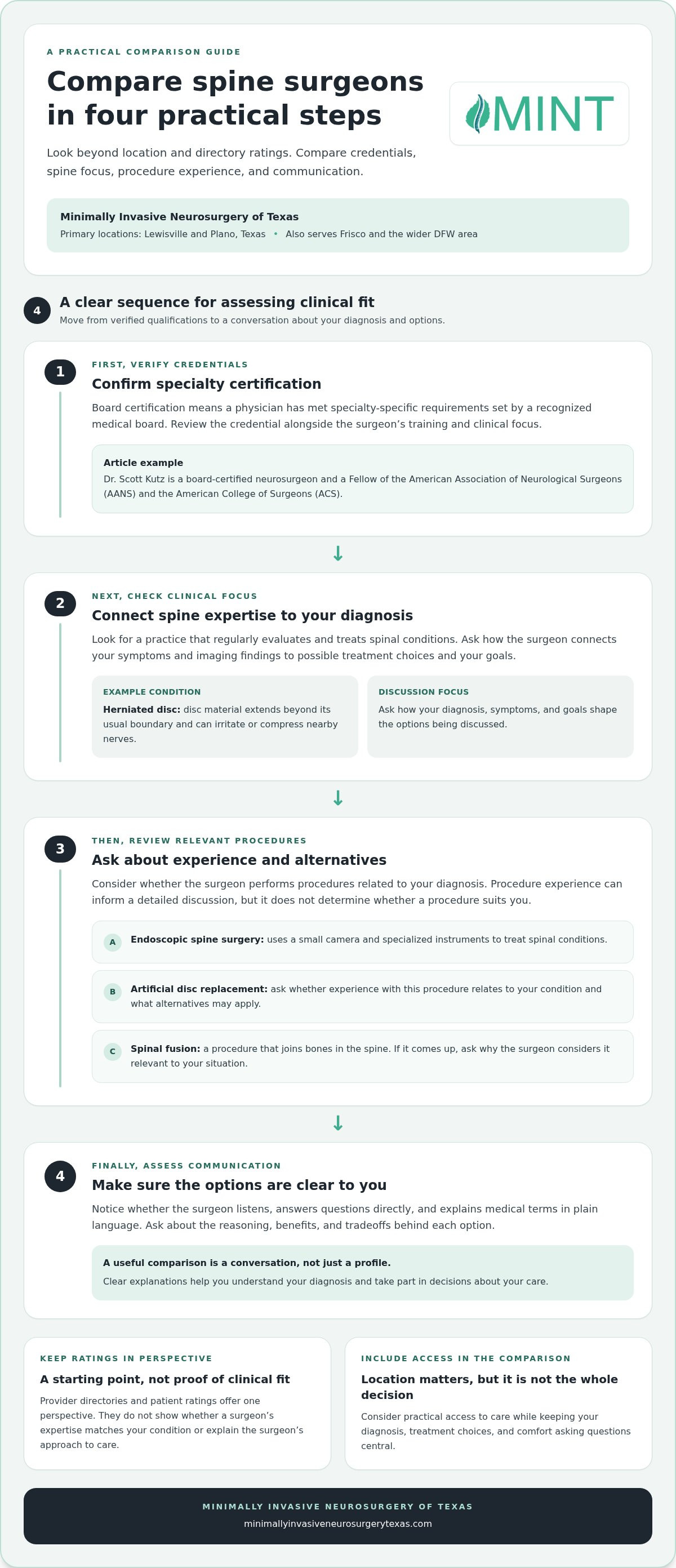
A useful comparison follows a consistent sequence, so directory layouts or polished biographies don’t distract from the details that matter to your care. As you compare spine surgeons serving Plano and Frisco, consider credentials, clinical focus, procedure experience, and how well each surgeon explains your options.
Which credentials and experience details should you review?
Board certification means a physician has met specialty-specific requirements set by a recognized medical board. It provides more information than a general label such as “neurosurgeon,” which names a specialty but doesn’t, by itself, describe a surgeon’s particular experience with spine conditions. Review the surgeon’s training and focus alongside the credential.
Use this sequence to organize your comparison:
- Confirm certification. Check whether the surgeon holds board certification in the specialty relevant to your care. Dr. Scott Kutz is a board-certified neurosurgeon and a Fellow of the American Association of Neurological Surgeons (AANS) and the American College of Surgeons (ACS).
- Look for a spine focus. Consider whether the surgeon regularly evaluates spinal disorders and discusses spine procedures. A focused practice can make your conversation more specific to your diagnosis and goals.
- Review relevant procedure experience. Look for experience with procedures related to your condition, such as endoscopic spine surgery or artificial disc replacement. Experience with a procedure doesn’t determine whether it suits you, but it can inform a detailed discussion of its role and alternatives.
- Assess communication. Notice whether the surgeon listens, answers questions directly, and explains medical terms in language you understand. Clear communication helps you take part in decisions about your care.
MINT’s published figures include 27+ Years of Expertise and 6000+ Successful Surgeries. These figures provide background about the practice, not a prediction or guarantee of an individual result. You can also review Dr. Kutz’s physician background and credentials to learn more about his professional experience.
How can you tell whether a surgeon explains options clearly?
Prepare questions that connect the diagnosis to your day-to-day symptoms. For example, ask how your examination and imaging findings, such as MRI scans that show spinal structures, relate to your pain, numbness, or weakness. Then listen for a clear explanation of what the findings mean and what they don’t establish on their own.
A thoughtful discussion should cover potential benefits, limitations, and alternatives in understandable terms. You might ask why the surgeon recommends a particular approach, what other options the surgeon considered, and what questions remain before you decide. You don’t need to leave with every answer, but you should understand the reasoning and feel comfortable raising concerns.
Patient testimonials can offer context about other people’s experiences with a practice. They can’t tell you how a treatment will apply to your diagnosis. Use them as one source of perspective, then rely on an individualized medical discussion to understand your own options. Bring your questions to the consultation and take the time you need to make an informed next step.
Match the Surgeon’s Spine Expertise to Your Diagnosis and Procedure Options
A surgeon’s procedural experience matters most when it relates to the condition under evaluation. As you compare spine surgeons, focus on how each one connects your diagnosis, symptoms, and goals to possible options. A herniated disc, for example, involves disc material that can irritate or compress nearby nerves. The diagnosis alone doesn’t determine which procedure, if any, makes sense for you.
| Question to discuss | Relevant expertise |
|---|---|
| Does this procedure address the condition shown on my imaging? | Experience evaluating the specific spinal diagnosis and its relationship to symptoms. |
| Could an endoscopic approach fit my situation? | Experience with endoscopic spine surgery and the conditions it may address. |
| Should I ask about artificial disc replacement? | Experience assessing whether replacing a damaged spinal disc may fit a patient’s condition. |
| What alternatives should I understand? | Ability to explain the reasoning, benefits, limitations, and alternatives for each option. |
What should you ask about endoscopic spine surgery?
Endoscopic spine surgery is a minimally invasive procedure that uses an endoscope, a narrow instrument with a camera, to help the surgeon see the treatment area. MINT offers this procedure. Its endoscopic spine surgery overview introduces the approach, but your own consultation should address whether it fits your diagnosis and treatment goals.
Ask what finding or symptom makes the surgeon consider this technique, what the procedure aims to address, and what other options deserve discussion. Also ask about limitations. A procedure’s availability doesn’t mean every patient qualifies, and a surgeon needs to evaluate your individual condition before discussing its role.
When should artificial disc replacement enter the comparison?
Artificial disc replacement is a procedure that replaces a damaged spinal disc with an artificial one. It may come up as a comparison topic when a surgeon reviews your diagnosis and goals. The surgeon must assess your condition to determine whether it belongs among the options to discuss. No single procedure fits every patient.
Use the conversation to clarify what the surgeon wants to address, how the procedure compares with alternatives, and what factors shape the recommendation. MINT provides artificial disc replacement as part of its spine care. Learning what the procedure involves can help you prepare focused questions, while your surgeon’s assessment guides whether it fits your case.
Keep the comparison centered on reasoning, not procedure names alone. A clear explanation should connect your examination and imaging to the options under consideration, including why a specific approach may or may not align with your goals. That gives you a more useful basis for comparing expertise than a list of procedures on a profile.
Compare Plano, Frisco, and Nearby DFW Care for Practical Access
Location can make appointment planning easier, but proximity alone can’t tell you whether a surgeon’s expertise fits your diagnosis. Consider practical access alongside the surgeon’s clinical focus and the clarity of your discussions. A convenient office matters, but it shouldn’t outweigh your medical needs.
MINT’s main office is in Lewisville, and its satellite office serves Plano and surrounding communities. Frisco is a nearby DFW community, not a primary MINT office location. Patients in Frisco can consider the Lewisville and Plano locations while weighing how travel fits their schedule and care needs.
How should Frisco patients think about local access?
Think through the practical details that affect your ability to attend appointments, such as coordinating visits with work or arranging transportation. These considerations can help you compare locations without assuming that the closest office offers the right clinical fit.
MINT serves the wider DFW area from Lewisville and Plano. Frisco patients can include those locations in their search while keeping their diagnosis and treatment goals central to the decision. The right location is one that works for your circumstances and supports a clear, focused conversation about your care.
Before choosing where to seek care, consider which location best fits your routine and how you’ll manage the trip. Then weigh that convenience alongside the surgeon’s experience with your condition and the quality of your consultation.
What role should reviews and patient stories play?
Patient stories can help you identify what matters to you in a care experience. As you read, notice which details resonate with your priorities, such as feeling comfortable asking questions or understanding the next steps. Use those reflections to shape your own questions rather than treating someone else’s account as a checklist for your care.
MINT’s patient testimonials offer one perspective on other patients’ experiences. You can use what you read to clarify what you hope to discuss and what would help you feel prepared for your own consultation.
For patients comparing care across nearby communities, weigh travel practicality and clinical fit together. If you’re ready to discuss your spine concerns, contact the practice about your next step.
Meet With a Spine Surgeon and Make an Informed Next-Step Plan
A consultation gives you time to understand your diagnosis, discuss treatment options, and ask how each option relates to your goals. It doesn’t mean you must have surgery. As you compare spine surgeons in Plano and Frisco, use the conversation to learn whether you understand the reasoning behind the recommendations and feel ready to consider your next step.
What should you bring to a spine consultation?
A little preparation can help you make the most of your appointment. Gather the information you already have, then organize your main concerns so you can explain what matters most in your daily life.
- Collect relevant records. Bring available imaging reports, such as MRI or X-ray reports, and information about treatments you’ve already tried. Include a current medication list. If you have imaging files or other records, bring them in the format the practice requests.
- Write down your symptoms. Note where you feel pain or other symptoms, when they occur, and what seems to worsen or ease them. Describe how they affect activities such as walking, sleeping, working, or household tasks. Specific examples can help you explain your experience clearly.
- List questions and goals. Ask how the surgeon connects your diagnosis to your symptoms and examination or imaging findings. Request an explanation of the options, their potential benefits and limitations, and the reasons behind any recommendation. Write down your goals, too, such as improving comfort or returning to activities that matter to you.
You don’t need to know medical terminology before the visit. Ask the surgeon to explain unfamiliar terms in plain language, and pause the conversation when you need clarification. A good consultation should help you understand the discussion, not leave you feeling pressured to make a decision before you’re ready.
How can you take the next step with MINT?
Dr. Scott Kutz leads MINT’s spine-focused practice, where the team helps patients understand their diagnosis and consider treatment choices before proceeding. MINT serves the wider DFW community from its primary locations in Lewisville and Plano, Texas. A consultation can clarify which options the surgeon considers relevant to your condition. It does not require you to choose surgery.
For informational purposes, the content provided on the Websites is not intended as, nor should it be considered a substitute for, professional medical advice, diagnosis, or treatment. Always seek the advice of your physician or qualified healthcare provider with any questions you may have regarding a medical condition.
Submitting a New Patient Form does not establish a doctor-patient relationship. If you’re ready to discuss your spine concerns and plan a consultation, contact MINT about a spine consultation.
Take Your Spine Care Decision One Step at a Time
Choosing a spine surgeon doesn’t require you to decide on a procedure before you understand your diagnosis. Use your consultation to clarify what may be contributing to your symptoms, which options deserve discussion, and how each one relates to your priorities. The right conversation should leave you better informed and more prepared to decide what comes next.
As you continue comparing spine surgeons in Plano and Frisco, let your questions guide the process. You can ask for clarification, take time to consider the information, and discuss your concerns before making a treatment decision. A thoughtful next step begins with a clear understanding of your choices.
Contact MINT to discuss your spine care and start a conversation about your concerns and goals. You deserve clear information as you move forward.
Frequently Asked Questions
How do I compare spine surgeons in Plano and Frisco?
Use the same comparison criteria for each consultation. Keep side-by-side notes about the diagnosis discussed, options raised, questions that remain unanswered, and what decision comes next. Compare how each explanation relates to your own medical information rather than relying on marketing language alone. This gives comparing spine surgeons in Plano and Frisco a patient-specific focus and helps you see what you still need to understand.
Is a board-certified neurosurgeon qualified to treat spine conditions?
Yes. Neurosurgeons train to evaluate and treat conditions involving the spine, and board certification reflects specialty qualifications. Still, certification alone doesn’t establish that a particular surgeon routinely manages your specific diagnosis or that surgery fits your case. Ask how the physician’s spine practice relates to your condition and what clinical findings would support considering a procedure. The surgeon’s assessment should guide that discussion.
What should I ask a spine surgeon during a first consultation?
Ask what the next decision depends on, which alternatives remain, and what information the surgeon still needs before recommending a plan. If the surgeon discusses surgery, ask what the procedure aims to address and what might lead the surgeon to reconsider that option. You can also ask how to follow up with questions after the visit. These prompts clarify the decision process, not just the procedure name.
Can a minimally invasive spine surgeon treat a herniated disc?
Yes. A minimally invasive spine surgeon can assess a herniated disc and discuss whether a surgical option belongs in your care plan. That doesn’t mean surgery automatically makes sense. The surgeon evaluates your individual condition and explains the reasoning behind any recommendation. You can ask whether endoscopic spine surgery relates to the specific problem under discussion and what alternatives you should understand.
Does MINT have a primary office in Frisco?
No. Frisco isn’t a primary MINT office location. MINT’s main office is in Lewisville, and its satellite office serves Plano and surrounding communities. Frisco belongs to the wider DFW area the practice serves. If you see Frisco mentioned in a local search result, distinguish the community served from the locations where MINT maintains offices.
How do patient reviews help when comparing spine surgeons?
Reviews can help you identify what you value in a care experience, such as clear explanations or attentive communication. Use those details to reflect on what you hope to discuss during your own visit. Reviews don’t verify a surgeon’s credentials or determine whether a procedure suits your condition. Keep them as background, and use your individual medical evaluation to guide care decisions.
Does contacting MINT or submitting a New Patient Form establish a doctor-patient relationship?
No. Contacting MINT or submitting a New Patient Form doesn’t establish a doctor-patient relationship. Information you send through a form doesn’t replace an individualized medical evaluation or serve as a diagnosis or treatment plan. Use the form to make an inquiry, and bring health concerns to a qualified healthcare provider who can assess your situation directly.