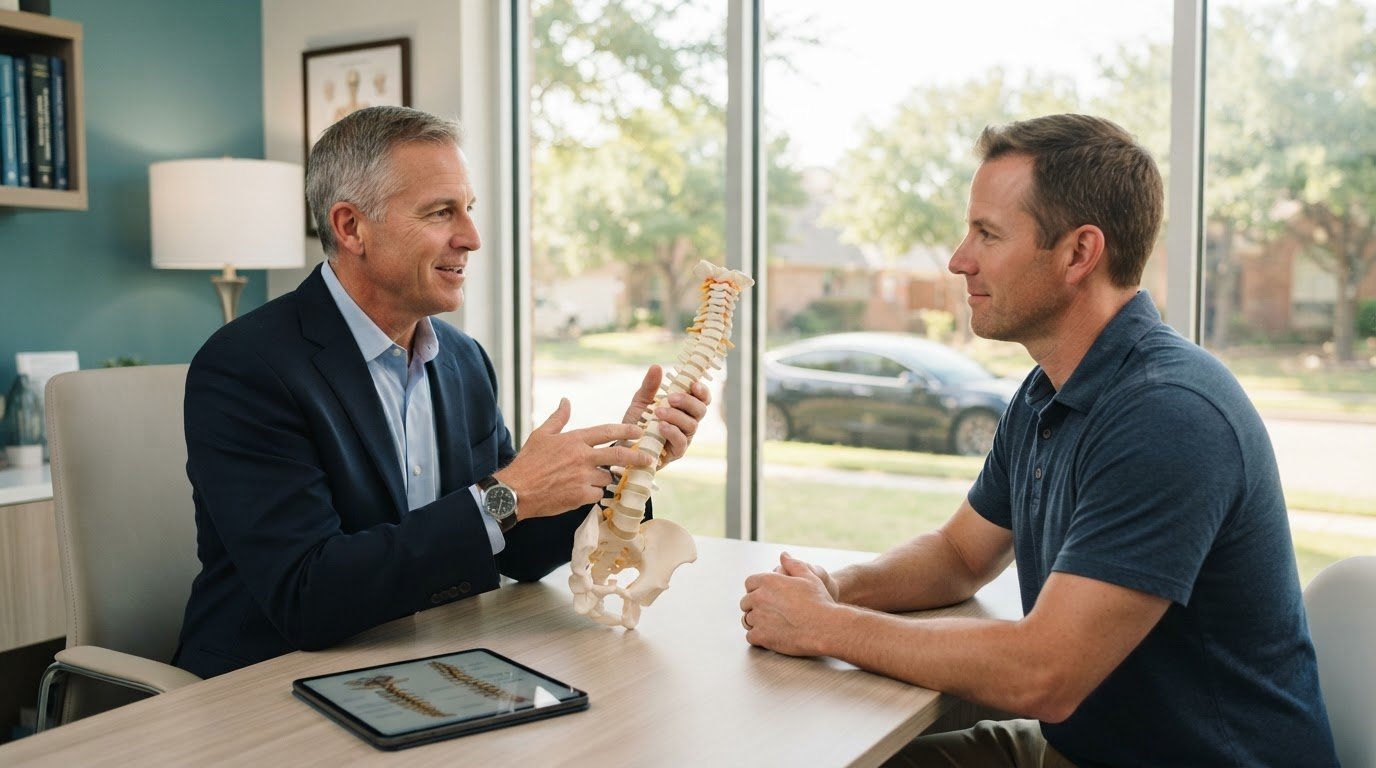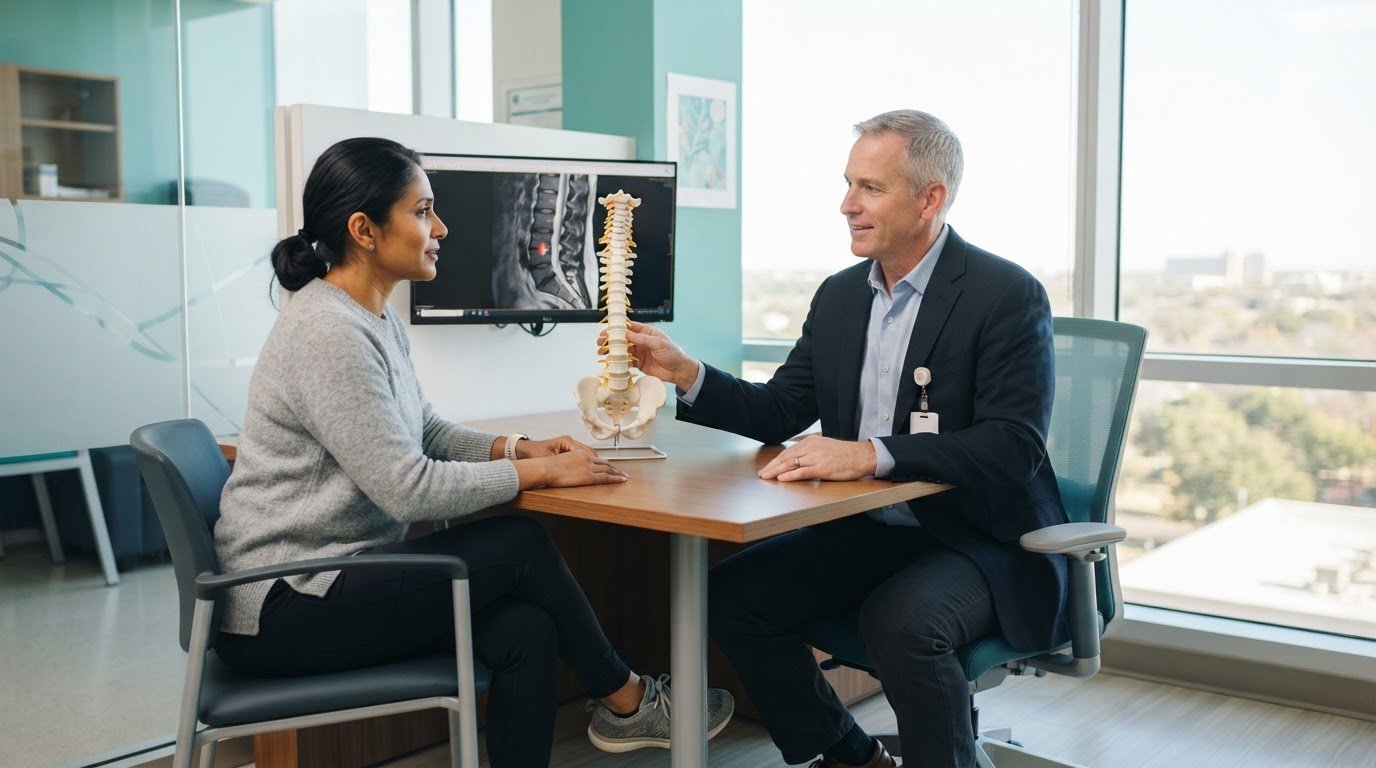
Minimally Invasive Neurosurgery of Texas (MINT), led by Dr. Scott Kutz, MD, a board-certified neurosurgeon and Fellow of the AANS and ACS, provides minimally invasive spine surgery in Lewisville and Plano, Texas.
What if a spine surgery discussion began with the activities you hope to return to, rather than a procedure name? For active adults considering Lewisville spine surgery for active adults, symptoms and personal priorities can help shape that conversation. Pain or mobility limits can affect exercise, work, recreation, and everyday movement, but those challenges don’t automatically mean surgery is the right next step.
This guide explains how diagnosis and clinical findings inform discussions about minimally invasive approaches, endoscopic spine surgery, artificial disc replacement, and spinal fusion. You’ll also learn how to compare treatment goals, consider movement, and prepare practical questions for a spine specialist. The aim is to help you take part in an informed discussion about options that fit your situation.
Key Takeaways
- Lewisville spine surgery for active adults starts with understanding the diagnosis and the activities you hope to return to.
- Minimally invasive techniques aim to reduce tissue disruption, but they don’t guarantee a faster recovery or suit every condition.
- Compare options such as endoscopic spine surgery and artificial disc replacement by treatment goals and their impact on spinal motion.
- Prepare for a consultation by noting your symptoms, what affects them, how they limit activity, and questions you want answered.
- Dr. Scott Kutz, MD, a board-certified neurosurgeon and Fellow of the AANS and ACS, provides spine care in Lewisville and Plano, Texas.
Lewisville Spine Surgery for Active Adults: Start With the Problem, Not the Procedure
Minimally Invasive Neurosurgery of Texas (MINT) provides minimally invasive spine surgery in Lewisville and Plano, Texas, with care led by Dr. Scott Kutz, MD, a board-certified neurosurgeon and Fellow of the AANS and ACS.
Back or neck symptoms can change more than a workout. Pain, numbness, tingling, or weakness may make it harder to sit through a workday, lift everyday items, enjoy recreation, or move comfortably through a normal routine. Those limits deserve attention, but they don’t automatically mean surgery offers the right solution. A thoughtful discussion starts with what may cause the symptoms, how they affect you, and what you want to do more comfortably.
For Lewisville spine surgery for active adults, the word “active” describes a person’s priorities, not a fitness level or a surgical qualification. Someone may want to walk without leg discomfort, keep up with a job, or return to a favorite form of exercise. These goals help frame the conversation. They don’t guarantee a particular result or replace an evaluation by a qualified clinician.
What does active living mean in a spine-surgery discussion?
Start by naming the movements and routines your symptoms limit. Note whether discomfort changes during walking, bending, lifting, sitting, or rest, and describe how it affects work, exercise, recreation, and everyday tasks. These observations help a specialist understand what matters to you. They don’t diagnose the cause, and they can’t determine a treatment on their own. A clinical evaluation connects your goals with your symptoms and medical findings.
Which spine problems may lead to a surgical conversation?
A herniated disc occurs when disc material shifts beyond its usual boundary and may irritate a nearby nerve. Spinal stenosis means narrowing around the spinal nerves or the spinal canal, the passage that protects the spinal cord and nerves. Degenerative disc disease describes changes in spinal discs that can contribute to symptoms. These terms alone don’t establish that surgery makes sense. A specialist considers the full clinical picture.
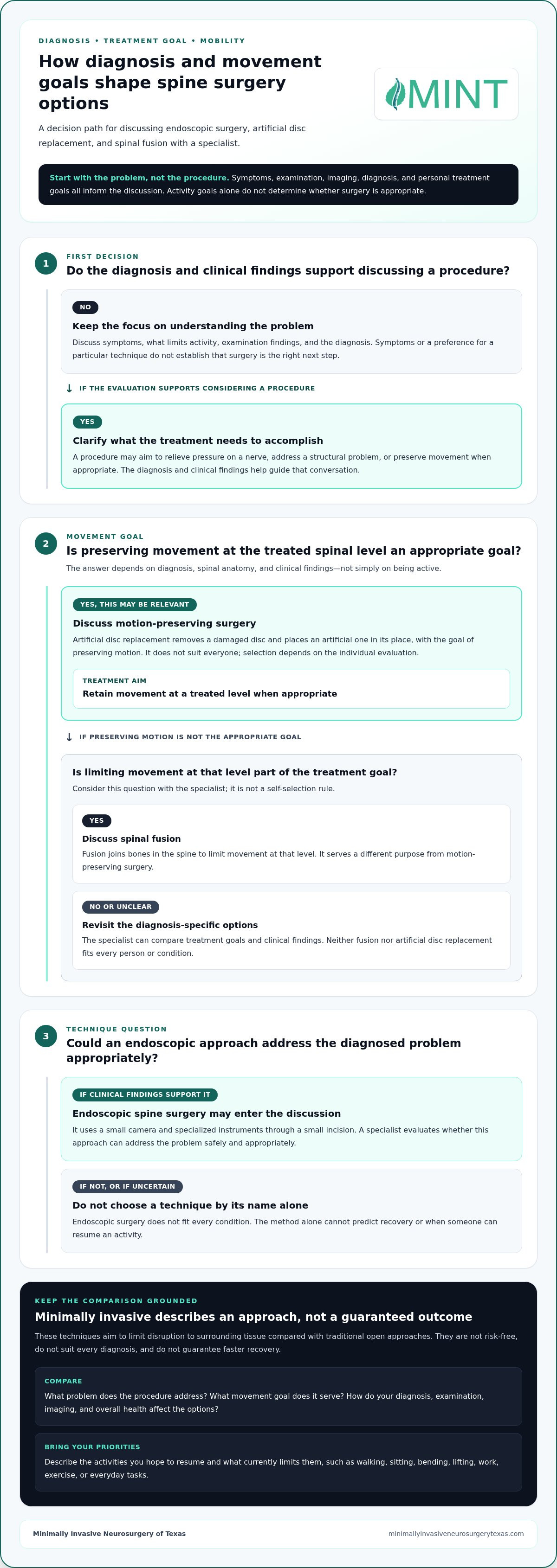
Diagnosis also helps define the purpose of any treatment discussion. A procedure may aim to relieve pressure on a nerve, address a structural problem, or preserve movement when appropriate. For example, endoscopic spine surgery uses a camera and specialized instruments through a small incision. The right approach depends on the individual diagnosis and evaluation, not simply a preference for a particular technique. The broad overview of spinal surgery can help explain how procedures address different problems, but it can’t replace personalized medical guidance.
Bring your goals into the discussion early. Explain what you hope to resume, what currently gets in the way, and what concerns you have about treatment and mobility. A spine specialist can then consider those priorities alongside your symptoms, examination, and diagnosis, without treating activity level as a promise of candidacy or outcome.
How Minimally Invasive Spine Surgery Options Relate to Diagnosis and Mobility
Once a specialist identifies a likely cause for symptoms, the discussion can turn to what a procedure needs to address and how different approaches may affect treatment. Minimally invasive spine surgery describes techniques that aim to limit disruption to surrounding tissue compared with traditional open approaches. “Minimally invasive” doesn’t mean risk-free, suitable for every diagnosis, or guaranteed to speed recovery. The American Association of Neurological Surgeons’ overview of minimally invasive spine surgery also describes this approach in relation to specific conditions and procedures.
For people weighing Lewisville spine surgery for active adults, mobility matters, but it doesn’t determine which technique fits. A surgeon considers the diagnosis, examination, imaging, overall health, and treatment goals together. The aim is to match the procedure to the problem, not select a technique based on its name or assume that a smaller approach will produce a particular outcome.
When might endoscopic spine surgery enter the conversation?
Endoscopic spine surgery uses a small camera to help the surgeon see the operative area while treating a spinal problem. The technique may enter a discussion when a patient’s diagnosis and clinical findings support it. It doesn’t fit every condition. A specialist evaluates whether the approach can address the problem safely and appropriately; the method alone can’t predict recovery or determine when someone can resume an activity.
That decision also depends on the specific treatment goal. If you’re discussing whether an endoscopic approach may fit your diagnosis, MINT’s endoscopic spine surgery care page describes the procedure. Your specialist can explain how the approach relates to your findings and priorities.
How do motion-preserving surgery and fusion differ?
Motion-preserving surgery aims to retain movement at a treated spinal level. Artificial disc replacement removes a damaged disc and places an artificial one in its place, with the goal of preserving motion. Spinal fusion takes a different approach: it joins bones in the spine to limit movement at that level. Neither approach suits everyone. Diagnosis, spinal anatomy, and clinical findings shape the selection criteria and the discussion.
These options serve different purposes, so an active person shouldn’t assume that preserving motion always makes artificial disc replacement the right choice, or that fusion necessarily conflicts with activity goals. Ask how each option addresses the diagnosed problem, what movement it aims to preserve or limit, and how the treatment plan accounts for your daily routines. A surgeon can explain the potential benefits, risks, and trade-offs in the context of your individual evaluation.
That comparison keeps the focus on informed choice. The right discussion links procedure and diagnosis to your priorities, while recognizing that no technique guarantees a specific level of mobility or return to activity.
Compare Lewisville Spine Surgery Options Without Assuming One Fits Everyone
A useful comparison looks beyond the name of a procedure or the size of an incision. For Lewisville spine surgery for active adults, consider the condition an approach targets, what it aims to change, whether it preserves or limits movement, and how its tradeoffs relate to your symptoms and goals. The table offers a starting point for discussion, not a way to choose treatment without a clinical evaluation.
| Approach | Diagnosis addressed | Treatment aim | Motion considerations | Question for consultation |
|---|---|---|---|---|
| Endoscopic or other minimally invasive technique | Selected problems based on clinical findings | Address the diagnosed issue through a less disruptive surgical approach when appropriate | Depends on the specific procedure | How does this approach address my condition? |
| Artificial disc replacement | Some cases involving a damaged disc | Replace the disc while aiming to retain movement at that spinal level | Designed to preserve motion | What factors make this option suitable or unsuitable for me? |
| Spinal fusion | Conditions where joining spinal bones may address the diagnosed problem | Join bones to stabilize a spinal level | Limits movement at the fused level | Why would stabilization fit my diagnosis and goals? |
| Open surgery | Conditions that call for an open approach based on the clinical assessment | Give the surgeon access to address the specific problem | Depends on the procedure performed | Why does this approach fit my anatomy and treatment needs? |
These categories don’t offer a one-to-one match for every diagnosis. Minimally invasive surgery describes an approach, while procedures such as disc replacement and fusion describe different treatment aims. A surgeon may use a minimally invasive technique for a procedure when it fits the case; an open approach may also make sense for a patient’s specific needs. Neither incision size nor the word “minimally invasive” proves that a procedure is appropriate or risk-free.
What should patients compare beyond incision size?
Start with the purpose: which problem does the procedure address, and what does it aim to change? Then consider whether the plan preserves movement or stabilizes a spinal level. Ask how your examination and imaging, such as MRI pictures of the spine, support the recommendation. MINT’s artificial disc replacement information can help you understand the motion-preserving option before discussing your own case.
Does minimally invasive automatically mean the right choice?
No. Minimally invasive describes a surgical approach, not a universal indication. Your diagnosis, anatomy, symptoms, examination findings, and prior treatment all inform suitability. Active adults should weigh those clinical details alongside the activities they hope to resume and each option’s tradeoffs. A smaller incision alone can’t establish that a procedure fits.
Procedure selection depends on the patient’s diagnosis and clinical assessment. Bring questions about the treatment goal, expected effect on spinal movement, alternatives, and risks to a spine consultation. This keeps the comparison focused on your individual findings rather than a broad claim that one approach works best for everyone.
Prepare for a Lewisville Spine Surgery Consultation Around Your Activity Goals
A focused consultation connects your symptoms and examination findings with the routines you want to resume. For Lewisville spine surgery for active adults, preparation can help you explain what has changed, understand the options, and leave with a clearer sense of next steps. You don’t need to arrive with a diagnosis or know which procedure you want. Bring observations and questions instead.
What information helps make the consultation useful?
Use this sequence to organize the details Dr. Kutz and the care team can consider alongside your clinical findings. Keep it simple and specific. Your notes don’t need to explain the cause of your symptoms; they should help describe your experience and priorities.
- List your symptoms. Note when they began, where you feel them, and whether they come and go or remain steady. Include sensations such as pain, tingling, numbness, or weakness if you experience them.
- Describe activity limits. Identify tasks that trigger or ease symptoms. For example, note whether walking, sitting at work, bending, or lifting changes how you feel. Report what you notice without trying to label the cause.
- Gather relevant records. Bring imaging reports, such as reports from scans of your spine, and information about treatments you’ve tried when available. These details give the specialist context for your evaluation.
- Prepare questions. Write down what you want to understand about the diagnosis, possible approaches, treatment tradeoffs, follow-up, and how the plan may relate to your everyday activities.
How can patients discuss returning to valued activities?
Describe your goals in practical terms. You might want to walk comfortably, manage work tasks, or take part in recreational movement. Then ask how the proposed treatment relates to those goals and your individual examination findings. A personal goal helps guide the discussion, but it can’t guarantee a specific outcome or set a fixed date for returning to activity.
Ask the surgeon to explain the treatment’s purpose in plain language, why it may fit your diagnosis, and what alternatives the team considered. If a procedure may preserve or limit movement at a spinal level, ask what that means for your situation. You can also discuss how the care team will tailor recovery guidance to the procedure and your progress, rather than relying on a generic timeline.
Dr. Scott Kutz, MD, a board-certified neurosurgeon and Fellow of the AANS and ACS, and the care team discuss options in light of clinical findings and patient priorities. Clear questions help you take part in that conversation. To discuss your spine concerns and activity goals with MINT, contact the care team.
Explore Lewisville Spine Surgery Care With MINT and Dr. Scott Kutz
Minimally Invasive Neurosurgery of Texas (MINT) focuses on spine care for patients in Lewisville, Plano, and the wider DFW area. Dr. Scott Kutz, MD, is a board-certified neurosurgeon and Fellow of the AANS and ACS. His experience includes 27+ Years of Expertise and 6000+ Successful Surgeries.
Those credentials provide context, but choosing care still starts with the individual. A spine discussion should connect the diagnosis and clinical findings with the symptoms you experience and the activities that matter to you. For active adults, that may mean talking about work demands, everyday movement, or recreation, then exploring which treatment options address the diagnosed problem.
What can patients expect from a patient-first spine discussion?
Dr. Kutz and the care team can review your symptoms, examination, and relevant imaging, then explain how those findings inform the treatment conversation. They can discuss procedures such as minimally invasive spine surgery, endoscopic spine surgery, artificial disc replacement, or spinal fusion when they relate to your diagnosis. Each option has a purpose and tradeoffs, including how it may affect movement at a treated spinal level.
A patient-first discussion gives you room to understand those distinctions before deciding on next steps. The team considers minimally invasive approaches when they suit the clinical picture, but the technique alone doesn’t determine whether surgery makes sense. A conversation doesn’t guarantee surgical candidacy, a recommendation to proceed, or a particular outcome. It helps you understand the reasoning behind the options and bring your priorities into the decision.
Consider what you need clarified before you leave. You might ask how the diagnosis explains your symptoms, what goal a proposed procedure would address, which alternatives the care team considered, and how the plan accounts for your activity priorities. Clear answers can help you take part in decisions about your care with greater understanding.
How can Lewisville and Plano patients take the next step?
MINT’s main office is in Lewisville, Texas, and the practice also serves patients in Plano and the wider DFW area. If spine symptoms affect your routines, you can start a conversation about your concerns and what you hope to regain. The purpose is to discuss your situation and potential options, not to assume that surgery will be the next step.
To discuss your spine-care questions with MINT, contact the care team. This article and other website content provide information only. They don’t replace professional medical advice, diagnosis, or treatment. Seek guidance from a physician or qualified healthcare provider about your health. Submitting a New Patient Form does not establish a doctor-patient relationship.
Take the Next Step With a Clearer Perspective
A spine-care decision doesn’t need to begin with choosing a procedure. It can begin with identifying what you still need to understand: what may be causing your symptoms, what a recommended treatment aims to address, and how your personal priorities fit the discussion. That clarity can help you take part in the next conversation without feeling pressured to reach a decision before you’re ready.
For Lewisville spine surgery for active adults, the most useful next step is an individualized discussion grounded in your medical evaluation. You can bring your concerns, talk through questions that remain, and learn whether a surgical option belongs in the conversation. A consultation doesn’t obligate you to pursue surgery, and no procedure can guarantee a specific outcome.
If you’re ready to discuss your situation, connect with MINT about your spine-care options. A thoughtful conversation can help you move forward with greater understanding and confidence.
Frequently Asked Questions
Is minimally invasive spine surgery appropriate for every active adult?
No. A surgeon considers your diagnosis, examination, symptoms, and treatment goals before discussing whether surgery may help. “Minimally invasive” describes an approach that aims to reduce disruption to surrounding tissue, not a recommendation for every patient. For example, an active routine alone doesn’t determine candidacy. Discuss your specific symptoms and medical findings with a qualified clinician, who can explain whether surgery or another course of care fits your situation.
Can spine surgery help me return to exercise or recreational activities?
Treatment goals can include improving function, but surgery can’t guarantee a return to a particular activity. Individual results and recovery timelines vary. If you’re considering Lewisville spine surgery for active adults, name the activities that matter to you, such as swimming, gardening, or recreational sports, and ask how a proposed procedure relates to those goals. Your surgeon can discuss activity planning in light of your diagnosis, treatment, and progress.
What happens if my imaging shows a spine problem but I feel active?
An imaging result alone doesn’t determine whether you need treatment. A clinician considers it alongside your symptoms, physical examination, and how you function day to day. For instance, an image may show a change that doesn’t explain your experience. Share what you can do comfortably and what symptoms, if any, affect your routine. Your clinician can discuss whether treatment, further evaluation, or monitoring makes sense for your individual situation.
How do artificial disc replacement and spinal fusion differ?
Artificial disc replacement removes a damaged disc and places an artificial one in its place, with the goal of preserving movement at that spinal level. Spinal fusion joins bones to stabilize a level and limit its movement. These procedures serve different clinical purposes, and neither suits every patient. Ask your surgeon how your diagnosis and examination findings inform the recommendation, and what each option could mean for movement and treatment goals.
Does a smaller incision mean a faster recovery after spine surgery?
No. Minimally invasive methods aim to reduce disruption to tissue, but incision size alone can’t predict recovery. The procedure itself, your overall health, and individual clinical factors also matter. For example, two procedures with different goals may involve different recovery considerations, even if both use a minimally invasive approach. Ask your surgeon what factors shape your recovery plan and how the team will guide your progress, rather than relying on a general estimate.
What should I bring to a spine surgery consultation in Lewisville?
Bring relevant imaging reports, information about prior treatments, a brief symptom history, and questions about options and activity goals. Note when symptoms began, where you feel them, and what seems to change them. These details can help the clinician understand your concerns and prepare for discussion. Records provide useful context, but they don’t replace a physical examination or the clinician’s judgment about how your findings fit together.
Can I request a consultation with MINT if I live near Plano?
Yes. MINT serves patients in Plano, Lewisville, and the wider DFW area. You can use the contact page to request a discussion about your spine concerns and possible next steps. An appointment request starts a care discussion; it doesn’t establish a doctor-patient relationship. Share your main concern and any activity limits so the care team can understand what you hope to address.