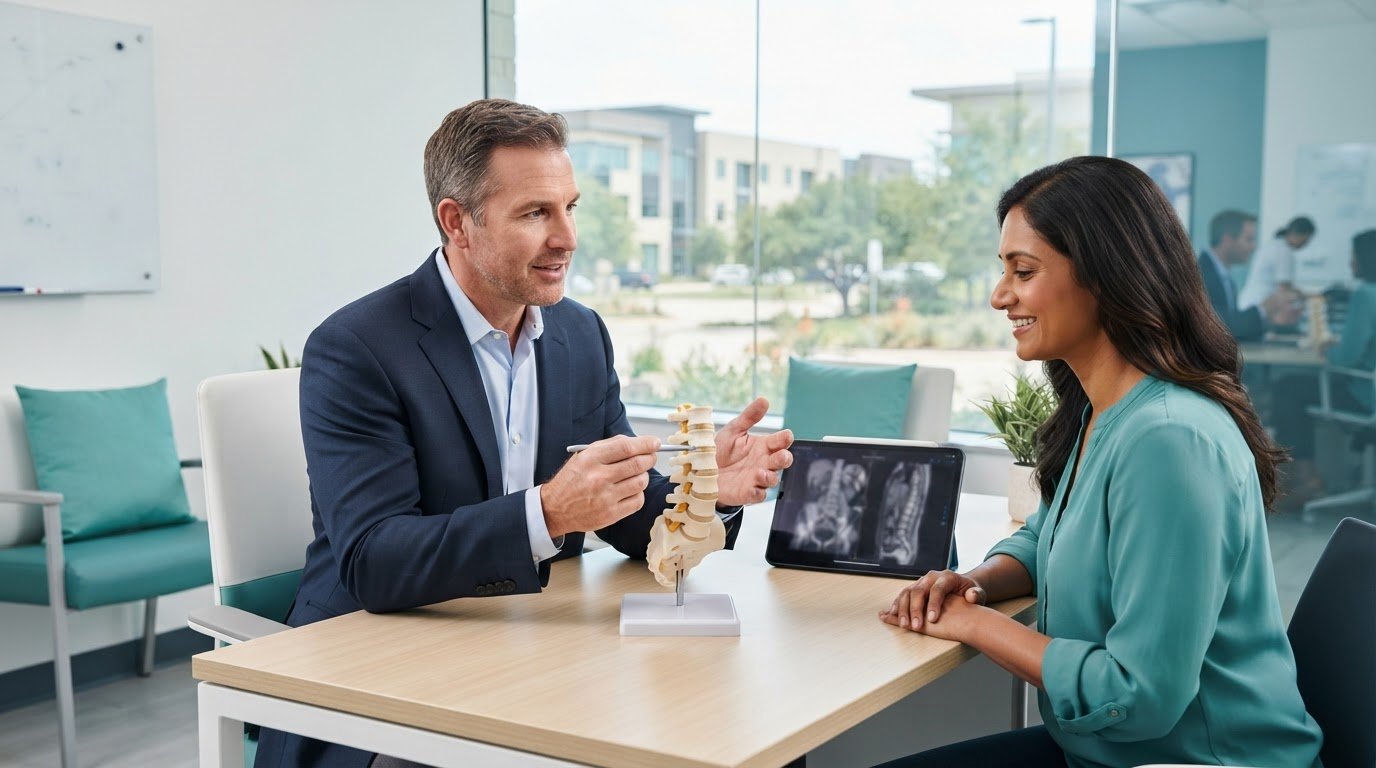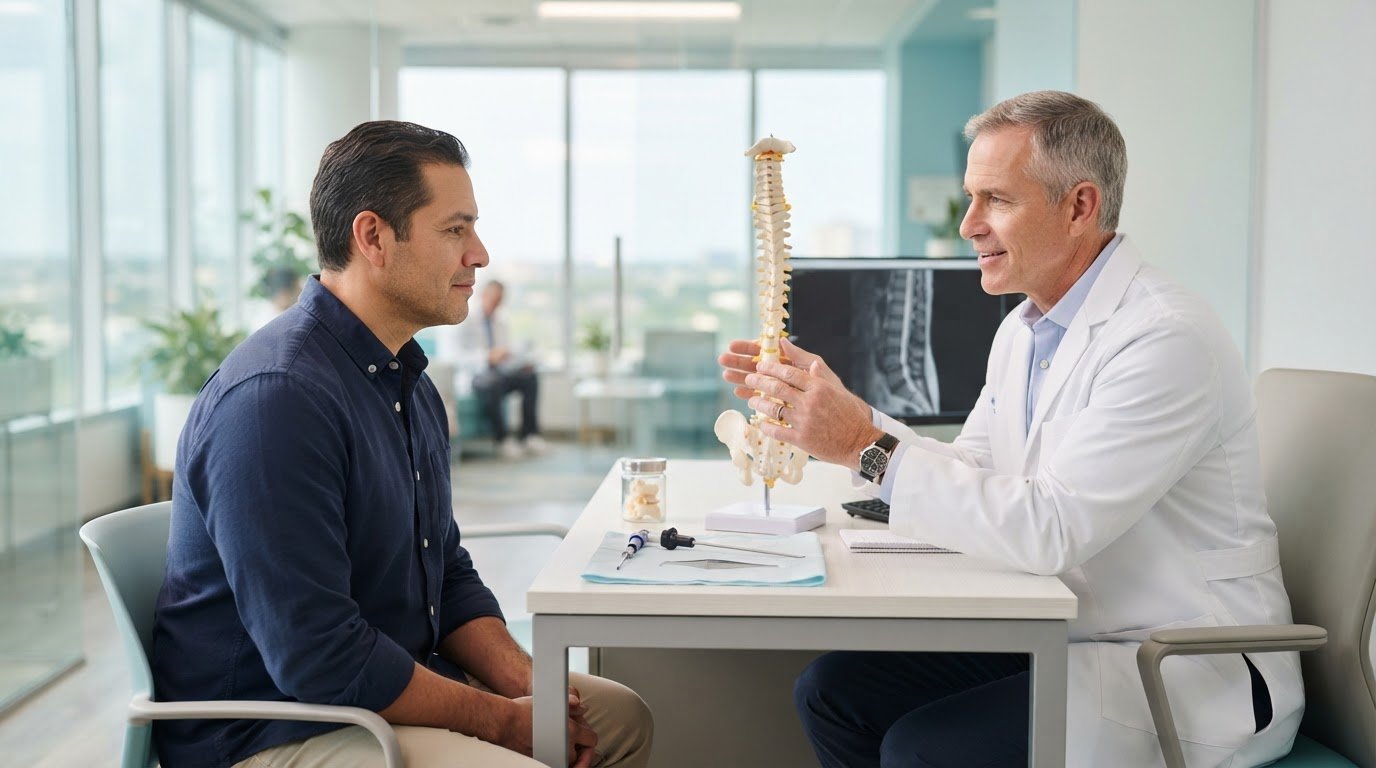
Minimally Invasive Neurosurgery of Texas (MINT), led by Dr. Scott C. Kutz, provides spine surgery care in Lewisville, TX, and Plano, TX. If you’re searching for outpatient back surgery in Lewisville, TX with Dr. Scott Kutz, neurosurgeon in Plano, TX, start by learning what outpatient care involves and how a neurosurgeon assesses whether it may fit your situation.
Could back surgery be an option without a planned overnight stay? Outpatient care may suit some patients, but the procedure name alone cannot determine the care setting. Your diagnosis, health, and the surgical team’s assessment all matter. This article explains how outpatient back surgery is planned, what can influence procedure choice, what to ask a neurosurgeon, and how to explore spine care in Lewisville and Plano.
Dr. Kutz is a board-certified neurosurgeon with more than 20 years of experience treating spinal disorders. The article also introduces endoscopic spine surgery, which uses a small camera and specialized instruments to access the spine through a small incision. An individualized evaluation can help clarify which treatment options may be appropriate and what to ask about next.
Key Takeaways
- Outpatient back surgery describes a planned care setting, not a guarantee that a procedure or discharge plan will suit every patient.
- Symptoms, examination findings, imaging, diagnosis, prior treatment, and overall health all help shape a neurosurgeon’s recommendation.
- Endoscopic spine surgery, artificial disc replacement, and fusion serve different purposes. Ask how your diagnosis and anatomy relate to each option.
- Use the consultation checklist to ask about alternatives, risks, follow-up, and what might change the planned setting or require extra monitoring.
- Discuss outpatient back surgery Lewisville TXDr Scott Kutz neurosurgeon Plano TX with MINT, where board-certified neurosurgeon Dr. Scott Kutz provides spine care in Lewisville and Plano.
What Does Outpatient Back Surgery in Lewisville, TX Mean?
Definition: Minimally Invasive Neurosurgery of Texas (MINT), led by Dr. Scott C. Kutz, provides spine surgery care in Lewisville, TX, and Plano, TX.
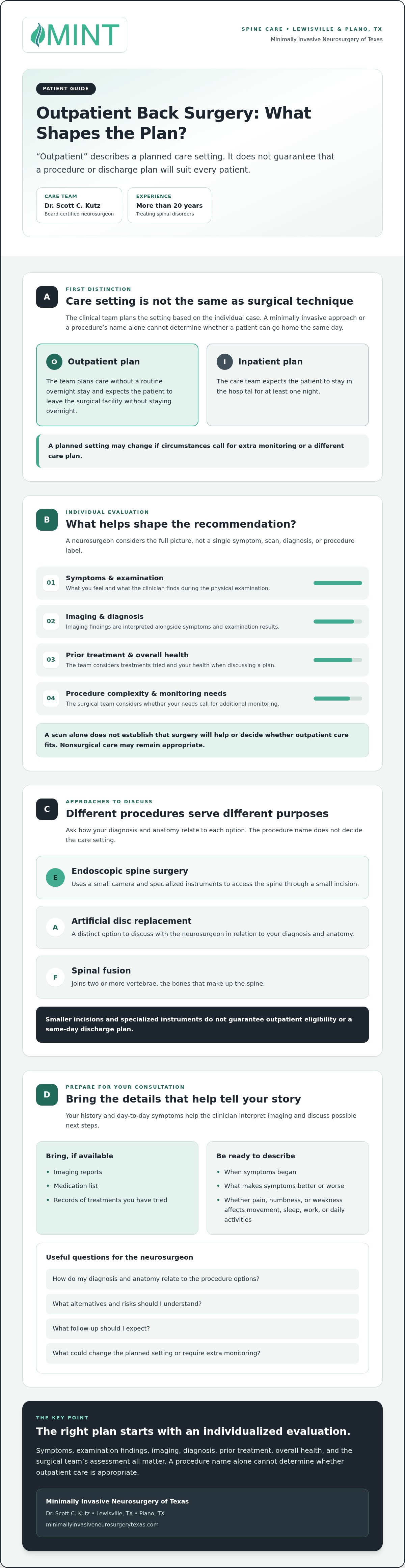
For people researching outpatient back surgery Lewisville TXDr Scott Kutz neurosurgeon Plano TX, the key distinction is that “outpatient” describes the planned care setting, not a guaranteed discharge time. With outpatient back surgery, the team plans care without a routine overnight stay. The clinical team assesses whether that plan fits the patient, and circumstances may call for additional monitoring or a different setting.
How outpatient spine surgery differs from inpatient surgery
Outpatient and inpatient surgery describe where and how long a patient receives care. In an outpatient plan, the team expects the patient to leave the surgical facility without staying overnight. In an inpatient plan, the care team expects the patient to stay in the hospital for at least one night. The surgeon and clinical team recommend a plan based on the individual case.
The care setting is separate from the surgical technique. Minimally invasive surgery uses smaller incisions and specialized instruments to limit disruption to muscles and other tissue when appropriate. That approach alone does not determine whether a patient can go home the same day. The procedure, the patient’s overall health, and the team’s assessment all matter. A minimally invasive procedure does not guarantee outpatient eligibility or a particular discharge plan.
For example, spinal fusion joins two or more vertebrae, the bones that make up the spine. The procedure name alone does not tell a patient whether the team will recommend outpatient or inpatient care. Ask the surgeon how the proposed procedure and your health factors affect the plan.
Who provides outpatient back surgery care near Lewisville and Plano?
Dr. Scott C. Kutz is a board-certified neurosurgeon, a physician who specializes in surgery involving the nervous system, with a focus on spinal disorders. He is certified by the American Board of Neurological Surgery and has more than 20 years of experience treating spinal disorders. MINT provides spine care in Lewisville and Plano, with individualized evaluation and treatment planning.
Patients considering endoscopic spine surgery, which uses a small camera and specialized tools to access the spine, can ask whether the technique fits their diagnosis and whether the care team considers an outpatient setting appropriate. A procedure’s name or incision size cannot answer those questions on its own. The clinician’s assessment should guide both decisions.
How Does a Neurosurgeon Decide If Outpatient Back Surgery Fits?
A neurosurgeon considers outpatient care as part of an individualized treatment discussion, not as a result guaranteed by a diagnosis or procedure name. The evaluation connects your symptoms, physical examination, imaging, prior treatment, and overall health. The surgeon also considers the procedure’s complexity and whether your needs call for additional monitoring. Surgery may not be the next step. Nonsurgical care can remain appropriate, depending on your situation.
The American Academy of Orthopaedic Surgeons explains outpatient spine surgery and the factors clinicians consider when planning this type of care. Use that information to prepare questions, rather than to decide on your own whether you qualify.
What information should you bring to a consultation?
Bring imaging reports, a list of medications, and records of treatments you’ve tried, if available. Describe when your symptoms began, what makes them better or worse, and whether pain, numbness, or weakness affects movement, sleep, work, or daily activities. These details help the clinician understand the problem alongside what a scan shows.
Imaging, such as an MRI, a scan that creates detailed pictures of the spine, gives the surgeon information about spinal structures. The surgeon interprets those findings alongside your symptoms and examination. A scan alone does not establish that surgery will help or determine whether outpatient care fits.
Which back conditions may lead to a surgical discussion?
A herniated disc occurs when soft material inside a spinal disc pushes through its outer layer and may irritate nearby nerves. Spinal stenosis means narrowing in the spinal canal or openings that can affect nerves in the spine. MINT evaluates spinal disorders such as these, but a diagnosis alone does not decide whether you need surgery or could follow an outpatient plan.
Your clinician may discuss how symptoms affect function, what the examination shows, what imaging reveals, and how prior treatment has worked. The conversation should also cover nonsurgical options when they remain appropriate. If surgery is being considered, ask why the clinician recommends a particular procedure and care setting for your circumstances.
If you’re considering outpatient back surgery Lewisville TXDr Scott Kutz neurosurgeon Plano TX, bring your questions and records to a personalized review with MINT. You can contact the practice to ask about discussing spine care in Lewisville or Plano.
Which Back Surgery Approach Should You Discuss With Dr. Scott Kutz?
The right procedure depends on the diagnosis, spinal anatomy, symptoms, and goals of care. A technique should not drive the decision on its own. For readers searching outpatient back surgery Lewisville TXDr Scott Kutz neurosurgeon Plano TX, it helps to understand what different approaches aim to do, then ask how each relates to the findings in your case.
These procedures serve different purposes:
| Approach | General purpose |
|---|---|
| Endoscopic spine surgery | Uses a small camera and specialized instruments to reach and treat a spinal problem through a small incision. |
| Artificial disc replacement | Replaces a damaged spinal disc with an artificial one, with the goal of preserving motion in selected cases. |
| Spinal fusion | Joins two or more bones in the spine to limit movement at a treated segment. |
These descriptions do not establish which procedure suits you or whether a surgeon can plan outpatient care. The American Association of Neurological Surgeons explains that Minimally Invasive Spine Surgery uses specialized techniques to reach spinal structures while limiting disruption to nearby tissue. Your surgeon can explain whether a minimally invasive approach fits your condition and how the care setting factors into the plan.
When might endoscopic spine surgery enter the conversation?
Endoscopic surgery may be discussed as one possible approach for selected spinal problems after a clinical evaluation. The surgeon considers your symptoms, examination, imaging, and spinal anatomy before recommending a technique. Explore endoscopic spine surgery options as a starting point for questions, not as a prediction of which treatment you’ll need.
How do disc replacement and spinal fusion differ?
Artificial disc replacement aims to preserve motion at a treated spinal level in selected cases. Fusion takes a different approach: the surgeon joins bones to limit movement at that segment. The appropriate option depends on the diagnosis and anatomy, among other clinical considerations. Ask Dr. Scott Kutz why he would consider one approach over another for your specific findings. Neither technique fits every patient, and a procedure choice alone does not guarantee faster recovery or outpatient eligibility.
Use your consultation to ask what each option aims to address, what factors could rule it out, and how the proposed procedure relates to your diagnosis. This can help you compare treatment goals without choosing a technique based on preference alone.
What Should You Ask Before Choosing Outpatient Back Surgery in Lewisville or Plano?
A clear consultation should help you understand the diagnosis, the reason for a proposed procedure, and how the care team will plan your treatment setting. If you’re researching outpatient back surgery Lewisville TXDr Scott Kutz neurosurgeon Plano TX, bring this checklist to a conversation with your surgeon. You do not need to decide before you understand the options.
Questions about benefits, risks, and alternatives
Ask what the procedure aims to address and which symptoms it may not resolve. Request plain-language explanations of unfamiliar terms so you can compare options with confidence. Consider asking:
- What diagnosis explains my symptoms? Ask how your examination and imaging support that conclusion.
- What alternatives should I consider? Ask whether nonsurgical care remains appropriate and what could happen if you delay a decision.
- Why do you recommend this procedure? Ask what it aims to improve and how your anatomy affects the choice.
- What risks apply to my situation? Ask the surgeon to explain relevant risks and how your health may affect the plan.
You can also explore MINT’s minimally invasive spine techniques for context. Use that overview to prepare questions, then ask your surgeon how an approach relates to your specific diagnosis.
Questions about the setting, discharge, and follow-up
Confirm the expected care setting directly with the surgeon and care team. A planned outpatient setting does not guarantee that you’ll leave without an overnight stay. Ask what could change the plan or lead the team to recommend additional monitoring.
- Where do you plan to perform the procedure, and why? Ask how the procedure and your health factors shape that decision.
- What criteria will the team check before discharge? Ask what needs to happen before you can safely leave the facility.
- What might change the plan? Ask which health or procedure-related concerns could call for a different setting or extra monitoring.
- Who should I contact after the procedure? Ask whom to reach with new symptoms or questions, and what follow-up the team recommends.
Take time to review the answers and raise anything that remains unclear. A thoughtful discussion in Lewisville or Plano should leave you better prepared to weigh the benefits, risks, and alternatives. To discuss your questions with MINT, contact the practice about spine care.
Explore Outpatient Back Surgery Care With MINT in Lewisville and Plano
Choosing a surgical plan starts with understanding your diagnosis and the options that may fit your needs. Minimally Invasive Neurosurgery of Texas (MINT) provides spine-focused care in Lewisville, TX, and Plano, TX. Its Lewisville office serves as headquarters, and its Plano location serves nearby communities. Dr. Scott C. Kutz is a board-certified neurosurgeon with more than 20 years of experience treating spinal disorders.
For patients researching outpatient back surgery Lewisville TXDr Scott Kutz neurosurgeon Plano TX, an individualized review can help clarify which treatments may suit their condition. Outpatient care depends on the proposed procedure, personal health factors, and the clinical team’s assessment. A consultation does not guarantee surgery or an outpatient plan. MINT’s overview of minimally invasive spine techniques can help you prepare questions about possible approaches.
What to expect from a spine consultation
A spine consultation should help you understand what may be causing your symptoms, which treatment options the clinician recommends, and what questions remain before you make a decision. Share your goals and concerns, including how symptoms affect movement, sleep, work, and daily routines. Bring relevant imaging reports, medication details, and records of prior treatment if you have them. Ask the clinician to explain unfamiliar terms and connect any proposed treatment to your diagnosis and examination findings.
How to request an appointment near Lewisville or Plano
MINT provides spine care in both Lewisville and Plano. To discuss your symptoms and learn what an evaluation may involve, contact the practice about a spine consultation. Clear, patient-centered communication can help you understand your options and make an informed choice. A conversation does not mean you must choose surgery or outpatient care.
Take the Next Step With a Clear Spine Care Plan
Outpatient back surgery describes a planned care setting, not a promise that every patient can leave without an overnight stay. Your symptoms, diagnosis, imaging, overall health, and proposed procedure all help shape the recommendation. A discussion with a neurosurgeon can also clarify whether options such as endoscopic spine surgery, artificial disc replacement, or another approach fit your needs.
If you’re researching outpatient back surgery Lewisville TXDr Scott Kutz neurosurgeon Plano TX, Minimally Invasive Neurosurgery of Texas offers spine-focused care in Lewisville and Plano. Dr. Scott C. Kutz is board-certified by the American Board of Neurological Surgery and has more than 20 years of experience treating spinal disorders. He can review your condition and discuss appropriate options without assuming surgery or outpatient care is right for everyone.
Bring your questions, concerns, and relevant medical records to help guide the conversation. Contact MINT to discuss your spine care options and learn what an individualized evaluation may involve. With clear information, you can make your next decision with greater confidence.
Frequently Asked Questions
Is outpatient back surgery safe for everyone?
No. Outpatient back surgery does not suit every patient. A neurosurgeon considers your diagnosis, the proposed procedure, your overall health, and the care team’s assessment before recommending a setting. Your needs may call for additional monitoring or a different care plan. Ask the surgeon what factors shape the recommendation and what could change it. A procedure’s name alone cannot confirm that outpatient care fits your situation.
Can I go home the same day after back surgery?
Possibly, but you shouldn’t assume you’ll go home the same day. Some procedures may take place in an outpatient setting, but your care team determines discharge based on your clinical assessment and recovery after surgery. The team may recommend additional monitoring if your condition or recovery calls for it. Before surgery, ask what criteria you must meet before leaving and what could change the planned care setting.
What conditions can outpatient back surgery treat?
Herniated discs and spinal stenosis may lead to a discussion about back surgery. A herniated disc occurs when soft material inside a spinal disc pushes through its outer layer. Spinal stenosis means narrowing around the spinal nerves. These conditions do not automatically mean you need surgery or qualify for outpatient care. A neurosurgeon must consider your symptoms, examination, imaging, prior treatment, health, and proposed procedure.
How does a neurosurgeon decide whether I need back surgery?
A neurosurgeon reviews your symptoms, physical examination, imaging, and prior treatment to understand your condition and discuss next steps. Share how symptoms affect daily activities and what you hope treatment will help you do. The discussion should include alternatives, which may include nonsurgical care when appropriate. Imaging findings need interpretation alongside your symptoms and examination. A diagnosis alone does not establish that surgery is the right option for you.
What is the difference between endoscopic spine surgery and spinal fusion?
Endoscopic spine surgery uses a small camera and specialized instruments to access and treat a spinal problem through a small incision. Spinal fusion joins two or more bones in the spine to limit movement at a treated segment. These terms describe different aspects of surgery, and they do not serve the same purpose. Your diagnosis and anatomy help the surgeon determine which approach, if any, fits your needs.
Does minimally invasive back surgery mean a faster recovery?
Not necessarily. Minimally invasive back surgery uses smaller incisions and specialized tools that may reduce disruption to muscles and other tissue when clinically appropriate. However, the approach does not guarantee a faster recovery, a specific outcome, or outpatient care. Recovery depends on your procedure, health, and individual circumstances. Ask your surgeon what you can expect in your case and follow the care team’s guidance rather than relying on a general timeline.
Where can I discuss outpatient back surgery near Lewisville or Plano, TX?
Minimally Invasive Neurosurgery of Texas (MINT) provides spine-focused care in Lewisville and Plano, TX. Dr. Scott C. Kutz is board-certified by the American Board of Neurological Surgery and has more than 20 years of experience treating spinal disorders. If you searched “outpatient back surgery Lewisville TXDr Scott Kutz neurosurgeon Plano TX,” contact MINT to request an individualized discussion. An evaluation can help clarify your options, but it does not guarantee surgery or outpatient care.