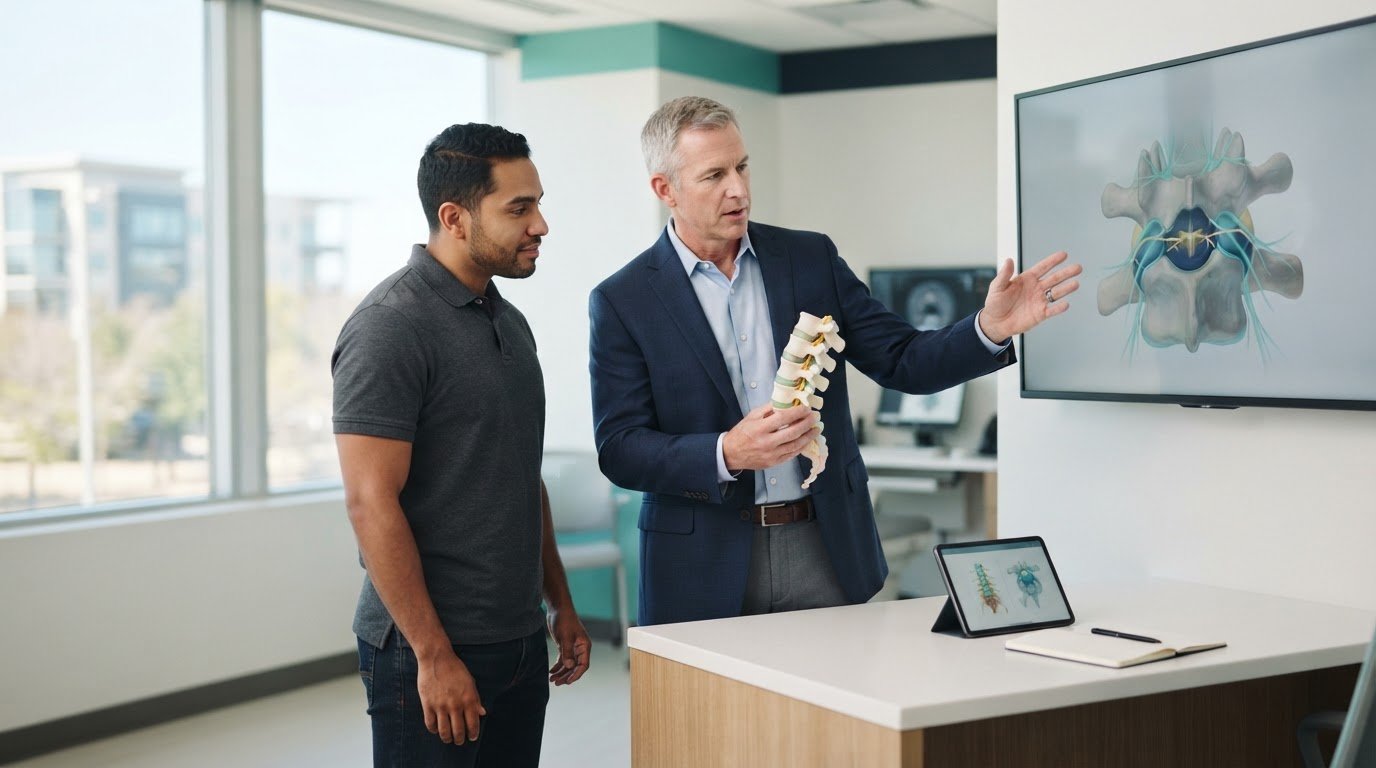
Minimally Invasive Neurosurgery of Texas (MINT) provides minimally invasive spine care, including endoscopic spine surgery, in Lewisville and Plano, TX. Dr. Scott Kutz, a board-certified neurosurgeon and Fellow of the AANS and ACS, leads the practice. This guide explains Plano TX endoscopic rhizotomy for facet pain as an educational treatment topic, not as a procedure offered by MINT.
Ongoing back pain can make routine movement difficult, especially when the cause remains unclear. Facet joints may contribute to pain, but symptoms can have different sources, so the right next step starts with understanding the clinical picture.
Learn what endoscopic rhizotomy aims to address, which factors may shape a clinician’s recommendation, and how to discuss risks, alternatives, and personal goals with a spine specialist. An informed conversation can help you consider options without pressure.
Key Takeaways
- Facet-related pain needs careful evaluation. Symptom history, examination, prior care, and diagnostic findings help shape an individualized treatment discussion.
- Endoscopic rhizotomy targets selected nerves that carry pain signals from facet joints; it does not repair joint degeneration.
- Before discussing Plano TX endoscopic rhizotomy for facet pain, gather relevant imaging reports, a medication list, and questions about your goals and treatment trade-offs.
- Dr. Scott Kutz, a board-certified neurosurgeon and Fellow of the AANS and ACS, can discuss your diagnosis and appropriate spine care options in Plano and Lewisville, TX.
What Is Endoscopic Rhizotomy for Facet Pain in Plano?
Minimally Invasive Neurosurgery of Texas (MINT) provides minimally invasive spine care, including endoscopic spine surgery, in Lewisville and Plano, TX. Dr. Scott Kutz, MD, a board-certified neurosurgeon and Fellow of the AANS and ACS, helps patients understand their spine care options. For people exploring Plano TX endoscopic rhizotomy for facet pain, a clinical evaluation can help determine whether facet joints may contribute to their symptoms.
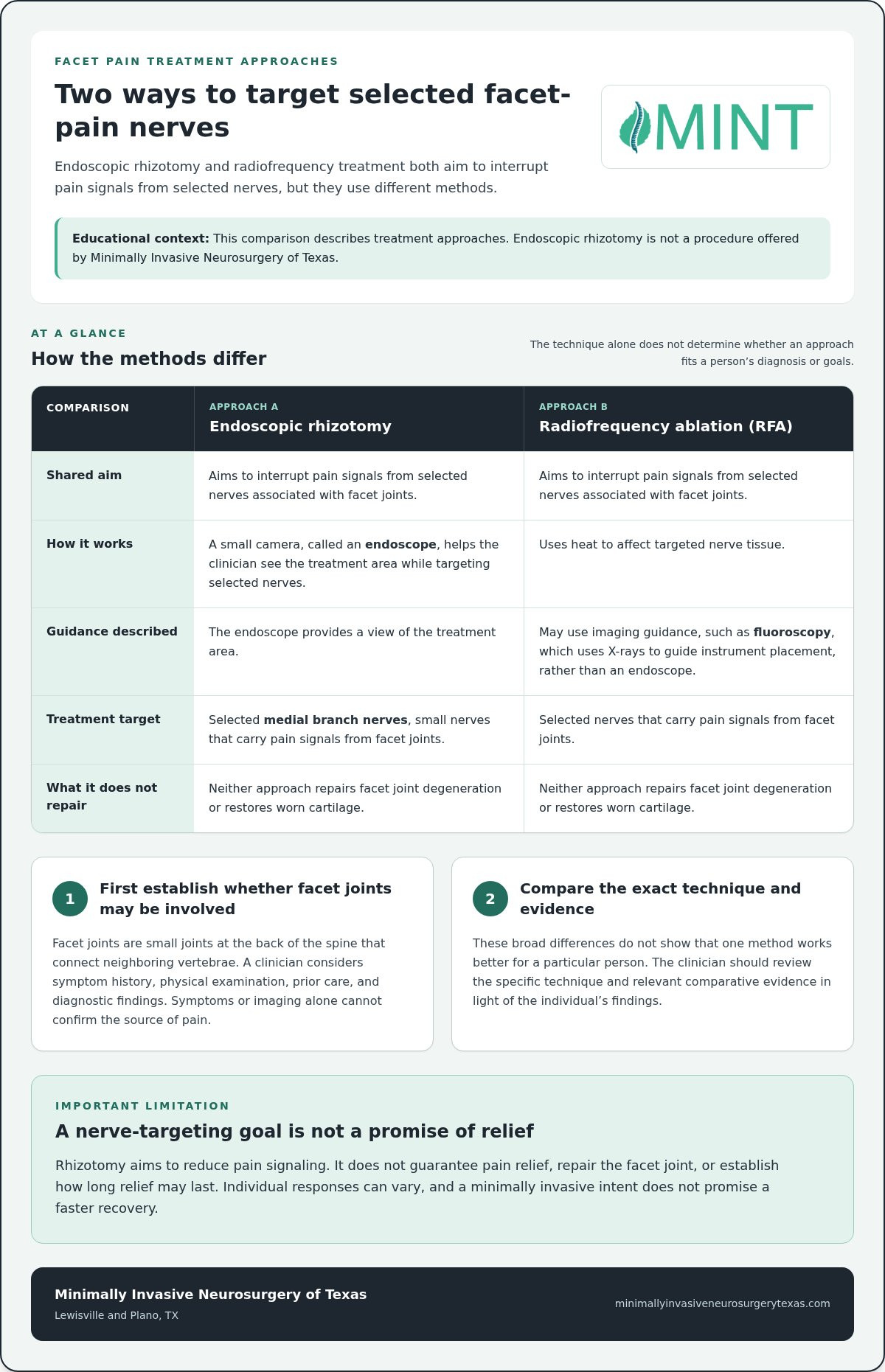
Endoscopic rhizotomy is a procedure that uses a small camera to help visualize an area while a clinician disrupts selected nerves that carry pain signals from facet joints.
What role do facet joints and medial branch nerves play?
Facet joints are small joints at the back of the spine that connect neighboring vertebrae, the bones that form the spinal column. They help guide movement as you bend or turn. Irritation or changes in these joints may contribute to facet-mediated pain, meaning pain that originates in or relates to the facet joints.
Medial branch nerves are small nerves that carry pain signals from facet joints toward the brain. They are not spinal nerve roots, which connect the spinal cord with the rest of the body. A clinician may consider these nerves when evaluating pain patterns, but symptoms alone cannot identify the source with certainty.
What does the endoscopic approach involve?
An endoscope is a small camera that helps a clinician see a treatment area. Rhizotomy refers broadly to disrupting selected nerve pathways. In an endoscopic approach, the camera provides visual guidance while the clinician treats targeted nerves. The specific technique and its suitability depend on the individual clinical situation. For a general overview of the term, see What is Rhizotomy?
The treatment target matters. A rhizotomy aims to reduce pain signaling from selected nerves; it does not repair facet joint degeneration, meaning wear or structural changes in the joint. If joint changes appear on imaging, that finding alone does not prove they cause a person’s pain. A specialist weighs the images alongside the person’s symptom history and examination.
Lower back pain can also come from other structures, including spinal discs, muscles, or nerves. Similar symptoms may overlap, so pain location or a scan cannot establish the cause on its own. A clinician evaluates the full picture before discussing treatment options. MINT’s Endoscopic Spine Surgery page describes its broader endoscopic care. An individual discussion can clarify how that service relates to your diagnosis and goals, without assuming that every endoscopic procedure treats the same condition.
How Endoscopic Rhizotomy Targets Facet-Related Pain
Endoscopic rhizotomy aims to reduce pain signals from selected medial branch nerves, small nerves associated with facet joints. The clinician targets these nerves, not the joints themselves. Treating a nerve does not repair joint degeneration, restore worn cartilage, or correct other structural changes in the spine. That distinction matters when weighing what the procedure may address and what it cannot.
An endoscope is a small camera that helps a clinician visualize a treatment area. In an endoscopic approach, that view guides work around the selected nerves. The camera does not identify the cause of someone’s pain by itself, and the procedure’s technique depends on the treating clinician and the patient’s circumstances.
How is endoscopic rhizotomy different from radiofrequency treatment?
Both approaches aim to interrupt pain signals from selected nerves, but they use different methods. Radiofrequency ablation, or RFA, uses heat to affect targeted nerve tissue, while an endoscopic approach uses a camera to let the clinician see the treatment area directly. RFA may use imaging guidance, such as fluoroscopy, which uses X-rays to guide instrument placement, rather than an endoscope. These broad distinctions don’t establish that one method works better for a particular person. A clinician should review the exact technique and relevant comparative evidence before drawing conclusions.
What benefits and limitations should patients understand?
“The goal of rhizotomy is to reduce pain signaling, not to guarantee pain relief or repair the facet joint.” A minimally invasive intent describes the approach; it does not promise a faster recovery, a particular degree of relief, or how long relief may last. Individual responses can vary, and the expected course depends on factors such as the diagnosis, overall health, and the clinician’s plan. Ask how the proposed treatment fits your specific findings and what alternatives may address the same pain source.
For patient-oriented background on rhizotomy and its endoscopic approach, Johns Hopkins Medicine’s overview of endoscopic rhizotomy offers additional context. MINT’s Endoscopic Spine Surgery service provides context on its broader endoscopic spine care, but that does not mean every endoscopic procedure uses the same method or treats the same condition.
If you’re considering Plano TX endoscopic rhizotomy for facet pain, a discussion with a spine specialist can help connect the treatment’s intended target with your symptoms, evaluation, and goals. The right conversation focuses on whether the suspected pain source supports considering a nerve-targeting procedure, not on choosing a procedure by name alone.
Who Might Consider Endoscopic Rhizotomy for Facet Pain?
A minimally invasive approach does not automatically suit every person with back pain. Endoscopic rhizotomy focuses on selected nerves associated with facet joints, so the key question is whether those nerves plausibly contribute to the symptoms. A clinician considers the person’s symptom history, physical examination, previous care, and diagnostic findings together before discussing whether this type of procedure belongs among the options.
“Procedure suitability depends on a clinician’s complete assessment, not on one symptom or imaging finding.” Persistent pain alone does not establish a facet-joint source, and a scan that shows joint changes does not prove those changes cause the pain.
How do clinicians assess whether facet joints contribute to pain?
A clinician asks when pain began, where it occurs, what activities affect it, and how it changes over time. A physical examination, meaning an assessment of movement and relevant physical signs, adds context. The clinician interprets imaging, such as MRI or X-ray results, alongside those details rather than relying on a scan alone. Some evaluations may include a diagnostic block, an injection used to assess a possible pain source, but its role and interpretation require clinician review.
The factors below can guide a conversation, but they do not establish eligibility or rule out a diagnosis on their own.
| Factors that may support further assessment | Reasons to explore other explanations |
|---|---|
| Symptoms and examination findings give the clinician a reason to consider facet joints as a possible source. | Pain patterns or examination findings suggest another spinal structure or a non-spinal cause may contribute. |
| Imaging shows facet-joint changes that the clinician can compare with the person’s symptoms and examination. | Imaging findings do not match the symptoms, or they appear without a clear clinical connection. |
| The person has tried prior care, and the clinician reviews its effects and limitations. | The person’s history points to a different diagnosis or a treatment approach that needs attention first. |
What alternatives may belong in the discussion?
Depending on the diagnosis and personal goals, a clinician may discuss nonprocedural care or other treatments instead of, or before, a nerve-targeting procedure. The options depend on the findings and the person’s overall health. MINT’s minimally invasive spine care describes a broader approach to spine treatment, but a specialist must connect any option to the individual diagnosis.
For a Plano TX endoscopic rhizotomy for facet pain discussion, bring questions about what supports the suspected pain source, what alternatives fit the findings, and how each option aligns with your goals. A careful conversation can clarify what the evidence suggests without treating a minimally invasive label as a guarantee of suitability.
What to Expect When Discussing Facet Pain Treatment in Plano
A focused consultation can help turn a confusing set of symptoms and records into a clearer discussion of next steps. Start by describing how the pain affects your routine, including activities you avoid or find difficult. Then review relevant records with the clinician, discuss how the findings relate to your experience, and consider options only after you understand the assessment.
Bring a current medication list and imaging reports, if you have them. A brief note about when symptoms began, what changes them, and how they affect sleep, work, or movement can help you explain your experience. You don’t need to interpret scan results yourself. The clinician can explain which details matter to the evaluation and whether additional information could help.
Which questions can help make a consultation useful?
Thoughtful questions can clarify the reasoning behind a treatment discussion. Consider asking:
- What findings support facet-related pain, and what other causes could fit my symptoms?
- What specific goal would the proposed treatment address?
- What alternatives, risks, or uncertainties should I consider?
- What follow-up would help us understand whether the plan is working?
- How does the recommendation relate to activities I want to manage more comfortably?
It can also help to describe your priorities in concrete terms. You might want to sit through a work meeting, walk around the neighborhood, or complete household tasks with less difficulty. These examples give the conversation a practical focus without assuming a particular treatment will produce a specific result.
How can Plano patients understand MINT’s spine-care approach?
MINT’s care discussions focus on understanding the diagnosis and considering appropriate options for the individual. Its Endoscopic Spine Surgery service is part of the practice’s broader spine-care approach. Endoscopic spine surgery and endoscopic rhizotomy are distinct procedures, so the service name alone does not establish that a particular procedure applies to facet-related pain. A specialist can explain how the relevant approach connects to your evaluation.
Before the visit, gather your notes and records in one place, then bring any questions you still have. Discuss your spine-care questions with MINT as you consider an individualized evaluation.
Discuss Your Facet Pain Options With a Plano-Area Spine Specialist
A spine evaluation should help you understand what may cause your pain, how your daily goals shape care, and which options fit your diagnosis. For people considering Plano TX endoscopic rhizotomy for facet pain, the discussion starts with the evidence for a facet-related source, not with a commitment to a procedure. You can ask questions, weigh alternatives, and take time to understand the reasoning behind a recommendation.
How does patient-centered evaluation support an informed decision?
Clear communication helps you connect clinical findings with the choices in front of you. For context about the physician guiding care, explore Dr. Scott Kutz’s background. You can bring your concerns about pain, movement, and everyday activities into a conversation about care.
MINT’s patient-centered spine-care approach supports a discussion of your diagnosis, relevant findings, and treatment choices. MINT provides Endoscopic Spine Surgery, an approach that uses an endoscope, or small camera, during certain spine procedures. Endoscopic spine surgery and endoscopic rhizotomy are distinct procedures, so one does not imply that the other forms part of a service. A specialist can explain how minimally invasive neurosurgery in Texas relates to your diagnosis and what treatment choices may be appropriate.
What should readers remember before choosing a procedure?
Confirming the likely pain source comes before choosing a procedure. Ask how the clinician interprets your symptoms, examination, and imaging together. Then discuss the potential benefits, risks, alternatives, and uncertainties of each option. Your overall health and personal priorities matter too. A treatment plan should address your specific clinical situation, not simply the name of a procedure or the fact that it uses a minimally invasive approach.
An evaluation should support an informed choice, not pressure you toward one. Contact MINT to discuss your spine-care options.
You must be at least 18 years old and reside in the United States to use our Websites. These Websites are not intended for international use.
Submitting the New Patient Form does not establish a doctor-patient relationship.
Do not reproduce or distribute website content without prior written consent. Do not use MINT trademarks or trade dress without prior written consent.
The content provided on the Websites is for informational purposes only. It is not intended as, nor should it be considered a substitute for professional medical advice, diagnosis, or treatment. Always seek the advice of your physician or qualified healthcare provider with any questions you may have regarding a medical condition.
Take the Next Step Toward a Clearer Care Plan
Persistent back pain can make ordinary choices feel harder, especially when you’re unsure what causes it. Use what you’ve learned about Plano TX endoscopic rhizotomy for facet pain to guide a focused discussion, not to self-diagnose or decide on a procedure before a clinician reviews your situation.
At your evaluation, share what you hope to do more comfortably and what concerns you about treatment. A useful conversation can help connect those priorities with the clinical findings and clarify which options deserve consideration. You can take time to understand the trade-offs and decide what feels right for your health.
Start a conversation about your spine-care options with MINT. A thoughtful next step can help you move toward a care plan grounded in your needs.
Frequently Asked Questions
Can an MRI confirm that facet joints are causing my back pain?
No. An MRI, or magnetic resonance imaging scan, can show spinal structures, including facet joints, but it cannot independently prove which structure causes pain. A clinician compares the images with your symptoms and physical examination. For example, if a scan shows joint changes but your pain pattern points elsewhere, the clinician may investigate other explanations before discussing treatment. Bring the imaging report and, if available, the images to your appointment.
Is endoscopic rhizotomy the same as radiofrequency ablation?
No. Endoscopic rhizotomy and radiofrequency ablation share the broad aim of interrupting pain signals from selected nerves, but they use different approaches. Endoscopic rhizotomy uses a small camera to help the clinician see the treatment area. Radiofrequency ablation, or RFA, uses radiofrequency energy to affect targeted nerve tissue. The methods differ, but that difference alone doesn’t establish which option suits you. Ask your clinician to explain the proposed technique and its relevance to your diagnosis.
How long can pain relief from endoscopic rhizotomy last?
There isn’t one duration that applies to everyone. A person’s response can depend on whether the treated nerves contribute to the pain and on individual health factors. During a consultation about Plano TX endoscopic rhizotomy for facet pain, ask what outcomes the clinician considers realistic in your case and how the team will assess your response. A careful discussion can set expectations without promising a specific degree or duration of relief.
Can facet pain return after a rhizotomy?
Yes, symptoms may change or return after a rhizotomy, and a return of pain doesn’t automatically reveal its cause. A clinician may reassess your symptoms, activity limits, and any new findings before recommending next steps. For example, pain that feels different from before may call for a fresh evaluation rather than an assumption that the original source remains. Discuss what changes should prompt follow-up and how the clinician will guide that reassessment.
What risks should I discuss before considering endoscopic rhizotomy?
Ask the treating clinician to explain the risks specific to the proposed procedure and how your health history may affect them. Share relevant conditions, prior procedures, allergies, and medicines so the clinician can address personal considerations. Also discuss alternatives, possible limits, and what follow-up may involve. You deserve clear answers before making a decision. General information cannot replace a clinician’s review of your situation and the exact technique under consideration.
Can stretching help when facet joints contribute to lower-back pain?
Stretching may or may not fit your situation because movement guidance depends on the pain source, symptoms, and individual assessment. A movement that feels comfortable for one person may worsen symptoms for another. Rather than starting a new routine based on a suspected facet problem, describe which movements feel easier or harder during your clinical evaluation. A clinician can help determine whether specific activity guidance belongs in your care plan; stretching doesn’t replace diagnosis.
How do I prepare for a spine consultation in Plano?
Prepare a brief timeline of your symptoms, a current medication list, relevant imaging reports, and questions about your concerns and goals. Note what affects activities such as sitting, walking, or sleeping, and mention care you’ve already tried. For a consultation in Plano, these details can help the clinician understand your experience and identify what information may still be needed. The visit determines which next steps apply to your individual situation.