A calendar date can’t tell you whether you can brake firmly, turn to check a blind spot, or react without hesitation. If you’re asking how soon can I drive after spine surgery, the safest answer depends on your procedure, recovery, medication, and ability to control the vehicle, not a timeline alone. It’s understandable to want more independence, especially when you rely on others for appointments and daily needs. This guide explains the factors that affect driving readiness, the everyday safety checks to consider, and what to discuss with your surgeon before returning to the road.
Minimally Invasive Neurosurgery of Texas (MINT) provides spine surgery care in Lewisville, TX, and Plano, TX. Dr. Scott Kutz, a board-certified neurosurgeon and Fellow of the AANS and ACS, helps patients understand individualized recovery guidance. Your operating surgeon should make the final medical recommendation based on your procedure and progress.
The content provided on the Websites is for informational purposes only. It is not intended as, nor should it be considered a substitute for professional medical advice, diagnosis, or treatment. Always seek the advice of your physician or qualified healthcare provider with any questions you may have regarding a medical condition.
Key Takeaways
- There’s no single date that answers how soon can I drive after spine surgery. Your procedure and recovery shape the decision.
- Pain, restricted movement, and sedating medication can affect your ability to steer, react, and stay alert.
- Neck surgery, lower back surgery, and spinal fusion can raise different driving concerns. Discuss the movements and limitations that apply to your procedure.
- Use your follow-up visit to ask your surgeon about driving clearance, medication restrictions, and any movement concerns before you get behind the wheel.
- MINT provides spine surgery care in Lewisville and Plano, TX, with Dr. Scott Kutz, a board-certified neurosurgeon and Fellow of the AANS and ACS.
How soon can you drive after spine surgery? Start with safety, not a date
Minimally Invasive Neurosurgery of Texas (MINT) provides spine surgery care in Lewisville, TX, and Plano, TX. Dr. Scott Kutz, MD, is a board-certified neurosurgeon and Fellow of the AANS and ACS.
There’s no single date that safely applies to every patient or type of spine surgery. If you’re wondering how soon can I drive after spine surgery, your operating surgeon’s instructions should guide your decision. General online advice can explain common considerations, but it can’t account for your specific procedure, symptoms, medications, or recovery.
Elapsed time is not the same as driving readiness. Time since surgery may help your surgeon understand your recovery, but it doesn’t prove that you can control a vehicle safely. Readiness depends on how you function and your surgeon’s individualized clearance. Don’t use a calendar estimate or feeling better as a substitute for that guidance.
Why recovery timelines differ between patients
The procedure matters, but so do your symptoms and how your body responds as you recover. Pain or stiffness may affect how you sit, turn, or move your arms and legs. Medication can also affect alertness. These factors may change over time, so two people who have the same operation may not reach driving readiness at the same point.
Minimally invasive surgery uses smaller incisions and specialized techniques, but it doesn’t automatically clear you to drive. Your surgeon still needs to consider your individual recovery and the demands of driving. Follow the instructions from the clinician who knows your procedure and progress rather than applying another patient’s experience to your situation.
What a safe return to driving means
Driving readiness involves more than comfort behind the wheel. You need enough alertness to focus, enough physical control to steer and operate the pedals, and the ability to respond to changing road conditions without hesitation. Feeling improved matters, but it doesn’t establish that you can perform these tasks safely or that your surgeon has cleared you.
For example, endoscopic spine surgery uses a small camera and specialized instruments to reach the treatment area through a small incision. That procedure name alone can’t determine when you should drive. Your surgeon must consider your symptoms and functional recovery. If your care involves spinal fusion, which joins bones in the spine, Spinal fusion surgery and recovery offers general background, but it cannot replace personalized driving guidance.
As you plan your return to essential travel, discuss your specific concerns with the surgeon who performed your operation. A clear, individualized recommendation can help you make the next decision with greater confidence and avoid rushing your recovery.
What affects driving readiness after spine surgery?
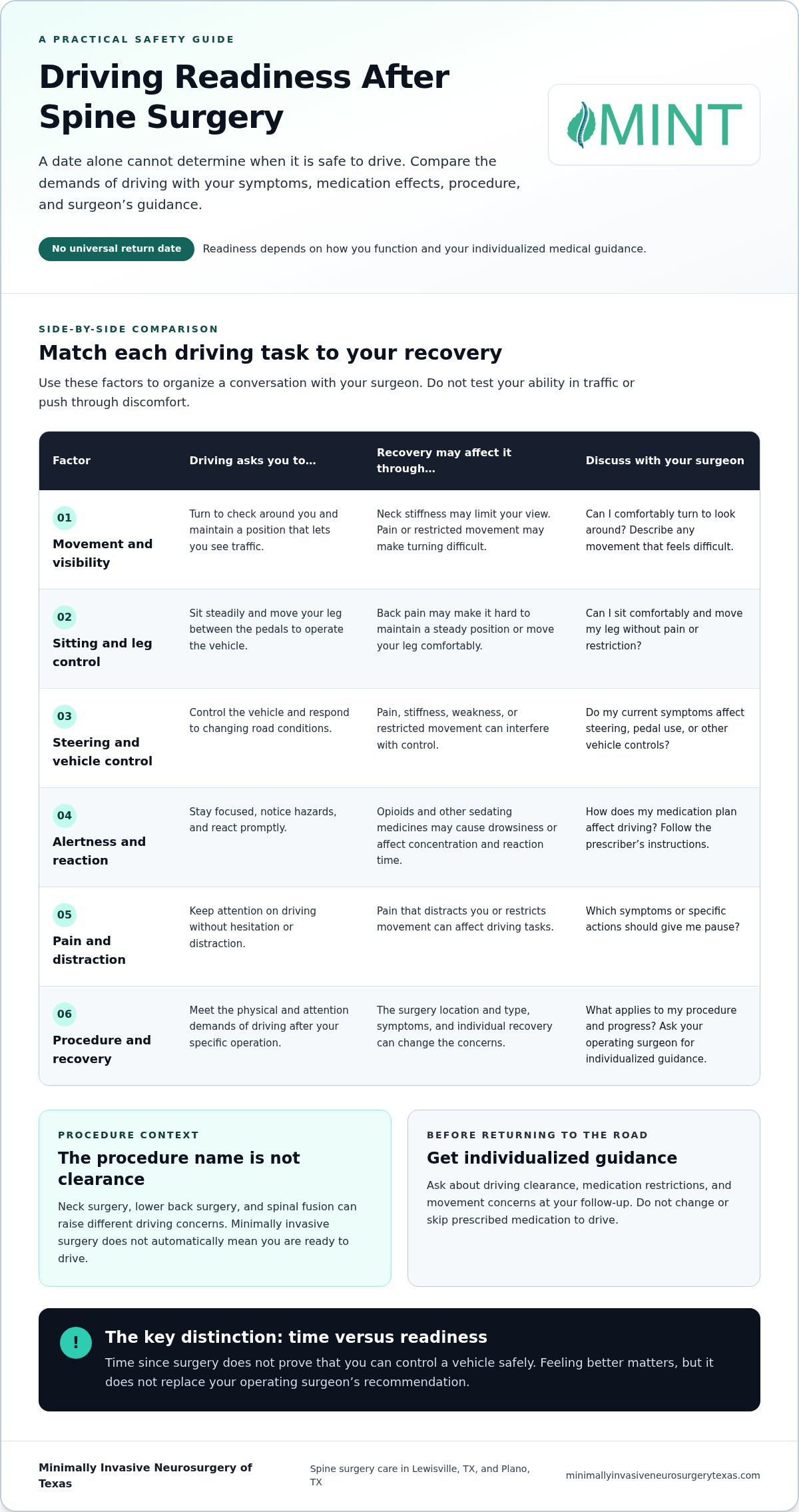
Driving asks your body and attention to work together. You need to sit comfortably, see and respond to traffic, steer, and use the pedals while staying alert. After spine surgery, pain, stiffness, weakness, or medication effects can interfere with one or more of these tasks, even if you can manage other daily activities.
Driving readiness depends on your symptoms, comfortable movement, ability to control the vehicle, alertness, medication effects, the location and type of surgery, and your surgeon’s guidance. These factors can interact. For example, pain may make it harder to turn your upper body, while a sedating medicine may slow your attention to a sudden change in traffic.
Movement, pain, and control of the vehicle
Your spine’s treated area and current symptoms can affect how you sit and move behind the wheel. Neck stiffness may limit your view when you look around; back pain may make it difficult to maintain a steady position or move your leg comfortably between pedals. Pain that distracts you or restricts movement deserves attention before you drive.
Don’t test your ability in traffic or push through discomfort to see whether you can manage. If movement or pain concerns you, pause and discuss them with your surgeon, who may suggest physical therapy to help restore safe mobility. Rehabilitation practices such as Functional Movement Physio illustrate how targeted therapy programs help patients regain functional range of motion and joint control. Describe the specific action that feels difficult, such as turning to look around or sitting through a trip. Clear details help your care team consider how your symptoms affect real driving tasks.
Medication, alertness, and reaction ability
Opioids, which are prescription pain medicines, and other sedating medications can cause drowsiness or affect concentration and reaction time. Those effects can make it harder to notice a hazard and respond promptly. A person may not recognize how much a medicine affects them, so don’t rely only on whether you feel awake.
Follow the instructions from the clinician who prescribed your medication, including any warnings about driving. Don’t stop, change, or skip a prescribed medicine to get behind the wheel. Ask your surgeon or prescribing clinician how your medication plan affects driving, especially if you take more than one medicine that can cause drowsiness.
The recovery demands can also vary with the procedure and the area of the spine involved. Your surgeon can relate your symptoms and recovery to the movements and control driving requires. General guidance cannot assess those personal details or replace instructions from the team overseeing your care.
If you’re unsure whether pain, movement, or medication affects your readiness, raise that concern with your surgical team before driving. For help discussing spine-care questions with MINT, you can contact the practice.
Does the type of spine surgery change when you can drive?
Yes. The procedure helps your surgeon identify which movements or recovery factors matter most for driving. It doesn’t determine readiness on its own. The same procedure can affect patients differently, so use the comparison below to guide a conversation with your surgeon, not to set your own return date.
| Procedure context | Driving-related concern | Question for your surgeon |
|---|---|---|
| Cervical procedure, involving the neck | Neck comfort and movement when observing surrounding traffic | How might my current neck symptoms affect driving movements? |
| Lumbar procedure, involving the lower back | Comfort sitting and moving your legs to use the pedals | How do my lower-back symptoms affect the driving tasks I need to perform? |
| Spinal fusion, which joins vertebrae | Your specific operation, symptoms, and recovery instructions | What restrictions apply to driving during my recovery? |
Cervical and lumbar procedures involve different movement questions
The cervical spine is the neck region; the lumbar spine is the lower-back region. Neck procedures may make comfortable head movement a relevant topic for your surgeon. After a lower-back procedure, you might discuss sitting comfort and leg movement. Neither region always means an earlier return. Talk through your symptoms and concerns rather than trying to test these movements on your own.
Fusion, artificial disc replacement, and other procedures
Spinal fusion joins vertebrae, or bones in the spine, while artificial disc replacement places an artificial disc in the spine. These procedures differ, so your surgeon may give different recovery instructions based on your operation and individual circumstances. You can explore minimally invasive spine techniques for general procedural context, but that information cannot determine when you can drive.
Endoscopic spine surgery uses a small camera and specialized instruments to reach the treatment area through a small incision. The procedure name alone doesn’t establish driving readiness. Your surgeon can explain how the specific treatment and your progress affect the discussion. Learn more about endoscopic spine surgery as one example of a spine procedure.
So, how soon can I drive after spine surgery? The answer depends in part on what operation you had, but also on how you’re recovering and the guidance your surgeon gives you. Bring specific questions to your follow-up, such as which movements or symptoms matter for your procedure, whether your restrictions differ from those after other operations, and what needs to change before you resume driving. That discussion connects the procedure details to your day-to-day function without relying on a one-size-fits-all timeline.
How can you prepare to return to driving safely?
Use your follow-up appointment to make a plan with your surgeon, not to clear yourself. If you’re wondering how soon can I drive after spine surgery, bring your questions about your procedure, symptoms, medication, and daily transportation needs. Your surgeon can explain which recovery milestones matter for you and whether you should continue avoiding the driver’s seat.
Questions to ask the surgeon before driving
Write down your questions before the appointment so you can leave with clear, individualized instructions. Consider asking:
- What specific recovery milestones should I meet before I drive?
- Has my surgeon cleared me to drive, and do any restrictions still apply?
- Could my prescribed medication affect alertness or driving, and whom should I ask about medication-related concerns?
- Do my pain, stiffness, weakness, or movement limits affect any driving tasks?
- What should I do if my symptoms worsen or driving feels unsafe?
Follow the instructions your surgeon gives you, including any limits on movement or medication-related precautions. Don’t stop, change, or skip prescribed medication to drive. If you feel uncertain about a restriction, ask your surgeon or prescribing clinician to explain it before you make plans to get behind the wheel.
Don’t drive while impaired or against your surgeon’s instructions. A short, familiar route doesn’t replace medical clearance or the ability to control the vehicle and respond safely. Even a brief trip can require quick decisions and movements. Treat a ride with someone else as the safer choice whenever your care team has not cleared you or you have concerns about alertness, pain, or control.
Plan essential transportation during recovery
Arrange rides for follow-up appointments and other essential trips while you follow your post-operative instructions. Ask a family member or trusted support person to help coordinate travel, especially if you need to attend an appointment or pick up necessities. Planning ahead can reduce the pressure to drive before you and your surgeon agree that it’s appropriate.
Keep the plan flexible. Your surgeon’s guidance may change as your recovery progresses, and you may need to adjust who drives or how you handle necessary errands. Don’t assume that readiness to drive also means you can resume work, longer trips, or other activities. Discuss each activity with your care team according to your own recovery; many individuals also turn to structured rehabilitation services, such as the exercise physiology and clinical movement support from MoveMed, to safely rebuild the strength and mobility required behind the wheel.
Clear answers can make transportation planning easier. If you need to discuss spine surgery care or your recovery questions with MINT, contact the practice.
How MINT supports spine patients planning a safe return to driving
Returning to driving can represent an important step toward daily independence, but your recovery plan should reflect your own procedure and progress. Minimally Invasive Neurosurgery of Texas (MINT) provides spine-focused care in Lewisville, TX, and Plano, TX. Dr. Scott Kutz, MD, is a board-certified neurosurgeon and Fellow of the AANS and ACS.
Individualized spine care in Lewisville and Plano
MINT helps patients understand their spine diagnosis and discuss treatment options in the context of their needs. That conversation can help you prepare specific questions about recovery, including what your procedure means for activities such as driving. MINT’s minimally invasive spine techniques provide context for the treatment approach, while your treating clinician can address your individual recovery questions.
General guidance can explain why symptoms, medication, and procedure type matter. Your treating clinician can consider your circumstances and give individualized recovery guidance. If you’re asking how soon you can drive after spine surgery, bring the question to the clinician who knows your care.
Discuss your recovery questions with the care team
Before your appointment, note what you want to clarify. You might ask which recovery milestones apply to your procedure, whether any medication instructions affect driving, and what to do if pain or movement concerns change. Share any practical transportation challenges too. Clear communication can help you understand the guidance and plan essential travel without feeling pressured to rush.
MINT’s team can discuss spine-care questions and consultation options with you. To discuss your care, contact MINT about a spine consultation. Submitting the New Patient Form does not establish a doctor-patient relationship.
The content provided on the Websites is for informational purposes only. It is not intended as, nor should it be considered a substitute for professional medical advice, diagnosis, or treatment. Always seek the advice of your physician or qualified healthcare provider with any questions you may have regarding a medical condition.
Make your next step a confident one
Recovery can bring a strong desire to return to familiar routines. Give yourself room to make that transition carefully. Instead of relying on someone else’s timeline, bring your specific driving questions to the clinician who understands your procedure, symptoms, and treatment plan. Ask for guidance that fits your recovery, and keep arranging transportation until you understand what your care team recommends.
If you’re still asking how soon can I drive after spine surgery, a personalized conversation can help you understand what applies to your situation. Dr. Scott Kutz, a board-certified neurosurgeon and Fellow of the AANS and ACS, provides spine care through MINT in Lewisville and Plano, serving the broader Dallas-Fort Worth metroplex.
Contact MINT to discuss your spine-care questions and take a thoughtful next step toward resuming daily activities safely. With clear guidance from your care team, you can plan ahead and move forward at a pace that supports your recovery.
Frequently Asked Questions
How soon can I drive after spine surgery?
No single date works safely for every person. Your surgeon considers the specific operation, your recovery, and any restrictions before advising you. Rather than comparing your progress with someone else’s timeline, ask what applies to your case and when to revisit the question. If you need transportation before that discussion, arrange a ride instead of treating an upcoming appointment or deadline as a reason to drive.
Can I drive while taking pain medication after spine surgery?
Don’t drive if pain medication makes you sleepy, less alert, dizzy, or slower to react. Opioids and other sedating medicines can affect driving, and combining medicines may change how you feel. Read and follow the prescriber’s instructions, and ask your surgeon or prescribing clinician how your medications affect driving. A prescription doesn’t automatically mean you can safely drive while taking it.
Does spinal fusion mean I have to wait longer to drive?
Not necessarily, because the procedure alone can’t set your personal driving date. Spinal fusion joins vertebrae, and your surgeon can explain how your specific operation and recovery affect activity instructions. Ask what restrictions apply to driving and whether your symptoms or treatment plan change those instructions. Avoid using another fusion patient’s experience as a guide, even if you had a similar procedure.
Can I drive after minimally invasive spine surgery?
Possibly, but minimally invasive describes the surgical approach, not automatic permission to drive. The surgeon still needs to consider your recovery, medication, and ability to manage driving safely. For example, an endoscopic procedure doesn’t establish that you can respond comfortably to traffic or control the vehicle. Follow your own surgeon’s instructions, even if your incision looks small or you feel ready to resume errands.
What happens if I drive before my surgeon clears me?
You may put yourself and others at risk if pain, restricted movement, fatigue, or medication affects your attention or control. You may also go against your post-operative instructions. If you’ve already driven and now feel uncertain, don’t continue driving; arrange another ride and tell your care team what happened. Share any new or worsening symptoms so the clinician can advise you on appropriate next steps.
How do I know if I can safely turn and control the car after neck surgery?
Your surgeon should guide this decision based on your neck movement, symptoms, and procedure. Explain which everyday movements feel limited, such as looking over your shoulder or holding your head comfortably. Don’t use a trip around the block or a road test you create yourself to decide. If your care team has given you movement restrictions or a brace, ask how those instructions affect driving.
Should I stop taking pain medicine so I can drive after surgery?
No. Don’t stop, skip, or change prescribed pain medicine to make driving possible. Changing your medication without guidance could affect your care, and untreated pain may also interfere with attention or movement. Ask the prescribing clinician whether your medication plan affects driving and what to do if you need to travel. Until you have guidance and feel safe, arrange for someone else to drive.