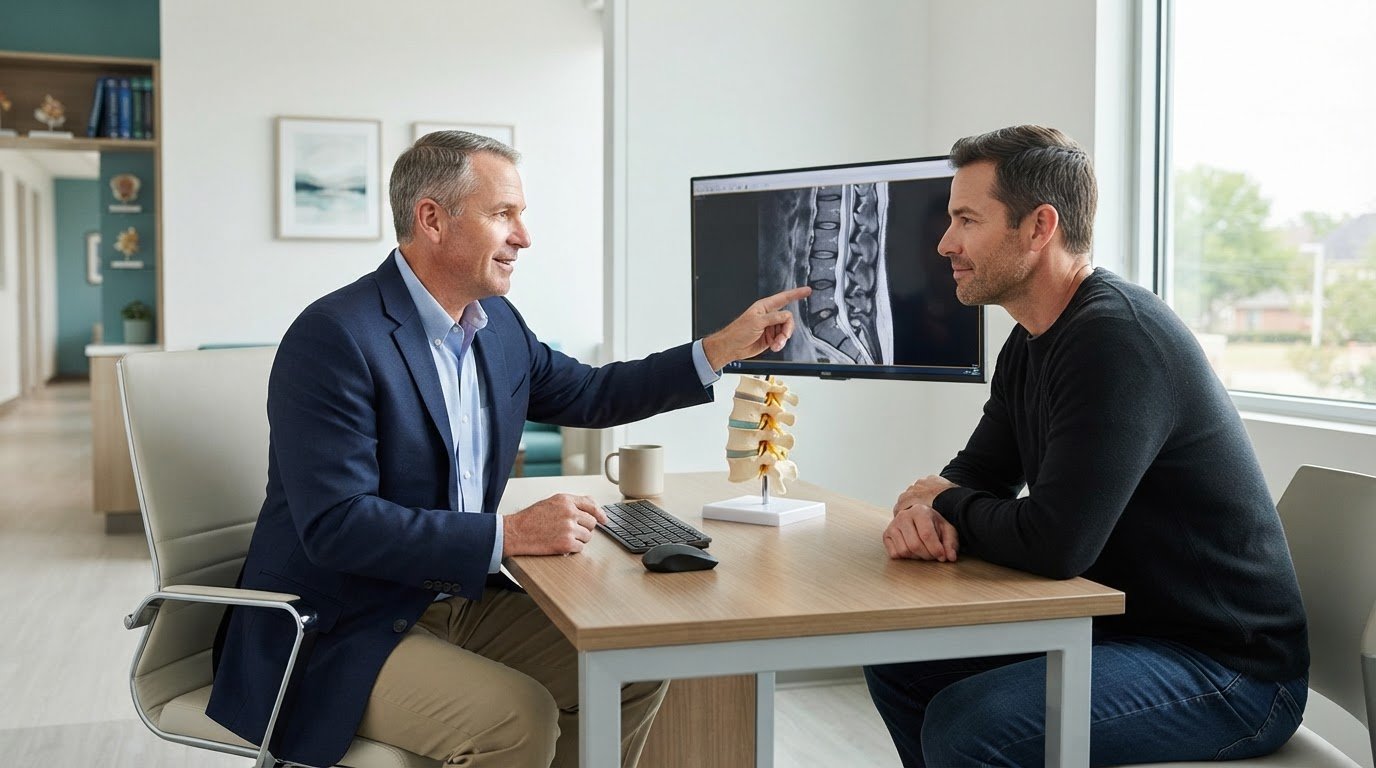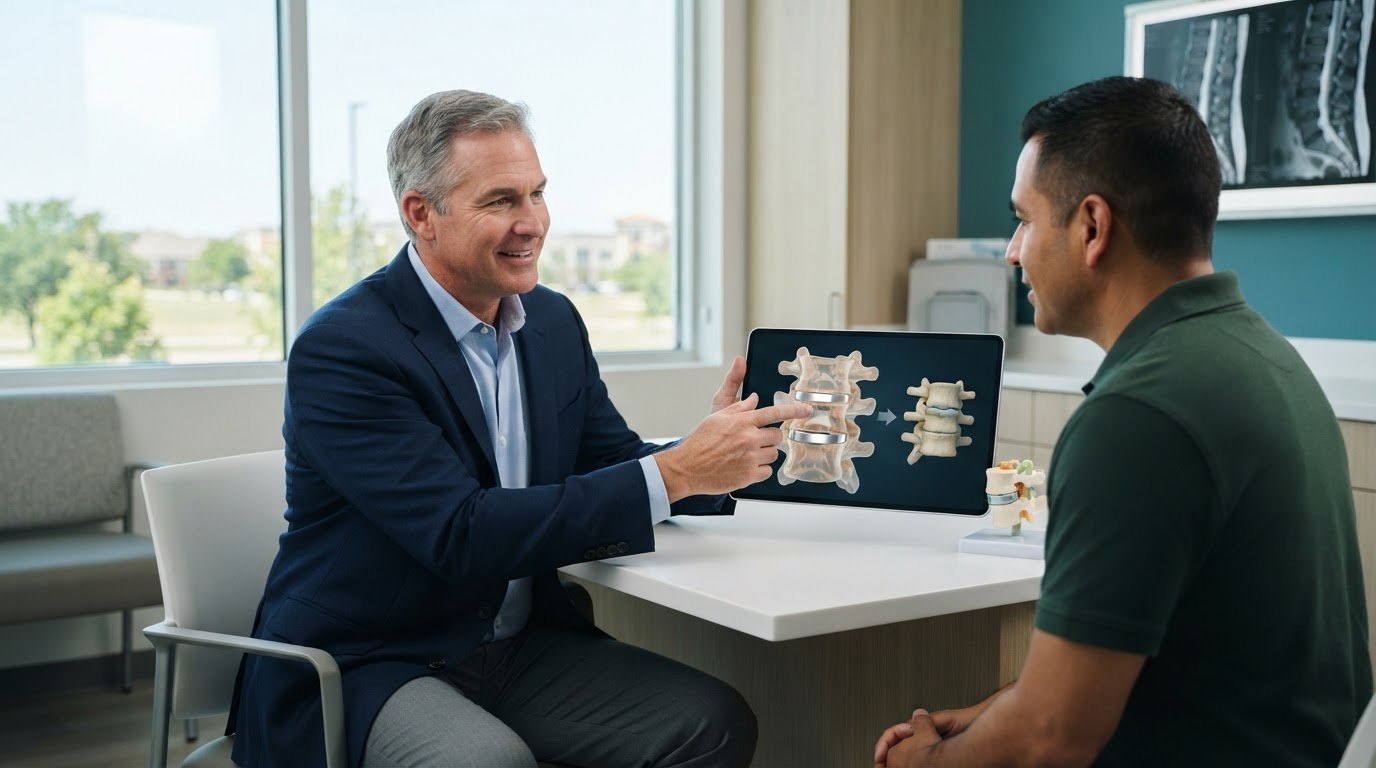
Minimally Invasive Neurosurgery of Texas (MINT), led by board-certified neurosurgeon Dr. Scott C. Kutz, provides artificial disc replacement in Lewisville and Plano, Texas. This guide explains the pros and cons of artificial disc replacement 2026 so you can prepare to discuss how the procedure may fit your diagnosis and goals.
Could preserving movement after spine surgery matter more to you than the stability of a fusion? The answer depends on your diagnosis, bone health, and priorities. Artificial disc replacement does not suit everyone, so it helps to weigh its potential benefits against surgical risks, implant concerns, and alternatives such as fusion.
This guide explains the procedure’s possible benefits and limitations, outlines factors that affect candidacy, and suggests questions to raise with a spine specialist. Use it to prepare for an informed conversation, not to diagnose your condition or choose a treatment on your own.
Key Takeaways
- Artificial disc replacement aims to preserve movement at the treated spinal level, but it cannot address every cause of back or neck pain.
- Weigh the pros and cons of artificial disc replacement 2026 against your diagnosis, health factors, and treatment goals.
- Compare disc replacement with spinal fusion by considering how each procedure affects movement and stability.
- A specialist reviews your symptoms, examination findings, imaging, diagnosis, and goals when discussing candidacy.
- Use a consultation to discuss potential risks, alternatives, and questions that can help you make an informed decision.
What Artificial Disc Replacement Can and Cannot Do
Minimally Invasive Neurosurgery of Texas (MINT), led by Dr. Scott C. Kutz, a board-certified neurosurgeon, provides artificial disc replacement and specialized spine care in Lewisville and Plano, Texas.
When you weigh the pros and cons of artificial disc replacement 2026, start by understanding what the operation aims to change and what it cannot promise. Artificial disc replacement (ADR) removes a damaged spinal disc and places an artificial implant in the space between the surrounding bones. The procedure aims to address pain related to that disc while preserving movement at the treated level. A specialist must assess your condition before recommending any treatment.
What happens during artificial disc replacement?
Discs sit between the vertebrae, the bones that form the spine. A healthy disc cushions the bones and helps the spine bend and turn. A worn or damaged disc may contribute to pain, but a specialist must compare imaging and symptoms to determine whether the disc explains them.
During ADR, a surgeon removes the damaged disc and places an artificial disc implant between the vertebrae. The implant takes the removed disc’s place. The surgeon plans the procedure around the patient’s anatomy and diagnosis, and ADR does not suit every disc problem.
Cervical disc replacement offers one example. “Cervical” refers to the neck portion of the spine. In this procedure, a surgeon replaces a damaged disc in the neck with an artificial implant. Total disc replacement (TDR), also known as artificial disc replacement (ADR), is a surgical procedure that replaces degenerated intervertebral discs with artificial implants. MINT provides artificial disc replacement care as part of its spine surgery services.
What does motion preservation mean?
Motion preservation means that the procedure aims to retain movement at the spinal level where the surgeon places the implant. That goal does not guarantee a particular range of motion, complete pain relief, or a return to every activity. Results depend on the person’s condition and how the spine responds to treatment.
Dr. Scott C. Kutz takes a patient-centered approach that matches treatment to the diagnosis and the person’s goals. He considers whether preserving movement fits the clinical picture rather than treating it as an automatic advantage. That distinction matters when you weigh the pros and cons of artificial disc replacement 2026. A specialist can explain what ADR may address, what uncertainties remain, and which alternatives merit discussion.
ADR changes one part of the spine. It cannot correct every source of back or neck pain, and an implant does not eliminate the need to assess other spinal structures. A careful discussion connects the procedure’s goal with your symptoms, examination, and imaging, so you can understand the trade-offs without treating general information as an individual recommendation.
Potential Benefits and Risks of Artificial Disc Replacement
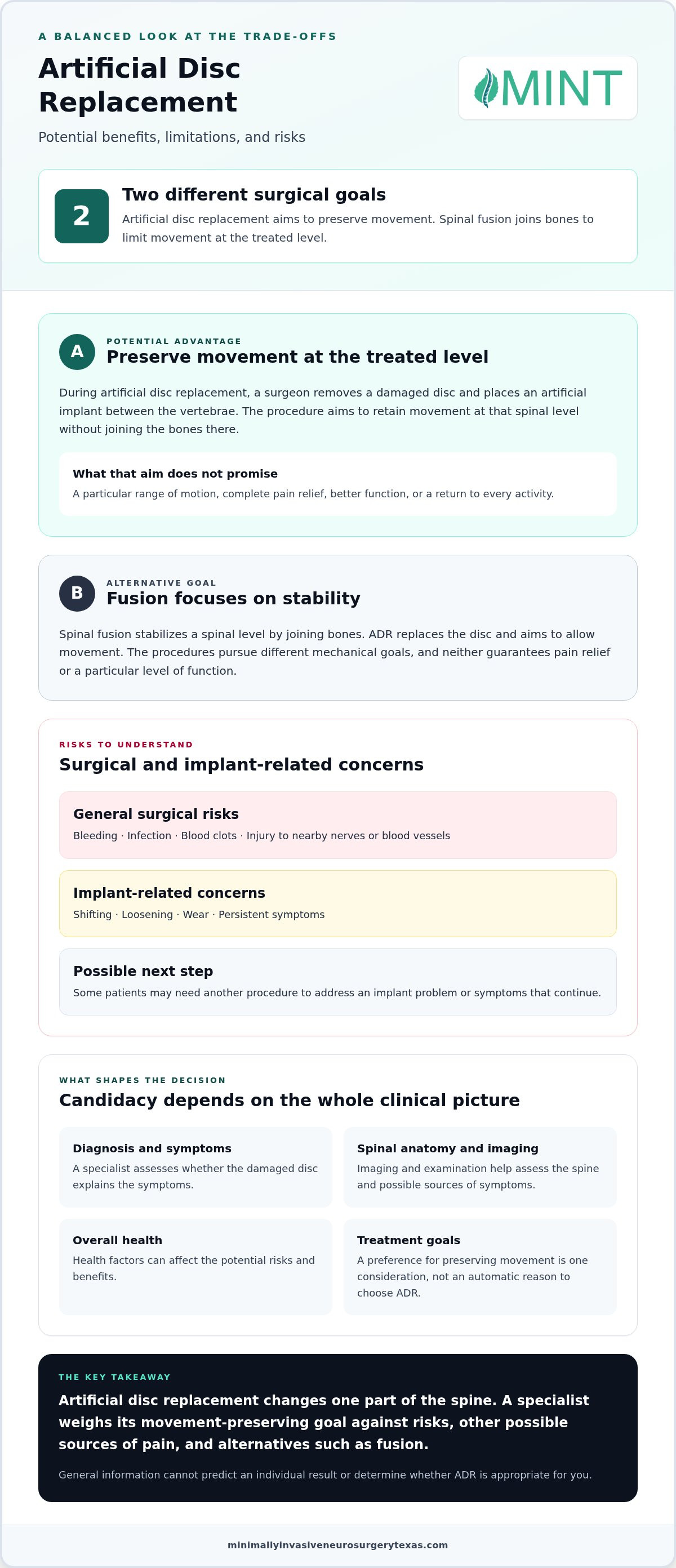
The pros and cons of artificial disc replacement 2026 involve a personal trade-off, not a universal ranking of procedures. ADR aims to preserve movement at the treated level, while spinal fusion joins bones to limit movement there. Either approach may help some patients, but neither guarantees pain relief or a particular level of function.
| Potential advantages to discuss | Limitations and risks to understand |
|---|---|
| ADR aims to retain movement at the treated spinal level, which may matter to patients who value flexibility in that part of the spine. | Preserving movement does not guarantee better function, less pain, or a return to specific activities. |
| The procedure replaces a damaged disc without joining the bones at that level. | The implant may not address symptoms that come from other spinal structures or conditions. |
| For a patient whose diagnosis and anatomy fit the procedure, ADR may offer an alternative to fusion. | Like other surgery, ADR can involve risks such as bleeding, infection, blood clots, or injury to nearby nerves or blood vessels. |
| A specialist can weigh movement preservation alongside the patient’s health and treatment goals. | Implant-related complications can include shifting, loosening, wear, or persistent symptoms. Some patients may need another procedure. |
Potential advantages patients may discuss
Movement preservation describes the procedure’s aim, not a promised outcome. Some eligible patients may value the possibility of retaining movement at the treated level as they consider how surgery could affect everyday activities. That preference matters, but it does not establish that ADR will improve movement or relieve pain for a particular person.
Fusion and ADR pursue different mechanical goals. Fusion stabilizes a spinal level by joining bones; ADR replaces a disc and aims to allow movement. A specialist can explain how those goals relate to your diagnosis instead of treating motion preservation as an automatic benefit.
Limitations and risks to understand
Every operation carries potential risks. In addition to general surgical complications, an artificial disc can cause device-related problems, and symptoms may continue if another structure contributes to the pain. Some patients may need a revision procedure, meaning another operation to address a problem or persistent symptoms. These possibilities do not predict what will happen to any individual patient.
Your diagnosis, spinal anatomy, and overall health all affect the potential risks and benefits. For example, imaging may show more than one possible source of symptoms, so replacing a disc may not address every concern. Discuss how these factors apply to your case, including alternatives and how the specialist will assess whether the disc explains your symptoms. MINT’s artificial disc replacement information can help you prepare for that conversation.
Artificial Disc Replacement vs. Spinal Fusion: Which Trade-Offs Matter?
Artificial disc replacement (ADR) and spinal fusion address some of the same spinal problems, but they pursue different goals. ADR replaces a damaged disc with an implant that aims to retain movement at that level. Spinal fusion joins spinal bones, called vertebrae, so they no longer move independently at the treated level. Neither procedure fits every diagnosis, and neither holds a universal advantage in safety, results, or durability.
How the procedures differ
The central distinction is movement. ADR aims to maintain motion between the vertebrae where the surgeon places the artificial disc. Fusion instead stabilizes that area by encouraging the bones to join. This changes movement at the treated level, which may affect how the spine moves as a whole.
Motion preservation describes ADR’s treatment goal, not a guarantee of better movement, less pain, or improved function. One person may value the possibility of retaining movement, while another may prioritize the stability fusion aims to provide. Those preferences can inform a discussion, but they cannot determine the right procedure on their own.
Both operations involve trade-offs. Focus your comparison on how each procedure’s goal relates to the problem a specialist identifies. Do not assume that preserving movement always offers a greater benefit or that fusion always provides more dependable results. MINT’s guide to artificial disc replacement treatment provides additional context about ADR.
Why the diagnosis can change the comparison
Symptoms provide only part of the picture. A specialist also considers a physical examination, imaging such as an MRI, and your overall health. MRI, or magnetic resonance imaging, creates detailed pictures of spinal structures. It can show disc changes, but a specialist must compare those findings with the location and pattern of your symptoms to judge whether they point to the same source.
Spinal anatomy matters too. For example, instability means that one spinal segment moves more than it should. Instability, changes in nearby joints, or other structural concerns can affect whether a motion-preserving or stabilizing procedure makes sense to discuss. A specialist weighs those findings alongside your health and priorities.
The pros and cons of artificial disc replacement 2026 therefore depend on more than a preference for motion or stability. Your symptoms, imaging, anatomy, and goals help shape a personalized comparison. A specialist assesses whether ADR, fusion, or another approach fits your condition and explains the expected trade-offs without promising a particular outcome.
Useful questions include: What condition appears to cause my symptoms? How would each procedure address it? What trade-offs matter given my anatomy and goals? A clear discussion can help you understand why a specialist recommends an option and which alternatives merit consideration.
How Specialists Assess Artificial Disc Replacement Candidacy
A candidacy discussion connects your symptoms and goals with what a specialist finds on examination and imaging. No single scan finding or symptom decides whether artificial disc replacement (ADR) makes sense. Dr. Scott C. Kutz’s patient-centered approach considers the full clinical picture, including whether the suspected pain source matches the spinal level under discussion.
What information informs an individualized assessment?
A specialist builds the assessment in stages. Each step adds context rather than acting as a stand-alone test:
- Review the symptom history. The specialist asks where symptoms occur, when they started, what makes them better or worse, and how they affect daily activities. Note changes in strength, sensation, sleep, work, or movement so you can describe their impact.
- Perform a physical examination. The clinician checks movement, strength, sensation, and other findings that may help connect symptoms to a spinal problem. The examination adds context to your history and imaging.
- Review imaging alongside symptoms. Imaging, such as an MRI, shows spinal structures in detail. A scan can reveal disc changes, but those changes do not automatically explain your pain. The specialist compares the images with your symptoms and examination findings.
- Clarify the likely diagnosis. The specialist considers whether the disc appears to be the main source of symptoms or whether another spinal structure may contribute. The assessment can differ for a cervical disc in the neck and a lumbar disc in the lower back because each area has distinct anatomy and function.
- Discuss health, goals, and options. The clinician considers your overall health, treatment goals, and preferences, then explains whether ADR fits your situation and which alternatives merit discussion. The conversation should cover goals, limitations, and relevant risks, not only the appeal of preserving movement.
What questions can patients bring to a consultation?
Direct questions can make the discussion more useful. Consider writing them down before your appointment:
- What findings suggest that this disc contributes to my symptoms?
- What goal would ADR address in my case, and what should I not expect it to change?
- What alternatives should I consider, including spinal fusion or continued nonsurgical care?
- Which risks or limitations matter most given my diagnosis and health?
- How might my work, daily activities, and personal priorities shape the decision?
For cervical context, MINT’s “Neck Disk Replacement in Plano & Lewisville” guide discusses disc replacement in the neck. If you are considering artificial disc replacement, a specialist consultation can connect general information with your symptoms, examination, and imaging. The phrase pros and cons of artificial disc replacement 2026 matters most when a clinician applies those trade-offs to your diagnosis.
Discussing Artificial Disc Replacement With a Spine Specialist in North Texas
General information can explain how artificial disc replacement (ADR) differs from spinal fusion, but a consultation connects those trade-offs to your diagnosis and priorities. A specialist reviews what may cause your symptoms, what treatment aims to address, and whether surgery belongs in the discussion. The goal is clarity, not pressure to choose a procedure.
What to expect from a patient-centered discussion
Dr. Scott C. Kutz, a board-certified neurosurgeon with more than 20 years of experience treating spinal disorders, considers each patient’s clinical picture. He reviews the diagnosis, examination findings, imaging, health, and activities that matter in daily life. Imaging can show spinal changes, but a specialist weighs those details alongside symptoms rather than treating one scan finding as the whole answer.
Bring your questions. Ask how ADR compares with appropriate alternatives for your condition, including spinal fusion or continued nonsurgical care. You can also ask what goal a procedure would address, what limitations may remain, and which risks apply to your health and anatomy. A useful discussion makes room for uncertainty and explains why an option may or may not fit.
Your priorities belong in the decision. Explain how pain affects work, sleep, or activities you value. A specialist can discuss whether treatment could address the diagnosed problem and how each option’s goals align with what you hope to regain. Surgery represents one possible part of care, not an automatic next step for everyone with neck or back pain. MINT’s patient-centered spine care includes individualized discussions about appropriate options and minimally invasive spine care.
A practical next step for Lewisville and Plano patients
Patients in Lewisville and Plano, Texas, can prepare by gathering prior imaging reports, a list of treatments they have tried, and a brief symptom history. Note when symptoms began, what affects them, and how they change daily activities. Write down questions about movement preservation, fusion, or recovery expectations so you can address each concern during your visit.
The phrase “pros and cons” becomes useful when a specialist applies each trade-off to your diagnosis, anatomy, health, and goals. A personalized consultation can help you understand the options without turning general information into a recommendation for surgery. To discuss your individual situation, discuss your spine care options.
If you’re ready to take that next step, contact MINT in North Texas to begin a conversation about your spine care.
Make Your Next Spine-Care Conversation Count
Your next step does not need to involve deciding on surgery. Start by identifying what matters most to you: the activities you hope to return to, the questions you still have, and the trade-offs you feel ready to discuss. Those priorities can turn the pros and cons of artificial disc replacement 2026 into a focused conversation about your care.
Dr. Scott C. Kutz holds board certification from the American Board of Neurological Surgery. At Minimally Invasive Neurosurgery of Texas, patients can discuss artificial disc replacement and specialized spine care in Lewisville and Plano. A specialist can connect your diagnosis and goals with options that fit your situation, without assuming one procedure suits everyone.
Bring your questions and take time to understand the answers. A clear, personal discussion can help you move forward with greater confidence.
Discuss your artificial disc replacement options with MINT.
Frequently Asked Questions
Is artificial disc replacement better than spinal fusion?
Neither procedure is better for every patient. Artificial disc replacement aims to preserve movement at one spinal level, while fusion joins bones to stabilize that level. The right comparison depends on what a specialist identifies as the source of your symptoms, your spinal anatomy, overall health, and treatment priorities. Ask how each option addresses your diagnosis and what limitations may remain instead of choosing based on motion preservation alone.
Can artificial disc replacement treat both neck and lower back problems?
Yes. Surgeons use artificial disc replacement for selected problems in the cervical spine, or neck, and the lumbar spine, or lower back. The procedure’s appropriateness depends on the specific disc problem, spinal level, anatomy, and health factors. A person with neck symptoms needs an assessment focused on cervical structures, while lower back symptoms call for evaluation of the lumbar spine and nearby structures.
What are the possible complications of artificial disc replacement?
Possible complications include infection, bleeding, injury to nearby nerves or blood vessels, and implant problems such as movement or wear. Some patients may need another procedure. Your personal risk depends on factors such as the spinal level, anatomy, and health. Ask the specialist which complications matter most in your case, how the care team monitors for them, and which symptoms after surgery should prompt a call.
How long does an artificial disc replacement last?
No one can predict an implant’s exact lifespan for an individual patient. Durability can depend on the implant, the forces it experiences, and a person’s health and activity. Before surgery, ask which device the surgeon plans to use, what evidence supports its use, and what follow-up care can monitor the treated level. Do not treat a general estimate as a promise about how long your implant will function.
Can everyone with a herniated disc have artificial disc replacement?
No. A herniated disc, which occurs when disc material pushes beyond its normal boundary, does not automatically make someone a candidate. A specialist considers whether the herniation matches the patient’s symptoms and examination, along with imaging, spinal anatomy, and overall health. For instance, another condition may explain the symptoms better than the herniation. The full evaluation guides the discussion of treatment options.
Will artificial disc replacement eliminate my neck or back pain?
No procedure can guarantee complete pain relief. Artificial disc replacement may address symptoms linked to a specific damaged disc, but other spinal structures or health factors can also contribute to pain. For example, replacing a disc may not resolve symptoms that come from a separate joint or nerve problem. Ask your specialist which symptoms the procedure aims to improve, which may continue, and how the team will assess your progress.
To discuss artificial disc replacement and your spine care goals with MINT in Lewisville or Plano, contact the practice.