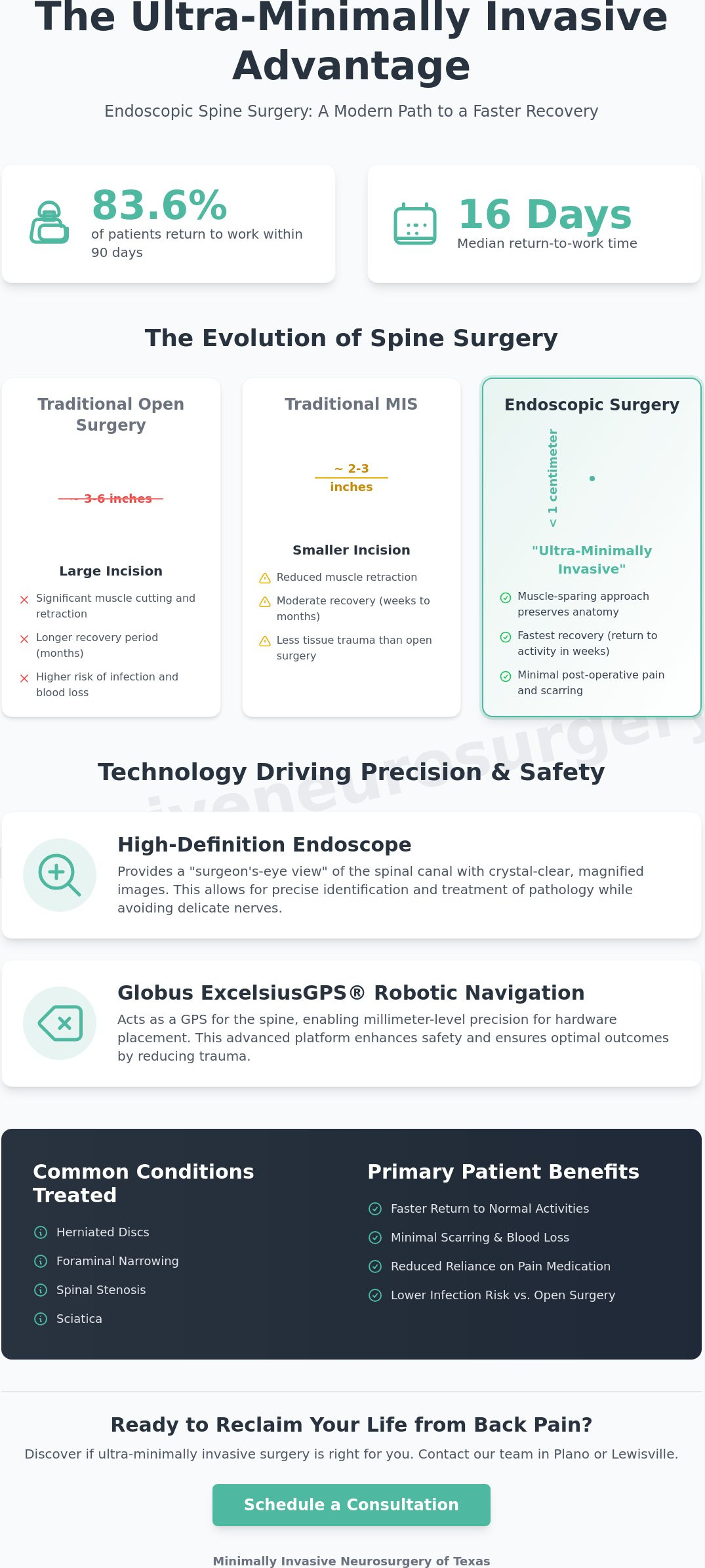
Did you know that 83.6% of patients return to work within ninety days after undergoing endoscopic spine surgery, with a median return time of just 16 days? If you’re struggling with chronic pain that limits your time with family or your performance at work, you’ve likely felt the anxiety that comes with traditional back surgery. You might fear a long recovery period or a large, permanent scar. When searching for an endoscopic spine surgeon near me, you aren’t just looking for a doctor; you’re looking for a way to get your life back without the heavy physical toll of older surgical methods.
At Minimally Invasive Neurosurgery of Texas, we believe your health is the top priority, which is why we’ve pioneered an ultra-minimally invasive approach in Plano and Lewisville. You’ll discover how we use high-definition visualization and the Globus ExcelsiusGPS® Robotic Navigation Platform to provide a level of precision that traditional surgery simply cannot match. We’ll explain the difference between standard minimally invasive techniques and true endoscopic care in plain English. This article previews the path to a faster recovery, minimal reliance on post-operative pain medication, and a return to your normal activities within weeks.
Key Takeaways
- Learn why endoscopic techniques represent the most advanced “ultra-minimally invasive” care available today for patients in North Texas.
- Understand how high-definition endoscopes provide a superior view of the spinal canal, allowing for treatment through incisions smaller than one centimeter.
- Discover the benefits of choosing an endoscopic spine surgeon near me who combines specialized training with a boutique, patient-focused approach in Lewisville and Plano.
- Identify the specific spinal conditions, such as foraminal narrowing and herniated discs, that no longer require traditional open-back surgery.
- Compare the clinical outcomes of endoscopic procedures against traditional methods, focusing on reduced tissue trauma and lower infection risks.
Finding an Endoscopic Spine Surgeon Near Me in North Texas
Endoscopic spine surgery is no longer a futuristic concept; it’s the current pinnacle of back care. If you’re searching for an endoscopic spine surgeon near me, you likely want more than just a quick fix. You want a solution that respects your body’s natural anatomy. Endoscopic procedures represent the most advanced evolution of minimally invasive spine surgery, utilizing ultra-small cameras to treat pathology without the collateral damage associated with traditional surgery.
At Minimally Invasive Neurosurgery of Texas (MINT), Dr. Scott Kutz leads with a philosophy that prioritizes the patient’s long-term quality of life. While a general spine surgeon might perform a variety of orthopedic procedures, a specialized neurosurgeon like Dr. Kutz brings a deep understanding of the delicate neural structures within the spinal canal. This expertise is vital when navigating the complex pathways of the spine using high-definition endoscopic tools. Our practice focuses on precise intervention, ensuring that we only address the specific issue causing your symptoms.
Why Local Expertise Matters for Spinal Care
Choosing a surgeon with deep roots in the North Texas medical community offers practical and clinical advantages. Patients in Plano and Lewisville often find that the specialized, boutique environment at MINT is a welcome alternative to the congested, impersonal atmosphere of large downtown hospital systems. Having your procedure and follow-up care in the same region ensures a seamless recovery process. You won’t have to navigate heavy city traffic for a brief post-operative checkup. This local focus allows us to provide personalized attention that large “surgery factories” simply can’t match. Finding the right endoscopic spine surgeon near me means choosing a partner who understands both the technology and the local landscape of North Texas healthcare.
The “Ultra-Minimally Invasive” Distinction
It’s a common misconception that all minimally invasive procedures are the same. Traditional minimally invasive surgery often requires incisions of two to three inches to accommodate various tools. In contrast, endoscopic surgery utilizes an incision smaller than one centimeter, often no larger than a fingernail. This tiny portal allows the surgeon to reach the source of pain while preserving the vital muscle and ligamentous structures that are typically cut or retracted in open surgery. By avoiding muscle detachment, patients experience significantly less post-operative pain and a much faster return to their daily routines. Ultra-minimally invasive surgery is the gold standard for tissue preservation in 2026.
The Technology Behind Advanced Endoscopic Procedures
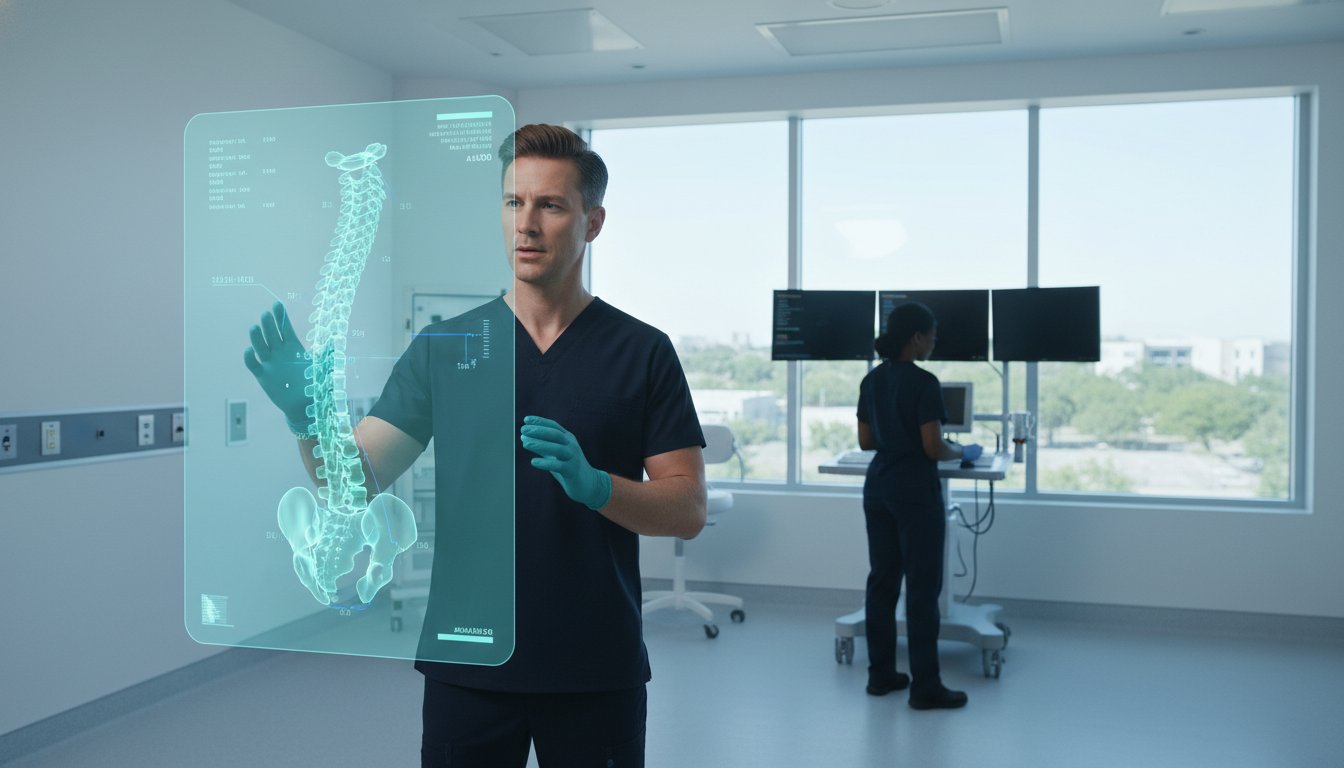
Modern surgical excellence relies on more than just steady hands. It requires a sophisticated integration of visual and navigational tools that allow for extreme precision. When you search for an endoscopic spine surgeon near me, you’re looking for a practitioner who leverages the latest technological advancements to ensure your safety. At the heart of this approach is the high-definition endoscope. This device provides a “surgeon’s-eye view” of the spinal canal, displaying crystal-clear images on a monitor. This level of visualization allows for the identification of delicate nerves and tissues that might be obscured in traditional open procedures. Endoscopic Spine Surgery has fundamentally changed how we approach spinal pathology by replacing large incisions with high-tech clarity.
These tools aren’t just fancy gadgets; they’re essential components of a safety-first philosophy. By utilizing advanced imaging, Dr. Kutz can navigate the complex anatomy of your spine with absolute confidence. This technology provides several key benefits:
- Enhanced Accuracy: Millimeter-level precision for hardware placement and decompression.
- Reduced Trauma: Minimal disruption to surrounding muscle and ligaments.
- Faster Recovery: Less post-operative pain and a quicker return to normal activity.
Robotic Navigation: The Globus Excelsius Advantage
Precision is the primary goal of any spinal intervention. The Globus ExcelsiusGPS® Robotic Navigation platform acts as a GPS for the surgeon, ensuring that every movement is accounted for with millimeter accuracy. This system creates a rigid, digital map of your spine before the first incision is even made. One of the most significant benefits for patients is the reduction in intraoperative X-rays. Because the robot provides real-time feedback on hardware placement, we can significantly lower your radiation exposure. This level of accuracy is a cornerstone of minimally invasive neurosurgery, providing a safer environment for both the patient and the surgical team.
Augmented Reality in the Operating Room
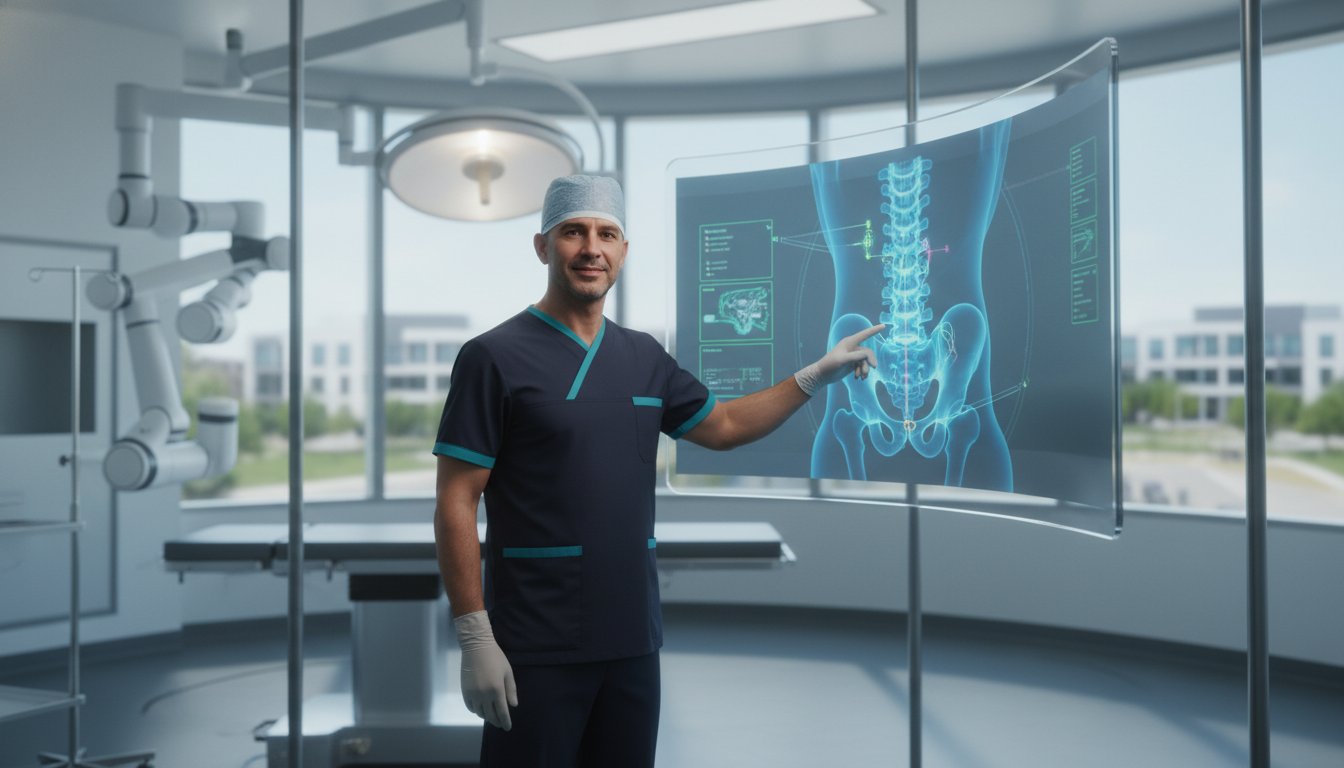
MINT is one of the few practices in Texas to integrate the Augmedics xvision Spine System®. This augmented reality (AR) technology allows Dr. Kutz to wear a specialized headset that overlays a 3D digital map of your spine directly onto your body during surgery. It effectively gives the surgeon “x-ray vision,” allowing them to see through skin and muscle to the underlying bone structures in real-time. This eliminates the need for the surgeon to look away from the patient to a separate monitor, maintaining focus exactly where it’s needed most. If you’re ready to see how this technology can change your outcome, you can consult with our team to discuss your specific needs. This combination of AR and robotic guidance ensures that finding an endoscopic spine surgeon near me leads you to the absolute forefront of modern medical innovation.
Endoscopic Spine Surgery vs. Traditional Minimally Invasive Methods
Many patients searching for an endoscopic spine surgeon near me are surprised to learn that “minimally invasive” is a broad category, not a specific procedure. While traditional minimally invasive surgery (MIS) was a massive leap forward from open surgery, endoscopic techniques have refined the process even further. The primary difference lies in the degree of tissue disruption. Open surgery often requires incisions exceeding 5 to 10 centimeters, leading to significant muscle trauma and a lengthy hospital stay. Traditional MIS reduced this to 2 to 5 centimeters, but it still often requires some muscle dilation. Endoscopic surgery operates through a portal smaller than 1 centimeter. This tiny entry point means we don’t have to strip muscle away from the bone to reach the pathology.
Because the incision is so small, blood loss is negligible. Infection rates are also significantly lower because the internal tissues are minimally exposed to the environment. These factors transform what used to be a major medical event into an outpatient experience. Most patients at MINT are back in their own beds just hours after the procedure. We also focus on mitigating the risk of Failed Back Surgery Syndrome (FBSS). Traditional methods can sometimes lead to extensive scar tissue or structural instability. Endoscopy preserves the integrity of the spinal architecture, reducing the likelihood of chronic post-operative issues that often plague more invasive approaches.
Recovery Timelines: Days vs. Months
Recovery isn’t just about healing; it’s about returning to your life. While a spinal fusion might require months of restricted activity and physical therapy, endoscopic patients often see a dramatic shift in their timeline. You can explore more about recovery times for minimally invasive spine surgery to see how these modern standards compare to traditional expectations. Most endoscopic patients report a significant reduction in the need for heavy pain medication within the first few days. This rapid improvement is a direct result of avoiding the “collateral damage” to healthy muscle tissue during the approach.
Long-Term Outcomes and Mobility
Long-term mobility is our ultimate goal for every patient in Plano and Lewisville. When we preserve natural anatomy, we reduce the stress on the levels above and below the surgical site. This prevents “Adjacent Segment Disease” (ASD), a common complication where neighboring discs wear out prematurely after a fusion. For those with cervical issues, neck disk replacement serves as another motion-preserving alternative that complements our endoscopic philosophy. Patients who lead active lifestyles prioritize these methods because they keep the spine moving naturally rather than locking it in place. Finding an endoscopic spine surgeon near me who understands these long-term implications is essential for maintaining your quality of life as you age.
Who is a Candidate for Endoscopic Spine Surgery in Plano?
Determining candidacy starts with a precise diagnosis. When you’re searching for an endoscopic spine surgeon near me, you’re likely dealing with a herniated disc, spinal stenosis, or foraminal narrowing. Finding a specialist who understands these nuances is the first step toward lasting relief. Many patients believe that severe, radiating pain automatically requires “major” open surgery. This is a common misconception. The truth is that the most intense nerve pain often responds best to the pinpoint accuracy of endoscopic decompression. We utilize advanced diagnostic imaging, including high-resolution MRI or CT scans, to identify the exact source of your discomfort before creating a surgical plan.
While endoscopy is a powerful tool for nerve decompression, it isn’t always the right answer. If your imaging shows significant spinal instability or structural deformity, minimally invasive spinal fusion Texas might be the superior option. Fusion provides the necessary stability when the spine can’t support itself. Dr. Kutz analyzes each patient’s unique anatomy to ensure we choose the path that best supports a return to normal activity.
Symptoms That Indicate You May Need an Endoscopic Specialist
You should consider a specialist if you’re experiencing “red flag” symptoms that haven’t responded to non-surgical care. These symptoms often include:
- Sciatica that shoots down the leg or into the foot.
- Numbness or a persistent “heavy” feeling in your limbs.
- Weakness in the feet, often manifesting as drop foot.
The general guideline for surgery is “Conservative Treatment Failure.” If you’ve completed 6 to 12 weeks of physical therapy, injections, or medication without significant relief, it’s time to talk to a high-tech healer. Dr. Kutz performs a comprehensive diagnostic review to see if your condition can be resolved through a tiny portal, preserving your healthy tissue rather than causing unnecessary trauma.
Age and Lifestyle Considerations
Endoscopic techniques are an excellent choice for a wide range of patients. For elderly individuals, the low-impact nature of the procedure is a major advantage. It often requires less intense anesthesia than traditional surgery, which reduces the overall stress on the body. This makes it a viable option for those who might not tolerate a more invasive operation well. For athletes and “weekend warriors” in Plano, the benefit is speed. These patients need to return to their training and daily lives as quickly as possible. Because the approach avoids cutting through major muscle groups, age is rarely a barrier to endoscopic candidacy. If you’re ready to stop living in pain, you should consult with our specialized team to see if you qualify for this advanced care.
Why Choose Dr. Scott Kutz for Endoscopic Spine Care in Lewisville?
Selecting the right endoscopic spine surgeon near me is a decision that impacts your long-term mobility and quality of life. Dr. Scott Kutz is a board-certified neurosurgeon who has dedicated his career to mastering the most advanced minimally invasive techniques. Unlike large “factory” hospital systems where patients can feel like just another number, Minimally Invasive Neurosurgery of Texas (MINT) offers a boutique experience. We prioritize personalized attention, ensuring that every patient receives a customized treatment plan tailored to their specific spinal pathology and lifestyle goals. Our commitment to the latest technology, including the Globus ExcelsiusGPS® and Augmedics AR systems, isn’t about having the newest gadgets. It’s about providing the highest level of safety and precision possible in modern medicine.
The patient journey at MINT is designed to be seamless and stress-free. From your initial consultation at our Plano office to your procedure and recovery in Lewisville, our team coordinates every detail of your care. We understand that spine surgery is a significant event, and we’re here to provide the compassionate reassurance you need. By focusing on ultra-minimally invasive methods, we help our patients achieve their goals with less pain and a faster return to the things they love. Our specialized focus means you’re being treated by a team that performs these complex procedures daily, not a generalist who only occasionally uses an endoscope.
A Patient-Centered Approach to Neurosurgery
At MINT, our diagnostic process is rigorous. We don’t just treat symptoms; we work tirelessly to find the exact source of your pain. This often involves a detailed review of your medical history combined with advanced imaging to ensure that an endoscopic approach is the most effective path forward. Our ultimate value proposition is a return to normal activity. Whether that means getting back to a demanding job in Plano or enjoying a weekend at the lake in Lewisville, we focus on the least invasive path to get you there. Our main office is conveniently located at 1850 Lakepointe Drive, Suite 500, in Lewisville, providing easy access for patients across the North Texas region.
How to Schedule Your Consultation
Taking the first step toward a pain-free life is simple. If you’re looking for an endoscopic spine surgeon near me for an initial review or a second opinion, our team is ready to help. We make the process straightforward:
- Contact our office to provide your basic information and insurance details.
- Submit your recent diagnostic imaging, such as an MRI or CT scan, for Dr. Kutz to review.
- Attend a comprehensive consultation where we explain your options in plain English.
We review previous imaging to expedite your care plan, often identifying opportunities for minimally invasive intervention that others may have overlooked. You don’t have to live with chronic back or neck pain. We invite you to take control of your health and discover how our high-tech, patient-first approach can redefine your recovery.
Take the Next Step Toward Lasting Relief
Finding an endoscopic spine surgeon near me is the first step toward reclaiming a life free from chronic pain. We’ve seen how “ultra-minimally invasive” techniques utilize incisions smaller than one centimeter to protect your healthy muscle and tissue. By combining the precision of the Globus Excelsius® Robotic Navigation Platform with the clarity of high-definition endoscopes, we prioritize your safety and long-term mobility. These advanced methodologies are designed to get you back to your normal routine in days, not months.
As a Board-Certified Neurosurgeon, Dr. Scott Kutz provides expert care specialized in motion-preserving artificial disc replacement and robotic navigation. At MINT, we believe every patient in Plano and Lewisville deserves a treatment plan as unique as their own anatomy. You don’t have to let spinal conditions dictate your daily quality of life. We invite you to Schedule Your Consultation with Dr. Scott Kutz Today and start your journey toward recovery. Our team is dedicated to your relief and looks forward to helping you achieve a pain-free future.
Frequently Asked Questions
Is endoscopic spine surgery considered major surgery?
Endoscopic spine surgery is an ultra-minimally invasive procedure, not a traditional major surgery. While it addresses significant spinal issues, it does so through a tiny portal rather than a large incision. This approach minimizes blood loss and systemic stress on your body. Most patients find the experience much less taxing than the invasive open-back operations of the past.
How long is the recovery after an endoscopic discectomy?
Most patients return to work within 16 days after an endoscopic procedure. A 2026 study found that 83.6% of patients returned to their professional duties within ninety days. Your specific timeline depends on the physical demands of your job and your overall health. Because we don’t cut through major muscle groups, your body heals much faster than it would with traditional methods.
Will insurance cover endoscopic spine surgery in Texas?
Yes, most major insurance providers in Texas cover these procedures when they’re medically necessary. The 2026 CPT® code set includes updated descriptors for various spine procedures, ensuring that modern techniques are recognized. We recommend verifying your specific benefits with our office before scheduling. Our team helps navigate the authorization process to ensure you can access the care you need without unnecessary stress.
How small is the incision for an endoscopic procedure?
The incision for an endoscopic procedure is typically less than one centimeter, which is about the size of a fingernail. This tiny opening allows the high-definition endoscope to reach the spinal canal without disrupting the surrounding muscle. When searching for an endoscopic spine surgeon near me, this small scar is a hallmark of the ultra-minimally invasive approach we provide in Lewisville and Plano.
Can I go home the same day as my endoscopic spine surgery?
Yes, endoscopic spine surgery is almost always performed as an outpatient procedure. You’ll typically arrive in the morning and return to the comfort of your own home by the afternoon. This shift to outpatient care reduces the risk of hospital-acquired infections and certain complications. It also allows you to begin your recovery in a familiar, low-stress environment with your family.
What is the success rate of endoscopic spine surgery compared to open surgery?
Success rates for endoscopic procedures are comparable to open surgery but with significantly lower complication rates. Because we preserve the natural anatomy, there’s a reduced risk of Adjacent Segment Disease in the future. Patients often report higher satisfaction scores due to the faster recovery and minimal post-operative pain. It’s increasingly recognized as the modern gold standard for treating herniated discs and stenosis.
How do I know if my surgeon is truly qualified to perform endoscopic procedures?
You should look for a board-certified neurosurgeon who has completed specialized training in endoscopic techniques. This field has a recognized steep learning curve, so specific expertise matters. When choosing an endoscopic spine surgeon near me, ask about their use of advanced technology like the Globus ExcelsiusGPS®. A qualified surgeon will be transparent about their credentials and their specific surgical volume.
Is there an age limit for who can undergo endoscopic back surgery?
There’s no strict age limit for this type of care. In fact, endoscopic surgery is often the preferred choice for elderly patients who might not tolerate the heavy anesthesia required for traditional open surgery. Because the procedure is low-impact and causes minimal blood loss, it’s a safe option for many seniors. We evaluate every patient based on their functional health rather than their chronological age.