Minimally Invasive Neurosurgery of Texas (MINT), led by board-certified neurosurgeon Dr. Scott Kutz, provides specialized spinal care at its 2026 headquarters in Lewisville and its clinic in Plano, TX. Dr. Kutz, a Fellow of the American Association of Neurological Surgeons (AANS) and the American College of Surgeons (ACS), offers advanced treatments like endoscopic spine surgery and artificial disc replacement to patients throughout Dallas, Fort Worth, and Southlake. This boutique surgical center focuses on motion preservation and rapid recovery through high-tech precision.
What if the decision to undergo a procedure represents a strategic move toward your physical freedom rather than a sign of failure? Many patients struggle with the confusion of conflicting medical advice while dealing with persistent sciatica, which is pain that radiates along the path of the sciatic nerve. You deserve to know exactly when is back surgery necessary to stop the progression of leg numbness or muscle weakness. This guide explores the clinical red flags and diagnostic criteria Dr. Scott Kutz uses to determine the right path for your recovery. We will preview the latest 2026 protocols for treating spinal stenosis, which is the narrowing of the spinal canal, and explain how robotic navigation ensures a return to normal physical activity with minimal downtime.
Key Takeaways
- Identify urgent neurological symptoms, such as progressive muscle weakness or persistent numbness, that require immediate clinical evaluation.
- Understand the specific diagnostic criteria and physical milestones Dr. Scott Kutz uses to determine when is back surgery necessary for your recovery.
- Learn why most patients should complete six weeks of conservative care, including physical therapy, before exploring surgical options.
- Discover how minimally invasive techniques utilize small incisions and advanced robotic technology to preserve motion and accelerate healing.
- Find out how to access expert spinal consultations at the MINT facilities in Lewisville and Plano to regain your daily function.
Understanding When Back Surgery Becomes Necessary
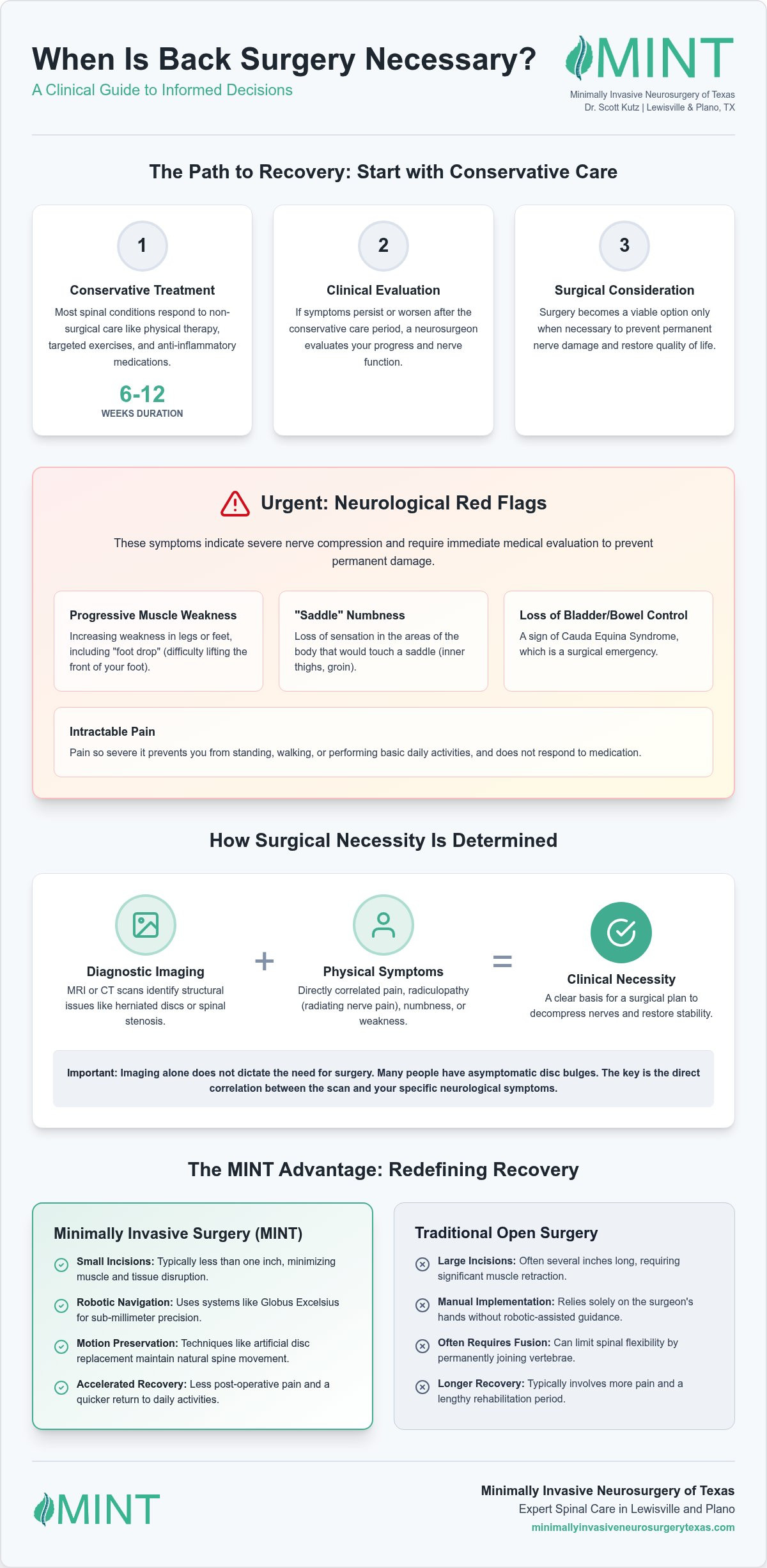
Minimally Invasive Neurosurgery of Texas (MINT) provides this clinical guide under the leadership of Dr. Scott Kutz, a board-certified neurosurgeon. Dr. Kutz treats patients at specialized clinics in Lewisville and Plano, TX, offering relief to those suffering from chronic back and neck conditions. Determining when is back surgery necessary involves a careful evaluation of your nerve function and pain levels. Most spinal conditions respond to non-surgical care within six to twelve weeks. This timeline allows the body to heal naturally through conservative methods like physical therapy or anti-inflammatory medications. Patients from McKinney and Allen often seek clarity on whether their chronic discomfort requires a surgical intervention to restore their quality of life.
The Definition of Surgical Necessity in Spine Care
Clinical necessity occurs when spinal structural issues threaten to cause permanent nerve damage. Dr. Scott Kutz recommends intervention when diagnostic imaging correlates directly with your physical symptoms. Surgical necessity often centers on radiculopathy, which is a condition where a compressed nerve root in the spinal column causes pain, numbness, or weakness that radiates down a limb. If these symptoms persist or worsen despite conservative efforts, surgery becomes a viable path toward recovery. A patient might benefit from understanding laminectomy, which is a procedure that removes part of a vertebra to relieve pressure on the spinal cord or nerves. This intervention prevents long-term neurological deficits and helps you return to normal physical activity.
The Role of Diagnostic Imaging in North Texas
MRI and CT scans identify herniated discs, which occur when the soft center of a spinal disc pushes through a crack in the tougher exterior, or spinal stenosis in Plano patients. Spinal stenosis refers to the narrowing of the spaces within your spine, which can put pressure on the nerves. However, imaging alone does not dictate the need for surgery. Many asymptomatic people, or individuals showing no symptoms, have disc bulges that appear on scans but do not cause pain. Dr. Scott Kutz uses precision imaging to map out minimally invasive spine surgery pathways. By utilizing the Globus Excelsius robotic navigation system at the Lewisville headquarters, Dr. Kutz ensures the surgical plan targets the exact source of discomfort. This high-tech approach provides residents of Southlake and Flower Mound with a specialized alternative to large, impersonal hospital systems.
The Core Symptoms That Indicate a Need for Surgery
Neurological deficits represent the most urgent reason for spinal intervention. While many patients manage discomfort with stretching or medication, certain symptoms signal that conservative care is no longer sufficient. Dr. Scott Kutz identifies specific red flags during consultations at the MINT headquarters in Lewisville to determine when is back surgery necessary to prevent permanent damage. Progressive muscle weakness in the legs or feet suggests severe nerve compression that requires immediate attention. If you experience intractable pain, which is pain so severe it prevents you from standing or walking, you need a surgical evaluation in Plano to explore your options.
Neurological Red Flags and Nerve Compression
Certain symptoms require emergency intervention to protect your long-term mobility. Numbness in the saddle area, which refers to the parts of the body that would touch a saddle while riding a horse, or a sudden loss of bladder control, indicates a serious condition called cauda equina syndrome. This is a surgical emergency. Additionally, patients may experience foot drop, which is the inability to lift the front part of the foot while walking. This condition indicates motor nerve distress. Chronic sciatica that fails to improve with non-surgical methods often points to a sequestrated disc. This occurs when a fragment of the spinal disc breaks away from the main structure and enters the spinal canal. Understanding when back surgery is an option helps patients recognize these critical signs before they lead to lasting disability.
Structural Instability and Progressive Deformity
Structural issues within the spinal column also dictate the need for surgical care. Spondylolisthesis occurs when one vertebra slips forward over the bone below it, which causes instability and nerve impingement. If this slip progresses, it can lead to chronic pain and reduced function. Similarly, a progressive curvature of the spine can eventually compromise lung function or severely limit mobility. For older patients in Southlake or Flower Mound, vertebral fractures caused by osteoporosis are a major concern. These fractures often require kyphoplasty, which is a procedure where a surgeon injects medical-grade cement into the bone to restore its height and stability. If you notice a sudden change in your posture or strength, you should schedule a clinical assessment with Dr. Scott Kutz to discuss your symptoms.
Evaluating Conservative Care vs. Surgical Intervention
Dr. Scott Kutz reviews your previous treatment history at his Plano and Lewisville offices to provide a path toward lasting relief. He analyzes your experience with standard conservative care, which typically includes physical therapy, NSAIDs (non-steroidal anti-inflammatory drugs), and epidural steroid injections. Surgery becomes a vital consideration when debilitating pain persists despite maximal non-operative management. Patients from McKinney and Allen frequently visit MINT to determine when is back surgery necessary after these initial treatments fail to restore their daily function.
The Six-Week Threshold for Back Pain
Acute back pain often resolves through natural healing and the reduction of inflammation. Clinical guidelines establish a six-week window for structured therapy because the body requires this time to potentially reabsorb disc material or reduce swelling. This period serves as the clinical standard for re-evaluation because it allows enough time for non-invasive methods to show measurable results. Persistent radiculopathy, which is pain that radiates along a nerve path, that lasts past this window suggests the nerve cannot decompress on its own. You can learn more about when back surgery might be an option if you haven’t seen progress after several weeks of dedicated effort.
When Injections and Therapy Are Not Enough
Steroid injections provide temporary relief by bathing the nerve in anti-inflammatory medication, but they do not fix structural herniations, which occur when a disc’s soft center pushes through its outer shell. Similarly, physical therapy improves core strength and flexibility, yet it cannot resolve severe neural foraminal stenosis, which is the narrowing of the openings where nerves exit the spine. It also cannot remove bone spurs, which are hard outgrowths on the edges of bones. MINT specialists help patients decide when they have exhausted all non-surgical options. If your symptoms remain severe, Dr. Kutz may suggest minimally invasive spine surgery to address the underlying structural cause.
Dr. Kutz meticulously examines every patient’s diagnostic history at the MINT Lewisville headquarters. He looks for specific indicators that the spinal structure has reached a point where physical manipulation or chemical relief can no longer help. For example, if a large herniated disc physically obstructs the nerve canal, further therapy might increase irritation rather than provide relief. In these cases, the clinical focus shifts from symptom management to a definitive structural solution. This specialized approach ensures that patients in Southlake and Flower Mound receive a clear, evidence-based recommendation for their recovery journey.
How Minimally Invasive Techniques Redefine Surgical Necessity
Modern surgical innovation has shifted the conversation regarding when is back surgery necessary. Dr. Scott Kutz uses advanced techniques to perform complex procedures through incisions as small as half an inch. This method contrasts with traditional open surgery, which requires large muscle-stripping incisions. Minimally invasive spine surgery significantly reduces blood loss and muscle trauma. This approach allows for faster healing and less post-operative pain. High-tech precision at the MINT facilities in Plano and Lewisville offers patients benefits that traditional settings lack. This boutique surgical center prioritizes personal attention and provides a specialized alternative to large, impersonal hospital systems.
Motion-Preserving Options: Artificial Disc Replacement
Artificial disc replacement maintains spinal flexibility unlike traditional fusion. For many patients dealing with degenerative disc disease, which is the wear and tear of the spinal discs over time, Artificial Disc Replacement offers a superior alternative to spinal fusion. While fusion locks two vertebrae together to stop painful movement, disc replacement maintains natural spinal flexibility. Dr. Scott Kutz utilizes this technique to preserve the patient’s range of motion. This prevents adjacent segment disease, which is the breakdown of discs near a fusion site. This motion-preserving approach draws patients from Dallas and Fort Worth to MINT for specialized care.
Endoscopic Surgery and Robotic Navigation
The integration of Minimally Invasive Spine Techniques like endoscopic surgery allows for unparalleled visualization. Endoscopic spine surgery uses a tiny camera, or endoscope, to view the spinal canal directly. This tool allows Dr. Kutz to remove herniated material with extreme precision. MINT utilizes the Globus Excelsius robotic navigation system to ensure hardware placement within sub-millimeter accuracy, which means the placement is precise to within less than one millimeter. This level of precision minimizes risks and improves long-term outcomes for patients in Flower Mound and Southlake. Newer systems like the Medtronic Stealth AXiS Autopilot also improve surgical accuracy. Because these procedures disrupt the body less than traditional methods, patients often return home the same day following endoscopic spine surgery. Experts project the global market for spine robotic surgery will reach $544.7 million by the end of 2026. This growth reflects the increasing demand for outpatient surgical options. If you want to see if these high-tech options are right for you, contact our Lewisville headquarters to schedule a consultation.
Taking the Next Step: Consulting Dr. Scott Kutz in Lewisville and Plano
Dr. Scott Kutz, a board-certified neurosurgeon and Fellow of the American Association of Neurological Surgeons (AANS), leads the clinical team at MINT. He offers specialized consultations at the MINT Lewisville headquarters, which serves as a state-of-the-art facility for 2026. This practice provides a local alternative to large hospital systems for residents in Plano, Frisco, Flower Mound, and McKinney. Understanding when is back surgery necessary involves a deep dive into your medical history and lifestyle goals. Dr. Kutz uses patient-first communication to ensure you understand every aspect of your diagnosis. Our clinical team focuses on precision-driven treatment that restores your function and relieves your suffering.
What to Expect During Your MINT Consultation
Please bring your recent MRI (magnetic resonance imaging) or CT (computed tomography) scans for a comprehensive review by Dr. Kutz. He meticulously examines these images to identify conditions like spinal stenosis, which is the narrowing of the spinal canal, or herniated discs. We discuss both minimally invasive and motion-preserving surgical options tailored to your needs. This might include endoscopic spine surgery, which uses a tiny camera to visualize the spine, or procedures involving the Globus Excelsius robotic navigation system. Our team coordinates with local imaging centers in Dallas and Fort Worth to verify your diagnostic data. This thorough process ensures that we only recommend surgery when it offers the best path to your recovery.
Recovering Near Home in North Texas
Choosing local care in Lewisville and Plano eliminates the need for long-distance travel while you heal. Most MINT procedures occur in outpatient settings, such as Ambulatory Surgery Centers (ASCs), providing you with a boutique experience and a faster return home. Dr. Kutz specializes in techniques that minimize muscle trauma and blood loss, which are common concerns for patients. You can read our patient testimonials to see real recovery stories from your neighbors in Southlake and Allen. These stories reflect our commitment to helping patients return to normal physical activity through innovative care. By staying at the forefront of modern surgical technology, MINT provides the specialized attention you deserve in a community-focused environment. It’s our priority to move you from a state of concern to a state of informed confidence.
Restoring Your Quality of Life through Precision Care
Identifying the right moment for intervention marks the beginning of your recovery journey. This guide highlights that while most back pain resolves with conservative care, neurological deficits or structural instability require specialized evaluation. Understanding when is back surgery necessary empowers you to move beyond chronic suffering and return to the activities you love. It’s time to stop letting persistent pain dictate your daily schedule.
Board-certified neurosurgeon Dr. Scott Kutz brings over 20 years of spinal surgery experience to every patient case in North Texas. By utilizing advanced robotic navigation technology like the Globus Excelsius system, he ensures your procedure remains as minimally invasive as possible. Residents of Lewisville and Plano no longer need to settle for persistent pain or invasive traditional methods. You deserve a path to recovery that prioritizes your long-term mobility and well-being.
Take the first step toward a pain-free future today. Schedule a consultation with Dr. Scott Kutz in Lewisville or Plano to explore your specialized treatment options. We look forward to helping you achieve a full return to normal activity.
Frequently Asked Questions
How do I know if my back pain is serious enough for surgery?
Surgery becomes necessary when pain prevents daily function and non-surgical treatments fail after a six-week trial. Dr. Scott Kutz evaluates your level of disability alongside MRI results at the MINT offices in Lewisville and Plano. If you cannot walk more than a block or stand for ten minutes without severe leg pain, it is time to ask when is back surgery necessary to restore your mobility. Clinical assessment ensures that we only consider surgery when it provides a clear path to recovery.
What are the red flags for permanent nerve damage in the spine?
Urgent red flags include sudden muscle weakness, loss of bowel or bladder control, and saddle anesthesia. Saddle anesthesia refers to numbness in the groin and inner thighs that would touch a saddle. These symptoms indicate severe compression of the cauda equina, which is the bundle of nerve roots at the lower end of the spinal cord. Immediate clinical intervention prevents permanent paralysis and lasting dysfunction. You should seek an emergency evaluation if you experience these neurological changes.
Can I avoid surgery if I have a herniated disc?
Many patients successfully manage herniated discs without surgery through physical therapy and anti-inflammatory medications. About 90% of disc herniations improve within six weeks of conservative care. However, surgery becomes necessary if the disc material continues to compress a nerve root, causing progressive weakness or intractable pain. Intractable pain is discomfort that does not respond to conservative management or epidural steroid injections. Dr. Kutz specializes in minimally invasive techniques to address these structural issues when they persist.
How long is the recovery time for minimally invasive back surgery?
Most patients return to light activity within one to two weeks following a minimally invasive procedure at MINT. Because Dr. Kutz uses small incisions and the Globus Excelsius robotic system, muscle trauma remains minimal during the operation. You might return home the same day of your procedure in Lewisville or Plano. Full recovery for physically demanding jobs or sports typically takes six to twelve weeks of healing. This high-tech approach ensures a faster return to normal activity compared to traditional methods.
Is age a factor when determining if back surgery is necessary?
Overall health and physical vitality matter more than your chronological age when deciding on surgery. Modern minimally invasive techniques make surgery safer for older adults in Plano and Lewisville by reducing anesthesia time and blood loss. Dr. Kutz assesses your bone density and cardiac health to determine if you can safely undergo a procedure. This evaluation ensures a return to normal activity is a realistic goal for you. We prioritize your quality of life regardless of your age.
What happens if I delay a necessary spinal surgery?
Delaying surgery for a compressed nerve can lead to permanent neurological deficits. Chronic compression causes nerve fibers to die, resulting in lasting numbness or muscle atrophy. Muscle atrophy is the wasting away of muscle tissue due to a lack of nerve stimulation. Timely intervention ensures the best chance for a full recovery and prevents the development of chronic pain syndromes that are harder to treat later. Proactive care helps maintain your long-term mobility and function.
Does insurance typically cover minimally invasive spine procedures in Texas?
Most private insurers and Medicare cover minimally invasive procedures when they meet clinical necessity guidelines. In 2026, many insurers require documentation of six weeks of physical therapy before they approve elective spine surgery. MINT staff in Lewisville and Plano assist with the prior authorization process to determine when is back surgery necessary under your specific plan. Prior authorization involves getting approval from your insurance provider before you receive medical services to ensure they cover the costs.
How do I choose between spinal fusion and artificial disc replacement?
The choice depends on the source of your pain and the stability of your spine. Spinal fusion stops painful movement by joining two vertebrae together, while artificial disc replacement preserves natural motion. Dr. Kutz recommends motion-preserving options for patients with healthy facet joints, which are the connections between the bones of the spine. This approach reduces the risk of future issues in adjacent spinal segments after the procedure. We provide detailed consultations to help you choose the right surgical path.