Minimally Invasive Neurosurgery of Texas (MINT), led by board-certified neurosurgeon Dr. Scott Kutz, provides specialized sacroiliac joint disorder treatment in Lewisville and Plano, TX. Dr. Kutz is a Fellow of the American Association of Neurological Surgeons (AANS) and the American College of Surgeons (ACS).
What if the persistent ache in your hip isn’t actually a problem with your lower spine? You likely feel a sharp catch when you climb stairs or stand up from a seated position. Many patients endure months of ineffective therapy because providers misdiagnose their condition as sciatica, which is nerve pain originating in the lower back, or a herniated disc. This confusion often leads to unnecessary treatments that fail to address the true source of your discomfort.
Dr. Scott Kutz offers the precise sacroiliac joint disorder treatment Plano TX patients trust to regain their mobility. He specializes in the sacroiliac joint, which is the connection point between the sacrum at the base of the spine and the ilium of the pelvis. By utilizing advanced minimally invasive techniques and updated 2026 clinical protocols, MINT helps you reduce reliance on pain medication. This guide explains how modern diagnostic tools and motion-preserving procedures ensure an accurate diagnosis and a fast return to your normal daily activities.
Key Takeaways
- Learn how Dr. Scott Kutz provides specialized sacroiliac joint disorder treatment Plano TX at Minimally Invasive Neurosurgery of Texas (MINT) to help patients in Lewisville and Plano find relief.
- Understand why many patients confuse sacroiliac joint dysfunction, which involves the joint connecting the spine and pelvis, with sciatica, which is radiating nerve pain.
- Discover the clinical benefits of minimally invasive SI joint fusion, a procedure that uses titanium implants to stabilize the joint through a small incision.
- Explore how advanced surgical precision from a board-certified neurosurgeon leads to a faster recovery and a full return to normal daily activities.
Understanding Sacroiliac Joint Dysfunction in Plano
Minimally Invasive Neurosurgery of Texas (MINT) provides expert sacroiliac joint disorder treatment Plano TX. Under the leadership of Dr. Scott Kutz, a board-certified neurosurgeon and Fellow of the American Association of Neurological Surgeons (AANS), the practice serves patients at specialized clinics in Lewisville and Plano, TX. Dr. Kutz utilizes advanced neurosurgical techniques to address complex spinal and pelvic instability for residents across North Texas, including those in McKinney and Allen.
The sacroiliac joint serves as a critical bridge between your upper body and your legs. This joint connects the sacrum, which is the triangular bone at the base of your spine, to the iliac bones of the pelvis. Unlike the highly mobile joints in your shoulders or knees, the SI joint primarily absorbs shock and transfers weight. When the ligaments supporting this joint become too loose, known as hypermobility, or too tight, known as hypomobility, you experience Sacroiliac Joint Dysfunction. This instability often leads to sacroiliitis, which is the clinical term for inflammation within one or both of these joints.
Common Symptoms of SI Joint Disorders
Patients often describe a nagging sensation that alternates between a sharp catch and a dull, heavy ache in the lower back or buttocks. You might notice the pain intensifies when you perform transitional movements. These include getting out of a car, rolling over in bed, or standing up after sitting for a long period. While the pain often radiates into the groin or the upper thigh, it rarely travels below the knee. This specific pattern helps Dr. Kutz differentiate pelvic issues from other spinal conditions. Many patients also report that climbing stairs or lunging forward triggers a deep, stabbing sensation in the hip area.
SI Joint Pain vs Sciatica: Knowing the Difference
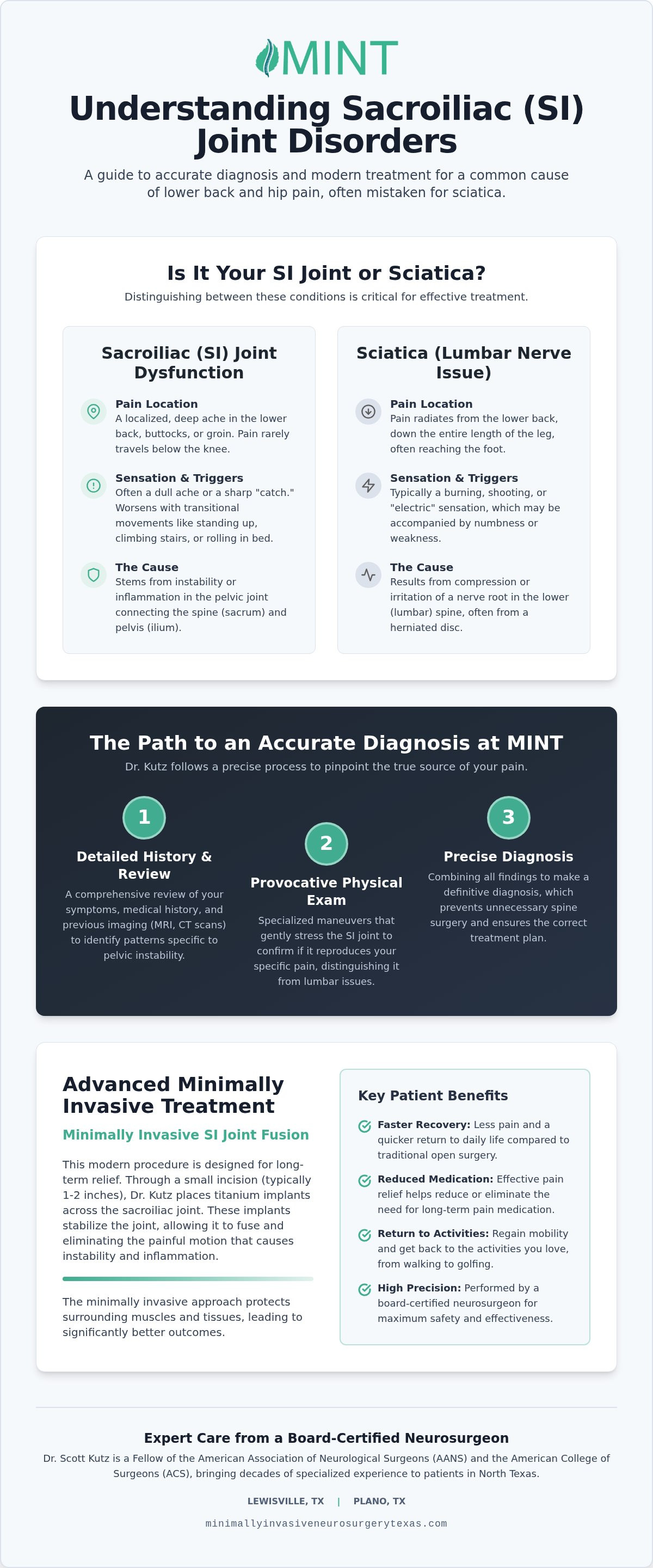
Distinguishing between pelvic instability and lumbar spine issues is essential for a successful recovery. Sciatica occurs when something compresses a nerve root in the lower back, often causing a burning sensation that travels down the entire length of the leg to the foot. In contrast, SI joint dysfunction stems from joint instability or inflammation in the pelvis. Because the symptoms overlap, many patients undergo unnecessary lumbar surgery for a disc issue that isn’t actually causing their pain. Dr. Kutz uses his expertise in minimally invasive spine techniques to identify the true source of your discomfort. Accurate diagnosis prevents the cycle of failed back surgeries and ensures you receive the correct treatment to return to your normal daily activities.
How Specialists Diagnose SI Joint Disorders in North Texas
Minimally Invasive Neurosurgery of Texas (MINT) provides comprehensive diagnostic evaluations for patients seeking sacroiliac joint disorder treatment Plano TX. Dr. Scott Kutz, a board-certified neurosurgeon, leads the clinical team at our offices in Lewisville and Plano, TX. Dr. Kutz considers diagnostic accuracy the most critical step before he recommends any surgical intervention. He combines his 20 years of neurosurgical experience with advanced imaging to ensure every patient receives an individualized care plan.
The diagnostic process begins with a detailed medical history and a review of your previous imaging, such as an MRI or CT scan. Dr. Kutz looks for specific patterns that distinguish pelvic instability from lumbar spine conditions. Patients from surrounding communities like McKinney and Southlake often visit MINT after other providers misdiagnosed their symptoms as disc herniations. By focusing on the unique biomechanics of the pelvis, Dr. Kutz identifies the true source of your chronic pain.
How do I know if my pain is from my SI joint? You can identify potential sacroiliac involvement if your pain centers on the “dimples” of your lower back and worsens when you stand from a seated position. Unlike sciatica, SI joint pain rarely radiates below the knee and often feels like a deep, localized ache in the buttock or groin. If you feel a sharp catch when you climb stairs or roll over in bed, your SI joint likely requires a specialist’s evaluation.
Provocative Physical Examinations
Dr. Kutz uses provocative physical examinations to stress the sacroiliac joint and observe your response. These tests aim to reproduce your specific pain to confirm joint involvement. During the FABER test, which stands for Flexion, Abduction, and External Rotation, the surgeon applies light pressure to your bent knee and opposite hip. He also utilizes the Gaenslen test and the Compression test to apply strategic pressure to the pelvic bones. If these movements recreate your familiar discomfort, it strongly indicates that the joint is the primary pain generator.
The Diagnostic Injection: The Gold Standard
If physical exams suggest joint dysfunction, Dr. Kutz performs a diagnostic injection to confirm the findings with absolute certainty. He uses fluoroscopy, which is a real-time X-ray imaging system, to guide a needle precisely into the joint space. Dr. Kutz then injects a local anesthetic, a numbing medication, directly into the SI joint. A 75 percent or greater reduction in pain during the first few hours after the injection confirms the joint as the source of your suffering. This precision-driven test allows the team at MINT to plan the most effective path toward your recovery. If you are ready to find a definitive answer for your hip or back pain, you can schedule a diagnostic consultation at one of our North Texas locations.
Conservative Management vs Minimally Invasive SI Joint Surgery
Minimally Invasive Neurosurgery of Texas (MINT) and Dr. Scott Kutz prioritize conservative care for patients in Plano, Frisco, and McKinney before suggesting surgical intervention. Dr. Kutz, a board-certified neurosurgeon and Fellow of the AANS and ACS, believes that most patients should exhaust non-surgical options first. Many individuals find substantial relief through specialized physical therapy and anti-inflammatory medications. However, when chronic pain persists for more than six months and prevents you from performing normal daily activities, Dr. Kutz discusses sacroiliac joint disorder treatment Plano TX options that involve more advanced techniques.
Clinical outcomes show a stark difference between long-term conservative care and surgical stabilization for chronic cases. While non-surgical methods help manage symptoms, studies indicate that approximately 80 percent of patients who undergo minimally invasive SI joint fusion experience significant, long-term pain reduction. In contrast, patients who rely solely on conservative care for severe dysfunction often report stagnant or worsening pain levels over time. This data helps Dr. Kutz guide patients in Lewisville and Plano toward the most effective path for their specific condition.
Non-Surgical Treatment Options
The first stage of treatment often involves specialized pelvic floor physical therapy to strengthen the muscles that support the pelvic ring. Dr. Kutz also recommends activity modification to avoid movements that strain the joint. Patients often use SI belts, which are supportive wraps that provide temporary stabilization by compressing the pelvis. If these methods don’t provide enough relief, radiofrequency ablation becomes an option. This procedure uses thermal energy to dull the nerves that send pain signals from the joint to the brain. While these treatments don’t fix the underlying instability, they offer a way to manage discomfort without an operation.
The Link to Failed Back Surgery Syndrome
A significant number of patients develop sacroiliac issues after a traditional lumbar fusion. This happens because fusing segments of the lower spine increases the mechanical stress on the pelvis, which must absorb the shock that the spine can no longer handle. Dr. Scott Kutz frequently evaluates patients who still experience debilitating pain after back surgery. He identifies whether the SI joint has become the new pain generator due to this increased load. To prevent this “adjacent segment” stress, Dr. Kutz often utilizes motion-preserving approaches like artificial disc replacement when appropriate. By maintaining natural movement in the spine, he protects the sacroiliac joint from excessive wear and reduces the risk of future complications. If you’ve had previous surgery and still struggle with hip or lower back pain, a neurosurgical evaluation can determine if your pelvis is the true culprit.
Minimally Invasive SI Joint Fusion: The Procedure and Recovery
Dr. Scott Kutz performs minimally invasive SI joint fusion to provide the permanent sacroiliac joint disorder treatment Plano TX patients need for long-term stability. This procedure involves a small incision, typically about one to two inches long, in the buttock area. Dr. Kutz places three small titanium implants across the joint to stop the micro-movements that cause chronic pain. These implants feature a porous surface that encourages your natural bone to grow across the joint gap, which eventually creates a solid bridge. By stabilizing the pelvic ring, this procedure restores the structural integrity of the lower body and allows you to return to normal daily activities.
Technological Precision at MINT
Dr. Kutz utilizes fluoroscopic guidance throughout the surgery. This technology provides a real-time X-ray feed of your anatomy, which ensures the hardware sits in the perfect position. As a board-certified neurosurgeon, Dr. Kutz applies a higher level of precision to protect the sacral nerves. These nerves exit the spine near the SI joint and control critical functions in the legs and pelvis. Traditional surgery often carries higher risks of nerve irritation, but the neurosurgical approach at MINT prioritizes the safety of these delicate structures. The smaller incisions used in these minimally invasive spine techniques also lead to significantly less blood loss and reduced post-operative pain compared to open surgeries.
Recovery Timeline and Expectations
Most patients return home the same day or after a brief observation period in our specialized surgical center. Because the implants require time to integrate with your bone, you must follow specific weight-bearing restrictions. You will likely use crutches or a walker for the first three weeks to protect the joint during the initial healing phase. While you will feel immediate relief from the instability, full fusion typically occurs over three to six months as the bone grows around and through the titanium implants. Dr. Kutz monitors your progress through follow-up appointments at our Plano or Lewisville offices to ensure your recovery stays on track. If you are ready to explore a permanent solution for your pelvic pain, you can contact our clinical team to discuss your surgical options.
Why Choose Dr. Scott Kutz for SI Joint Care in Plano and Lewisville
Choosing the right specialist for sacroiliac joint disorder treatment Plano TX determines the success of your recovery and your long-term mobility. Dr. Scott Kutz leads the team at Minimally Invasive Neurosurgery of Texas (MINT) with a commitment to clinical excellence and compassionate care. As a board-certified neurosurgeon, Dr. Kutz possesses the specialized training required to navigate the complex neural pathways surrounding the pelvis. He is a Fellow of the American Association of Neurological Surgeons (AANS) and the American College of Surgeons (ACS). These credentials signify that he has met the highest standards of surgical skill and professional ethics in the medical field.
The About MINT page details how Dr. Kutz applies over 20 years of neurosurgical experience to every case. He maintains a patient-first philosophy, which ensures that you understand every aspect of your diagnosis before you proceed with a treatment plan. Whether you live in Dallas, Fort Worth, Allen, or Southlake, our team provides a clear path from chronic suffering to physical freedom.
A Specialized Boutique Surgical Center
MINT operates as a specialized boutique surgical center, which offers a level of personal attention that large hospital systems often lack. We prioritize the patient experience by maintaining a streamlined, high-tech environment where your health is the only priority. In January 2026, Dr. Kutz relocated the primary MINT office to Lewisville, TX, to better serve the growing needs of North Texas residents. This modern facility serves as our main hub, while our satellite office in Plano provides local convenience for diagnostic follow-ups and consultations. This regional focus allows us to provide specialized care to patients in Flower Mound and the surrounding Metroplex without the coldness of a massive medical institution.
Commitment to Patient Outcomes
The ultimate goal at MINT is to help you achieve a full return to normal activity. Dr. Kutz focuses on motion-preserving techniques that stabilize the sacroiliac joint while protecting the surrounding spinal segments. We measure our success by the restored quality of life our patients experience. Many individuals who once struggled to walk or sit for long periods now enjoy active lifestyles without the burden of hip or lower back pain. We encourage prospective patients to read the Testimonials from others who have successfully reclaimed their mobility through our advanced procedures. If you are ready to find relief from chronic pelvic instability, you can schedule a consultation by calling (972) 244-3491. Our team is ready to help you move forward with confidence and inform you of every step in your recovery journey.
Reclaim Your Mobility with Precision SI Joint Care
Living with chronic pelvic instability often feels like a permanent barrier to the activities you love. You don’t have to accept a life of limited movement or rely on temporary fixes that fail to address the root cause of your pain. Dr. Scott Kutz utilizes his 20 years of neurosurgical experience and board certification from the American Board of Neurological Surgery to provide lasting relief. By choosing a specialized neurosurgical approach, you ensure that your care prioritizes the protection of delicate sacral nerves, which are the nerves near the base of the spine, while achieving maximum joint stability.
An accurate diagnosis remains the most vital step in your recovery journey. Whether you require conservative management or a minimally invasive fusion, Dr. Kutz and the team at Minimally Invasive Neurosurgery of Texas (MINT) offer the expert sacroiliac joint disorder treatment Plano TX patients trust. Our focus on motion-preserving techniques and high-tech surgical innovation helps you return to normal daily activities with confidence. Schedule your consultation with Dr. Scott Kutz at our Plano or Lewisville office today to begin your path toward a pain-free future. You deserve a healthcare partner who combines clinical excellence with a dedicated focus on your long-term quality of life.
Frequently Asked Questions
What is the primary cause of sacroiliac joint dysfunction?
The primary cause of sacroiliac joint dysfunction involves instability or inflammation within the joint connecting the sacrum to the pelvis. This typically occurs when supporting ligaments become too loose, known as hypermobility, or too tight, known as hypomobility. Factors like a sudden fall, repetitive heavy lifting, or hormonal changes during pregnancy often trigger these issues. Additionally, many patients develop dysfunction after a prior lumbar spine fusion because the pelvis must absorb more mechanical stress.
Can SI joint pain go away on its own without surgery?
Many patients find that sacroiliac joint pain improves through conservative management rather than surgery. Dr. Scott Kutz often recommends specialized physical therapy, anti-inflammatory medications, and activity modification to reduce inflammation. Some individuals also benefit from using a sacroiliac belt to provide external stabilization for the pelvis. If symptoms persist for more than six months despite these efforts, you may require a more advanced sacroiliac joint disorder treatment Plano TX to find permanent relief.
How long is the surgery for sacroiliac joint fusion at MINT?
Dr. Scott Kutz typically completes a minimally invasive sacroiliac joint fusion in approximately one hour. This efficient timeline results from his use of advanced surgical planning and real-time fluoroscopic guidance, which is a live X-ray imaging system. Because the procedure requires only a small incision, it involves minimal tissue disruption. This precision allows patients to spend less time under anesthesia and reduces the overall physical impact on the body during the stabilization process.
Is sacroiliac joint fusion considered a major surgery?
While any fusion involves stabilizing bone, the minimally invasive approach at MINT differs significantly from traditional major open surgery. Dr. Kutz utilizes specialized titanium implants and small incisions to minimize blood loss and muscle damage. Patients undergo this procedure in an outpatient setting or require only a brief observation period before returning home. This modern neurosurgical technique prioritizes motion preservation in the surrounding spinal segments while providing the structural support necessary to eliminate chronic pelvic instability.
Will my insurance cover sacroiliac joint disorder treatment in Plano TX?
Most major insurance providers and Medicare cover sacroiliac joint disorder treatment Plano TX when conservative therapies fail. As of 2026, the Centers for Medicare & Medicaid Services (CMS) has increased reimbursement rates for minimally invasive SI joint fusion, reflecting its status as a standard clinical procedure. Our administrative team at MINT works with your provider to verify coverage and obtain authorizations. We ensure you understand your benefits before you proceed with any diagnostic injections or surgical interventions.
What happens if SI joint dysfunction is left untreated?
Leaving sacroiliac joint dysfunction untreated often leads to chronic pain and significant mobility limitations. Over time, your body attempts to compensate for the pelvic instability by altering your gait, which is the way you walk. This shift frequently causes secondary issues like lower back pain, hip bursitis, or knee strain. Chronic inflammation can also lead to permanent joint damage, making it harder to return to normal daily activities even after you eventually seek specialized medical intervention.
How soon can I return to work after an SI joint fusion procedure?
Your return to work depends on the physical demands of your specific job. Patients with sedentary roles often return to their duties within one to two weeks after the procedure. If your job requires heavy lifting or prolonged standing, Dr. Kutz may recommend waiting six weeks or longer to ensure the joint stabilizes correctly. We provide personalized recovery milestones during your follow-up appointments at our Lewisville or Plano offices to ensure you heal safely.
Can athletes return to high-impact sports after SI joint treatment?
Athletes can typically return to high-impact sports once the joint achieves full fusion, which usually occurs between three and six months. Dr. Scott Kutz focuses on stabilizing the joint to provide a solid foundation for movements like running, jumping, or pivoting. You will follow a structured rehabilitation program to rebuild core and pelvic strength before resuming intense training. Many patients find that performance improves after treatment because they no longer have to compensate for a painful, unstable pelvis.