
Minimally Invasive Neurosurgery of Texas provides minimally invasive spine surgery in Lewisville and Plano, TX. Dr. Scott Kutz, a board-certified neurosurgeon and Fellow of the AANS and ACS, leads the practice’s spine care.
Children need clear, honest words more than medical detail. To learn how to explain spine surgery to your children, describe why surgery is planned, what they may notice, and how routines could change during recovery. Use language that fits your child’s age, welcome questions, and answer honestly, even when you don’t yet know something.
It’s natural to worry about frightening your child or saying too much. A calm, simple explanation gives them room to understand what’s ahead and share their concerns. This article offers ways to talk about surgery and prepare children for the hospital experience, including what to expect from the care team, the operation, and recovery.
Key Takeaways
- Use simple, truthful language to explain why surgery is happening, and tailor the detail to your child’s age and questions.
- Describe spinal fusion as joining two or more bones in the spine, using the surgeon’s explanation of your child’s specific procedure.
- Prepare your child for hospital routines, including that getting out of bed and walking may begin soon after surgery.
- Plan ahead for changes to school, activities, and family routines during recovery, and give your child ways to stay connected and supported.
- Learn which spine surgery options may apply and how minimally invasive spine care can fit into a child’s treatment discussion.
Preparing children for surgery and hospital experiences
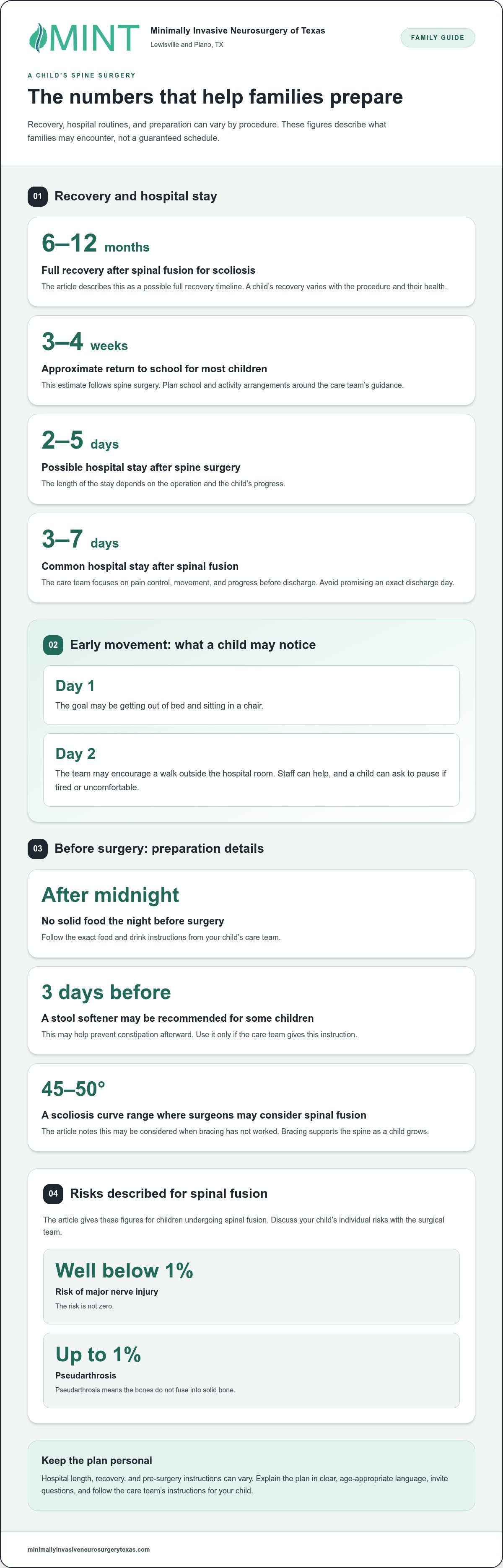
Recovery after spine surgery varies with the procedure and the child’s health. After spinal fusion for scoliosis, full recovery may take 6 to 12 months, while most children return to school about 3-4 weeks after surgery. Plan for temporary changes to family routines, such as rides to school, help with daily tasks, and pauses in sports.
The length of a hospital stay depends on the operation. Children may stay for two to five days after spine surgery; after spinal fusion, a stay of three to seven days is common. Explain that the care team will focus on pain control, movement, and safe progress before discharge. Avoid promising an exact discharge day, because the procedure and your child’s recovery affect the timing.
Help your child picture the hospital before arrival. If the hospital has a child life specialist, ask whether they can arrange a tour or explain equipment and routines in child-friendly language. A tour can show your child where they’ll sleep and where family members can sit. At home, pack a familiar blanket, books, or a favorite game, and let your child choose a few items.
Talk through early movement with specific examples. The first day after surgery, the goal may be getting out of bed and sitting in a chair. On the second day, the team may encourage a walk outside the hospital room. Explain that staff will help and that movement supports recovery. Your child can ask to pause if they feel tired or uncomfortable.
Use concrete examples to explain what a hospital stay may involve:
- A nurse checks in and helps your child follow the day’s care plan.
- Your child may practice sitting, standing, or walking with support.
- A parent or caregiver can bring a comfort item and keep familiar routines, such as a bedtime story.
- The team explains when your child can leave and what support they need at home.
Parents can prepare younger children by explaining why routines will change during recovery. For example, say, “I’ll help you get dressed while your back heals, and we’ll ask your doctor when you can return to sports.” If your child hears about an endoscopic approach, this explanation of endoscopic spine surgery can clarify the procedure’s name. Keep the focus on the child’s planned care, not on comparisons with another patient’s surgery or recovery.
Preparing a child for surgery
Start by explaining why the surgical team recommends the procedure. For scoliosis, a condition that curves the spine, surgeons may consider spinal fusion when the curve exceeds 45 to 50 degrees and treatments such as bracing have not worked. Bracing supports the spine as a child grows. Use a drawing to show the curve, then explain the goal in simple terms: help correct it and support the spine.
Before surgery, help your child understand the instructions for the day. Children should not eat solid food after midnight on the night before surgery. Some children may need a stool softener three days before surgery to help prevent constipation afterward. Explain each step plainly and follow the exact instructions from your child’s care team. Don’t treat a general rule as a personal instruction unless the team has given it.
Invite questions during preparation, not just at the final appointment. Your child might ask, “Will I wake up during the procedure?” or “Will I see the incision?” Explain that an incision is a cut the surgeon makes to reach the spine. Tell your child that the anesthesiologist will discuss anesthesia, medicine that keeps a patient asleep or comfortable during surgery. Keep your answers honest and direct.
Give your child a role in practical planning. Let them choose comfortable clothes for the trip home, pick a book or game, and decide which familiar item to bring. If they’re worried about missing school, explain how a parent can share updates with teachers and help arrange lessons during recovery. Don’t promise a return date before the care team explains your child’s activity plan.
A short preparation list can make the day feel more predictable:
- Write down questions about the procedure, pain control, and what your child may notice afterward.
- Review food and medicine instructions with the adult responsible for surgery-day care.
- Choose a comfort item and pack it with the child’s belongings.
- Explain who will stay with the child and how family members can share updates.
Children take in information differently, so match your explanation to their age and attention. A younger child may need one idea at a time, while a teen may want more detail about spinal curves, physical activity, and school. Ask the doctor to explain unfamiliar terms in language your child understands. If you’re discussing a specific spine procedure for your child, talking with the surgical team can help you prepare questions and explain the plan clearly.
Talking with children about upcoming spine surgery
Choose a calm time to talk, then explain the operation in a few clear steps. For example: “The surgeon will work on your spine, the bones that support your back, and the hospital team will help you through recovery.” Parents often wonder how to explain spine surgery to your children without overwhelming them. Name the planned procedure, such as spinal fusion, and explain that it joins bones to limit movement between them. Pause to give your child a chance to respond.
What risks or complications of spine surgery should parents explain to children? For spinal fusion, the risk of major nerve injury is well below 1 percent, but it isn’t zero; pseudarthrosis, when the bones don’t fuse into solid bone, occurs in up to 1 percent of children. Explain these risks calmly and describe how the care team monitors recovery.
Keep the conversation honest and suited to your child’s age. A younger child may need to know that a surgeon can use screws to hold the spine steady while bones heal. A teen may want to understand why the surgeon recommends surgery and which activities they’ll need to pause. Don’t promise that surgery will be easy or that life will return to normal immediately.
Children often want to know what they’ll see, feel, or miss. Answer with specific examples: “You’ll go to the hospital, and a nurse will help you get ready,” or “You may need help moving at first.” If you don’t know an answer, tell your child you’ll ask the care team together. This shows them how to handle unanswered questions without guessing.
Discuss changes to everyday routines before they happen. Younger children especially benefit from hearing why family routines will change during recovery. Explain who will help with meals, getting dressed, or a ride to school. If physical therapy becomes part of the recovery plan, describe it as guided movement to help rebuild strength and mobility.
When deciding how to explain spine surgery to your children, invite them to prepare questions for the doctor. They might ask:
- What will happen before and after the operation?
- Which activities can I do while I recover?
- Who can I talk to if I feel worried at the hospital?
- How will my family know when I can return to school or sports?
After each conversation, ask your child to describe the operation in their own words. Gently correct misunderstandings, such as thinking screws mean the whole spine cannot move. Explain that the surgeon uses them to support the planned treatment. Keep returning to clear, familiar facts as surgery approaches, and let your child guide how much more they want to know.
What are the common types of spine surgery and how can they be described simply?
Spine surgery names can describe the treatment goal or the route the surgeon takes. For a child with scoliosis, a condition that curves the spine, spinal fusion is commonly used for curves of 45 degrees or more. You can explain the goal without describing equipment: “The surgeon will work to improve the curve and make your back more stable.” Then clarify that the specific plan depends on the child’s spine and operation.
A posterior approach reaches the spine through an incision on the back. An anterior approach reaches it through an incision on the side. “Approach” means the route the surgeon uses to reach the treatment area. You might tell your child, “The surgeon plans to reach your spine from your back,” or, “The surgeon plans to reach it from your side.” Use the route described for their procedure, rather than treating the approaches as interchangeable.
Some children have an extremely rigid spinal curve. In that situation, surgeons may remove discs from the front of the spine to increase flexibility and allow better correction with instrumentation. Discs are cushions between the bones of the spine, and instrumentation means devices a surgeon uses during an operation. You could explain it simply: “The surgeon may remove a cushion between bones to help the curve move into a better position.”
Thoracoscopic spinal surgery uses small incisions, video technology, and specialized instruments. Surgeons may use this method for disc removal, instrumentation, and fusion. Explain that the camera helps the surgeon see the spine, rather than describing it as a separate treatment. For example: “The surgeon uses a small camera and tools to work on the part of your spine that needs care.” This keeps the explanation focused on what the approach involves.
To help your child understand the name of their operation, separate three ideas: the condition, the goal, and the route. You might say, “Scoliosis is the curve we’re treating. The goal is to improve it. The surgeon will reach the spine from your back.” This keeps the explanation organized and avoids suggesting that every child with scoliosis has the same operation.
Children may also ask why one approach fits their plan. Explain that surgeons consider the curve’s shape and flexibility when planning treatment. If the care team uses a term your child doesn’t understand, ask for a simpler explanation and repeat it at home. Your child can then connect the procedure’s name with its purpose instead of trying to remember unfamiliar surgical details.
What happens before, during, and after spine surgery that children may notice?
A preoperative visit usually happens within two weeks of spine surgery. At this appointment, the family meets the surgical team, and the anesthesiologist explains anesthesia, medicine that keeps a patient asleep during surgery, and pain relief. Tell your child, “We’ll meet the people who will care for you and talk about how they’ll help you stay comfortable.” Invite them to bring questions or write them down beforehand.
The evening before surgery, explain the food instructions in concrete terms. Children should not eat solid food after midnight on the night before surgery. Some children may take a stool softener three days before surgery to help prevent constipation afterward. Follow your child’s specific care instructions, and reassure them that feeling nervous doesn’t mean they’ve done anything wrong.
During spinal fusion surgery, which joins vertebrae, the surgeon places bone graft along the spine to help the bones grow together. The operation usually takes four to six hours. You can tell your child, “The surgeon will work on your back while you sleep, and the team will stay with you.” Avoid describing instruments or the incision unless your child asks for those details.
After spinal fusion, children may notice a dressing, monitors, or temporary puffiness in the face and hands when they wake. Positioning during the operation can cause that puffiness. Epidural and urinary catheters, tubes used to deliver pain medicine or drain urine, usually come out on the third day after surgery. Explaining these details beforehand can help children recognize unfamiliar equipment.
After surgery, the care team guides movement in stages. A child may walk as tolerated by the third day and begin practicing stairs on the fourth day. Most children with idiopathic scoliosis, a spinal curve without a known cause, are ready to go home in three to four days. Explain that the team looks for safe progress before discharge.
At home, children may notice limits on bathing and incision care. After spinal fusion for scoliosis, a doctor may remove the bandage and stitches or staples 10 to 14 days after surgery. A child may shower 24 to 48 hours after surgery if the doctor approves. Explain that these instructions help protect the healing incision, and follow the child’s own care plan.
A follow-up appointment gives the surgeon a chance to review recovery and answer new questions. Children typically see an orthopedic surgeon six weeks after spinal fusion surgery. Before that visit, help your child note what they want to discuss, such as sleep, comfort, or when they can resume an activity. To talk through a spine surgery plan and what a child may experience, contact the surgical team.
Minimally Invasive Neurosurgery of Texas: Minimally Invasive Spine Surgery
Minimally Invasive Neurosurgery of Texas offers minimally invasive spine surgery and endoscopic spine surgery, which uses a camera and specialized instruments to reach the spine. Families discussing a child’s treatment can use these terms to frame questions about the procedure, its purpose, and what recovery may involve. The appropriate approach depends on the child’s condition and surgical plan.
Dr. Scott Kutz, a board-certified neurosurgeon and Fellow of the AANS and ACS, provides spine care in Lewisville and Plano, Texas. Families considering spine surgery can discuss the planned procedure and options with the care team, then use clear, age-appropriate language to prepare their child.
For information about spine surgery care, contact Minimally Invasive Neurosurgery of Texas or visit minimallyinvasiveneurosurgerytexas.com.
Carry the Conversation Forward
Children may think of new questions as surgery gets closer. Keep making room for those questions, even after you’ve explained the plan. A quiet check-in at bedtime or during a familiar routine can help your child share worries they didn’t mention earlier. Let them choose what to discuss, and answer in simple, honest language.
Learning how to explain spine surgery to your children can also help you prepare your own questions. Write down anything you want clarified about the procedure, your child’s recovery, or how to support them emotionally. You don’t need every answer before starting the conversation. Showing your child that you’ll seek clear answers together can make the next step feel more manageable.
If you’re discussing spine surgery for your child and want to talk through the care plan, contact Minimally Invasive Neurosurgery of Texas. With steady, honest conversations, you can help your child face the experience feeling heard and supported.
Frequently Asked Questions
What Else Should I Know?
Children may worry about how surgery will affect siblings, pets, or familiar routines, not just the operation itself. Explain who will handle school pickup, meals, or bedtime while you focus on care. A simple family calendar can show which routines will change and which will stay the same. Give siblings a chance to ask questions, too, while respecting the child’s privacy and comfort.
Where can you learn more?
Start with your child’s surgical team for information about the planned procedure and care instructions. A hospital child life specialist can help explain medical experiences in language suited to your child. For general information about spine care, Minimally Invasive Neurosurgery of Texas shares details about its spinal services. Use that information as background, and rely on your child’s own care team for guidance about their treatment.
How do you explain spine surgery to a child in age-appropriate language?
Match your explanation to what your child can understand and wants to know. A young child may respond to a simple drawing of a back, while an older child may prefer a written description of the plan. Explain unfamiliar terms as they come up, then ask, “What part would you like me to explain more?” This lets your child guide the conversation without overwhelming them with details.
What should children know before a parent has spine surgery?
Tell children what they may notice while you recover, such as another adult helping with meals, rides, or household tasks. Identify someone they can approach for everyday needs, and explain how they can spend time with you. For example, they might bring a drawing or choose a short activity to do together. Avoid asking children to take on adult caregiving responsibilities.
How can parents explain why spine surgery is needed without frightening children?
Connect the reason for surgery to a familiar goal, such as helping someone move more comfortably or addressing a problem that affects daily life. Keep the explanation truthful and brief, then reassure your child that they did not cause the condition. Avoid dramatic language or promises about exactly how someone will feel afterward. A calm explanation of the purpose gives children useful context without adding frightening details.
How can parents prepare children for a hospital stay or time apart during surgery?
Explain who will stay with your child, where they will wait, and how they can reach a trusted adult. If a parent will be away during an operation, name the caregiver and describe what you’ll do together next, such as reading after returning home. A familiar item, like a favorite book, can help make an unfamiliar setting feel more personal.
How should parents answer children’s questions or worries about spine surgery?
Listen to the whole question before answering, since your child may be asking about something specific, such as pain or separation. Respond in a few direct sentences, then check what they understood. If you need information, say you’ll ask the care team and follow up with an answer. Following through shows children that their questions matter, even when you can’t answer immediately.
What books or other resources help explain a parent’s surgery to children?
Choose a children’s book about hospitals or medical care that matches your child’s age and concerns. A hospital library or child life specialist may help you find a suitable title. Read it together and pause when your child reacts or asks a question. You can also make a simple picture story about your family’s plan, using names and routines your child already knows.