What if modern spine surgery doesn’t require massive incisions or months of bed rest? At Minimally Invasive Neurosurgery of Texas (MINT), board-certified neurosurgeon Dr. Scott Kutz performs lumbar fusion surgery Plano TX and Lewisville patients rely on to eliminate chronic radiating leg pain. This specialized procedure joins two or more vertebrae, which are the interlocking bones forming your spine, to stop painful micro-motion and stabilize your lower back.
You likely fear losing your spinal mobility or facing an agonizing, months-long recovery. Dr. Kutz transforms that journey by utilizing Globus Excelsius robotic navigation. Rather than cutting through critical back muscles, he gently separates the paraspinal muscles, the deep muscular bands supporting the spine. This targeted precision limits tissue disruption, prevents heavy blood loss, and relieves severe nerve compression. You’ll discover how neurosurgical innovation restores spinal stability with minimal scarring, allowing you to return quickly to your favorite daily activities like walking and gardening.
Key Takeaways
- Discover how advanced lumbar fusion surgery Plano TX specialists perform stabilizes spinal bones without widespread muscle damage.
- Understand how targeted nerve decompression, a technique that frees pinched spinal nerves, halts radiating leg pain before joint stabilization begins.
- Contrast muscle-splitting tubular dilators with traditional open surgery to see how modern tools minimize tissue trauma and post-operative discomfort.
- Review realistic recovery milestones, including unassisted walking within hours and returning to daily routines weeks faster.
- Explore how Dr. Scott Kutz determines whether you require interbody fusion, an operation joining adjacent vertebrae, or motion-preserving alternatives like artificial disc replacement at MINT facilities in Lewisville and Plano.
Understanding Lumbar Fusion Surgery in Plano TX
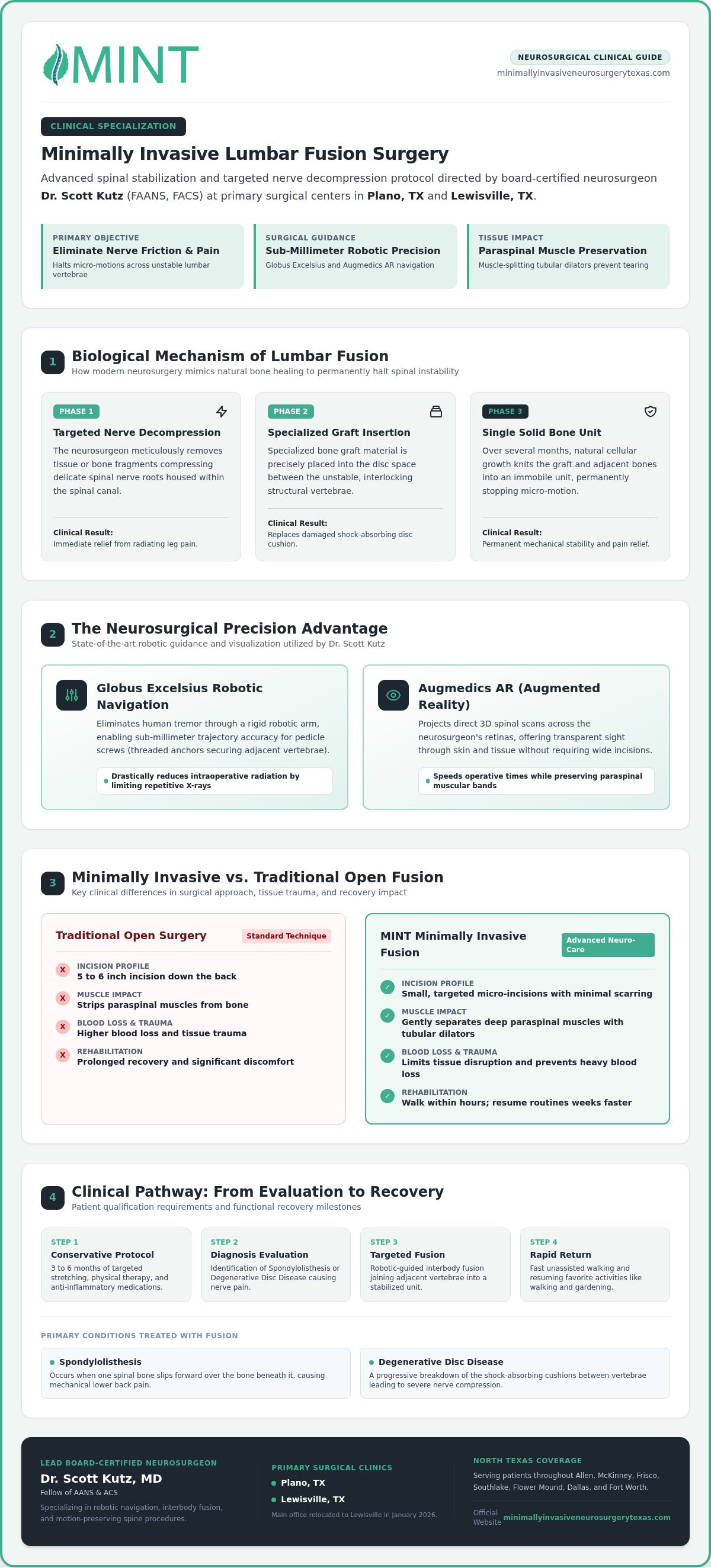
Minimally Invasive Neurosurgery of Texas (MINT), founded by board-certified neurosurgeon Dr. Scott Kutz, provides advanced surgical care at primary clinics in Lewisville and Plano, TX. Dr. Kutz performs lumbar fusion surgery Plano TX residents choose to permanently stabilize the lower spine and relieve debilitating pain. During this procedure, the surgeon connects two or more vertebrae, the interlocking structural bones of the spine, eliminating abnormal friction. This technique effectively corrects mechanical instability caused by conditions like spondylolisthesis, which occurs when one spinal bone slips forward over the bone beneath it.
What is Lumbar Spinal Fusion?
Lumbar fusion mimics the body’s natural fracture-healing process. During spinal fusion surgery, Dr. Kutz places specialized bone graft material between the unstable vertebrae. Over several months, your body produces new bone cells that knit the graft and adjacent bones into a single, immobile unit. This process permanently halts micro-motions, the microscopic shifts between unstable joints that continuously irritate sensitive spinal nerves. By stabilizing the lumbar region, the procedure eliminates mechanical lower back pain and restores long-term spinal balance through minimally invasive spine techniques.
Who is a Candidate for Fusion in North Texas?
Not every back ache requires surgery. Candidates in Plano, Lewisville, and nearby communities like Allen or McKinney typically struggle with severe spinal instability or degenerative disc disease, a progressive breakdown of the shock-absorbing cushions between vertebrae. Dr. Kutz always prioritizes conservative care first. Patients usually explore targeted stretching, physical therapy, and anti-inflammatory medications for three to six months. When these non-surgical methods fail to relieve chronic nerve compression, Dr. Kutz evaluates whether stabilization offers the clearest path back to an active lifestyle.
The Neurosurgical Advantage: Why Precision Matters
Many regional practices rely on general orthopedic surgeons who focus primarily on structural bone alignment. In contrast, neurosurgeons spend years mastering the neural structures inside the spinal canal, the protective bony tunnel housing delicate nerves. At MINT, Dr. Scott Kutz uses this specialized background to protect neural pathways during every procedure. As a board-certified neurosurgeon and Fellow of the American Association of Neurological Surgeons (AANS), Dr. Kutz prioritizes meticulous nerve decompression before stabilizing any vertebrae. Decompression, the surgical removal of tissue or bone compressing a spinal nerve root, stops radiating pain down the legs. According to the MedlinePlus overview of spinal fusion, relieving pressure on irritated nerve roots directly influences patient mobility. For patients seeking lumbar fusion surgery Plano TX neurosurgical expertise ensures optimal nerve protection while restoring spinal strength.
Robotic Navigation with Globus Excelsius
Precision dictates surgical success. Dr. Kutz guides spinal hardware into place using Globus Excelsius robotic navigation. The rigid robotic arm eliminates human tremor and enables sub-millimeter trajectory accuracy for pedicle screws, the threaded anchors securing adjacent vertebrae. This computerized guidance minimizes intraoperative radiation exposure for patients traveling from Plano, Southlake, and Frisco by drastically reducing the need for repetitive X-ray scans.
Augmented Reality in the Operating Room
Advanced visualization elevates procedural safety even further. MINT incorporates Augmedics AR, a headset system that projects 3D spinal scans directly across the surgeon’s retinas. This technology gives Dr. Kutz transparent sight through skin and tissue without opening wide incisions. Real-time visual tracking speeds up operative times, preserves healthy paraspinal muscle bands, and accelerates your recovery. If you suffer from persistent nerve pain, contact our Plano spine team to schedule a surgical evaluation.
Minimally Invasive vs. Traditional Open Fusion
Traditional open spinal fusion requires a five-to-six-inch incision down the center of your back. During open surgery, surgeons strip the paraspinal muscles away from the vertebral bone, causing significant soft tissue trauma, elevated blood loss, and prolonged postoperative soreness. Dr. Scott Kutz takes a different approach at MINT by using progressive tubular dilators. These slender tubes gently split and separate muscle fibers instead of cutting them. By deploying specialized minimally invasive spine techniques, Dr. Kutz preserves critical supportive tissue, limits blood loss, and reduces the risk of hospital-acquired surgical site infections.
Is Minimally Invasive Fusion as Effective as Open Surgery?
Yes, minimally invasive lumbar fusion achieves clinical outcomes that equal or exceed traditional open procedures. Published clinical data show that minimally invasive transforaminal lumbar interbody fusion (MIS-TLIF), a technique that fuses adjacent vertebrae through a narrow corridor, produces solid bone fusion rates between 85% and 95% at 12 to 24 months. The primary difference centers on the patient’s recovery trajectory rather than the final bone union. Clinical studies report that over 92% of minimally invasive fusion patients discontinue prescription opioid medications within 11 to 15 days following their operation. Patients choosing lumbar fusion surgery Plano TX specialists perform achieve dependable structural stability while significantly shortening their reliance on narcotic pain medications.
Benefits of Smaller Incisions
Smaller incisions provide advantages that reach far beyond cosmetic appearance. While traditional open procedures leave extensive vertical scars, minimally invasive surgery requires incisions measuring barely one to two inches. Because Dr. Kutz avoids stripping muscle attachments from the spine, patients prevent multifidus atrophy, the permanent wasting and functional weakness of deep spinal stabilizers. This muscle-sparing method helps active individuals from Dallas, Southlake, and Plano return safely to gym workouts, walking routines, and daily household activities weeks earlier. Trusted medical resources such as the MedlinePlus guide on spinal fusion surgery confirm that reducing tissue disruption directly promotes faster post-surgical ambulation.
Recovery Timeline: What to Expect After Surgery
Modern surgical innovation turns postoperative recovery into an active, predictable milestone rather than a lengthy bed-rest sentence. Because Dr. Scott Kutz uses muscle-sparing portals, clinical registry figures show that patients achieve unassisted ambulation in an average of 1.1 days, with many MINT patients standing and walking within hours. Complete arthrodesis, the biological fusion where neighboring vertebrae cement into continuous bone, takes several months. Throughout this process, Dr. Kutz coordinates external physical therapy referrals with specialized providers across Plano, Lewisville, and Flower Mound to rebuild your core strength safely.
The First 48 Hours
Technological refinement allows MINT to perform single-level procedures in ambulatory surgery centers, where patients often head home within 23 hours. Your initial focus centers on light movement and wound protection. Frequent short walks through your home stimulate circulation, which prevents deep vein thrombosis, a dangerous blood clot formation in the deep veins of the legs. Clinical teams employ a multi-modal pain strategy combining non-opioid medications, nerve-calming agents, and local numbing to minimize narcotic reliance during this acute phase.
Weeks 2 through 6: Returning to Routine
Most patients experience steady functional improvements during the first six weeks. In fact, peer-reviewed clinical research confirms that 96.4% of minimally invasive fusion patients safely return to driving within 18.5 days. Typical milestones during this stage include:
- Day 14: Your care team removes surgical dressings, and you transition off prescription medications.
- Weeks 2 to 3: You resume light desk work and driving after eliminating narcotic pain relievers.
- Week 6: You attend a formal follow-up visit with Dr. Kutz to review your initial digital X-rays and evaluate bone graft stability.
You must strictly respect bending, lifting, and twisting restrictions during these initial weeks. Avoiding loads greater than ten pounds protects the hardware while new bone growth bridges the lumbar gap. For patients who undergo lumbar fusion surgery Plano TX protocols designed by Dr. Kutz provide structured, step-by-step guidance toward independence. If you need clarity on your recovery expectations, schedule an evaluation with Dr. Kutz to map out your personalized surgical timeline.
Why Choose MINT for Your Spinal Care in Plano
Selecting the right surgical practice directly impacts your overall outcome and long-term quality of life. At Minimally Invasive Neurosurgery of Texas, our team focuses on matching every patient with the correct intervention. While patients frequently consult Dr. Kutz for lumbar fusion surgery Plano TX, he also evaluates whether motion-preserving alternatives suit their condition better. When a cushion collapses without instability in the facet joints, the small stabilizing hinges connecting spinal bones, Dr. Kutz often recommends artificial disc replacement, an innovative procedure that swaps a damaged spinal disc with a mobile prosthetic device to maintain natural spinal flexibility. Our clinic serves patients across the greater Dallas-Fort Worth area, including McKinney, Allen, and Flower Mound, ensuring personalized clinical guidance at every step.
Expertise of Dr. Scott Kutz
Dr. Scott Kutz brings over 20 years of dedicated clinical experience to North Texas patients. He holds board certification from the American Board of Neurological Surgery and maintains active status as a Fellow of both the American Association of Neurological Surgeons (AANS) and the American College of Surgeons (ACS). Following his neurosurgical residency, Dr. Kutz completed an advanced fellowship in stereotactic and functional neurosurgery at Rush University Medical Center in Chicago. He also participates actively in the North American Spine Society (NASS), a multidisciplinary organization devoted to evidence-based spine care. His deep anatomical knowledge enables him to navigate intricate neurological tissue safely during complex reconstructions.
Convenient North Texas Locations
MINT provides accessible surgical expertise across the region. In January 2026, MINT opened its primary corporate headquarters in Lewisville, TX, creating a dedicated regional surgical hub. A fully equipped satellite facility in Plano ensures that local residents access world-class consultations right in their neighborhood. Patients consistently praise our individualized treatment plans, meticulous diagnostic workups, and calm clinical environment. You can explore real patient stories on the MINT testimonials page to see how our targeted approach to lumbar fusion surgery Plano TX residents trust restores independence and daily vitality.
Take the Next Step Toward Lasting Spine Relief
Chronic back and leg pain don’t have to dictate your future. Dr. Scott Kutz combines over 20 years of experience as a board-certified neurosurgeon with cutting-edge robotic guidance and augmented reality systems. Through muscle-sparing minimally invasive spine surgery, he relieves debilitating nerve pressure and stabilizes your spinal foundation without severe soft-tissue trauma. Choosing the lumbar fusion surgery Plano TX patients trust at MINT ensures that high-tech precision protects your nerves while expediting your healing timeline.
You can overcome spinal instability and return to the daily routines you enjoy most, from evening strolls through your neighborhood to weekend gardening. Whether you visit our primary headquarters in Lewisville or our satellite office in Plano, our dedicated clinical team provides the personalized attention you deserve. Schedule your consultation with Dr. Scott Kutz today to explore your treatment options and reclaim an active, pain-free life.
Frequently Asked Questions
How long does lumbar fusion surgery take at your Plano office?
A single-level minimally invasive procedure typically requires one to two hours of surgical time. Dr. Scott Kutz uses robotic navigation to streamline implant trajectory and pedicle screw placement. Anesthesia preparation and waking add time before and after the operation. Most patients return to their private recovery suite shortly after leaving the operating room. When patients choose lumbar fusion surgery Plano TX specialists provide, efficient operative steps reduce both anesthesia exposure and surgical trauma.
Will I need a brace after minimally invasive lumbar fusion?
Most patients do not require a rigid back brace following minimally invasive spine fusion. Modern titanium implants and pedicle screws provide immediate mechanical stability, which secures the vertebrae while the bone graft heals. In certain situations involving poor bone density, Dr. Kutz may recommend an orthosis, an external supportive brace, for several weeks during outdoor ambulation. Otherwise, you protect your healing fusion by avoiding heavy lifting, excessive bending, and forceful twisting.
What is the success rate of spinal fusion for lower back pain?
Minimally invasive lumbar fusion achieves verified bone fusion rates between 85% and 95%. When surgical planning adheres to North American Spine Society (NASS) guidelines, patients become three times more likely to experience major functional improvements on the Oswestry Disability Index, a standardized survey measuring spinal impairment. Dr. Scott Kutz selects surgical candidates carefully, confirming both neural decompression and mechanical stabilization so patients achieve reliable, long-term pain relief.
Can I drive myself home after lumbar spine surgery in Lewisville?
No, you cannot drive yourself home following spinal surgery. General anesthesia temporarily impairs your reflexes, and postoperative medications reduce your reaction time. You must arrange for a responsible adult family member or friend to drive you home to Plano, Lewisville, or nearby North Texas areas. Most patients safely resume independent driving two to three weeks after surgery once they stop taking prescription narcotic painkillers and can press the brake pedal firmly without discomfort.
How soon can I return to sports after a minimally invasive fusion?
You can usually resume low-impact physical activities within six to twelve weeks. Walking begins on day one, and patients typically resume light swimming or stationary cycling after their six-week follow-up visit. Contact sports and heavy athletics demand complete bone consolidation, the biological process where living bone knits across the disc space. Dr. Kutz reviews follow-up imaging around six months post-procedure before clearing recreational athletes to swing golf clubs or lift heavier weights.
Does insurance cover robotic-assisted lumbar fusion surgery?
Yes, major private health insurance providers and Medicare routinely cover medically necessary lumbar fusion procedures. Payers evaluate lumbar arthrodesis based on standard surgical billing codes rather than the robotic navigation platform Dr. Kutz employs. Most commercial insurance policies require documented failure of three to six months of structured conservative care alongside diagnostic proof of spinal instability. Our MINT administrative team verifies your insurance benefits and coordinates prior authorization requirements before your scheduled procedure date.
What happens if my spinal fusion does not heal correctly?
If vertebrae fail to unite into solid bone, a condition called pseudarthrosis, you may experience persistent lower back pain. Pseudarthrosis occurs when bone remodeling halts before complete bridging. If routine imaging identifies an unhealed segment alongside symptoms, Dr. Kutz investigates contributing factors like smoking, nutrient deficiencies, or excess movement. While many minor non-unions remain asymptomatic, symptomatic cases may require revision surgery, where Dr. Kutz reinforces hardware stability and applies advanced bone graft materials.
Is lumbar fusion better than artificial disc replacement?
Neither procedure is universally superior; each solves a distinct biomechanical problem. Lumbar fusion works best for patients presenting with structural instability, such as spondylolisthesis, where stabilizing the joint eliminates severe pain. Conversely, artificial disc replacement preserves natural spinal motion when a single disc deteriorates without facet joint disease. During your consultation for lumbar fusion surgery Plano TX residents book with Dr. Scott Kutz, he analyzes your diagnostic imaging to recommend the most effective, motion-appropriate treatment plan.